Silky Smooth “Moondance” Chords & Guitar Lesson
Here's a unique song that bridged the gap between folk-rock and jazz-pop.
It’s inspired generations of musicians, and it’s a lot of fun to play.
Below, I want to share some insider tips on the guitar style behind it.
So grab your axe, and let’s dive into this “Moondance” chords and guitar lesson!
Who Wrote Moondance?
“Moondance” was written by Northern Irish singer-songwriter and musician Van Morrison. It’s one of his most iconic songs that blends jazz, soul, and pop in a way that has made it a timeless classic.
After finishing his second album (Astral Weeks), Morrison moved to Woodstock, New York. Inspired by a new environment, he wanted to write a song that sounded like a jazz standard. He wrote the melody on saxophone.
It was recorded at A&R Studios in New York City, in 1969. The studio band included Jeff Labes (piano), John Klingberg (bass), Gary Mallaber (drums), and Jack Schroer (alto sax), among others. The arrangement featured a swinging rhythm section and punchy groove similar to what you would hear in a jazz combo band.
“Moondance” first appeared on the album of the same title, released in 1970. This was Morrison’s third record. It wasn’t released as a single until 7 years after the album. At first, Morrison refused to release it as a single. He thought the album should be experienced as a whole. But, after the song grew in popularity on the radio and in album sales, he finally released it as a single in 1977.
Since then, it’s been an enormous success. “Moondance,” the record, was certified platinum and considered Morrison’s breakthrough commercial success. It’s appeared in Rolling Stone's “500 Greatest Songs of All Time”, and it’s been covered by dozens of artists.
Now, you may be wondering…
What is the tuning for Moondance?
The tuning for "Moondance" as recorded by Van Morrison is standard tuning. Standard tuning is spelled: E, A, D, G, B, and E.
Here are the strings:
- E (6th string, lowest pitch)
- A (5th string)
- D (4th string)
- G (3rd string)
- B (2nd string)
- E (1st string, highest pitch)
All right!
Now that you know the tuning for “Moondance”, let’s next talk about…
Moondance Chords
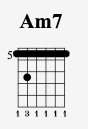
To play “Moondance”, as recorded by Van Morrison, you’ll only need to know 7 main chords they are Am7, Bm7, Dm7, E7, G, F, and Em. I play all these chords as closed-position chords. This gets a jazzier sound, however, it means that they are bar chords.
Let’s take a look at a few ways these shapes can be played on the fretboard:
Am7 is played using all 6 strings and in 5th position like this:
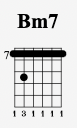
Bm7 takes the same form as Am7, but just shifts it up 2 frets like this:
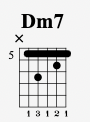
Dm7 is another variant of the previous 2 chords, however, this one is played from the 5th string down like so:
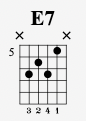
E7 looks like a C chord with one added note, and shifted up the neck like this:
G is played as a bar chord in 3rd position like this:
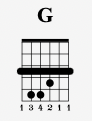
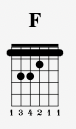
F moves the previous G shape down 2 frets like this:
Finally, Em is played in 7th position with a root on the 5th string like this:
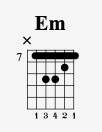
(Note: the last 3 chords are only used in the ending.)
If you’ve struggled to understand the fretboard for RHYTHM and LEAD guitar. and want to discover the easiest and fastest way. Then get your hands on my free Fretboard Guide PDF right here now:
Is Moondance hard to play on guitar?
I would say playing “Moondance” on guitar is going to require a solid intermediate skill level. It’s got a number of more sophisticated, jazzier style chords. However, many of the shapes shift around the neck. This provides some stability. But, it will still be challenging for many players to get right. So, take your time with this one.
What key is Moondance in?
“Moondance,” as recorded by Van Morrison, is in the key of A minor. Here’s a quick look at how the chords relate in the key of A minor:
Am7
Notes: A, C, E, G
Function: This is the i7 chord in the key of A minor.
It’s the tonic chord—the “home” base. The added 7th (G) gives it a mellow, jazzy flavor while still feeling grounded and resolved.
Bm7
Notes: B, D, F♯, A
Function: This is the ii7 chord, borrowed from the A Dorian mode.
It’s not diatonic to A natural minor because of the F♯. However, this chord is very often used in jazz standards and minor vamping chord progressions.
Dm7
Notes: D, F, A, C
Function: This is the iv7 chord in A minor.
It’s a smooth, soulful version of the regular minor iv chord. Works great in progressions like Am7 → Dm7 → G → C or similar jazzy sequences. It also provides a slight movement away from the i chord.
E7
Notes: E, G♯, B, D
Function: This is the V7 chord, from the A harmonic minor scale.
The G♯ gives it a strong pull back to Am. This dominant 7th chord creates tension and is key to resolving back to the tonic minor i chord. You’ll hear this chord at the end of the pre-chorus and also the chorus. It’s very useful for setting up sections.
G
Notes: G, B, D
Function: This is the ♭VII chord, diatonic to A natural minor or A dorian.
It gives a modal flavor—very common in minor key progressions like Am → G → F. It adds energy and movement without strong resolution.
F
Notes: F, A, C
Function: This is the ♭VI chord, diatonic to A natural minor.
Often used in modal minor progressions. This change adds drama and mood.
Em
Notes: E, G, B
Function: This is the v chord in A natural minor.
It’s the “soft” dominant. Without the G♯, it has a more modal, less tense feel than E7. Great when you want a minor sound without a strong pull to resolve. This happens as part of a walk-down progression at the very end of the tune.
Summary:
Am7 – i7 (tonic) in A minor
Bm7 – ii7 from A Dorian (modal color or jazz ii–V setup)
Dm7 – iv7 (subdominant)
E7 – V7 (dominant from A harmonic minor)
G – ♭VII (modal, Aeolian)
F – ♭VI (modal, Aeolian)
Em – v (soft dominant, natural minor)
So that’s the theory. Next, let’s look at…
What is the strumming pattern for Moondance?
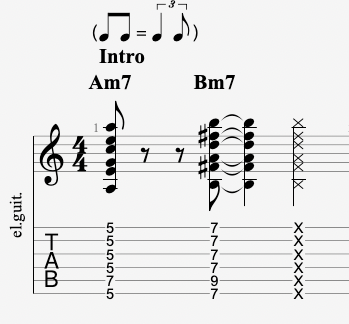
The main underlying groove for “Moondance” is a swinging 8th-note swing feel. In 4/4 time, 8th notes are usually counted as evenly spaced: "1 & 2 & 3 & 4 &" – but in a swing feel, they’re played with a long-short rhythm, like a triplet where the first two notes are tied and the third is played.
So instead of sounding even, they feel like:
“Dah - duh, Dah - duh, Dah - duh, Dah - duh”
You still count them as:
1 & 2 & 3 & 4 &
But the feel is more like:
“One...and, Two...and, Three...and, Four...and”
—with the “&” coming late, like it’s leaning forward into the next beat.
Here’s an example of a strumming pattern in the style of “Moondance”:
Conclusion
To wrap it up, “Moondance” is Van Morrison’s go at writing a jazz standard – and he nailed it! It’s a ton of fun to play.
So, keep practicing, and if you want to learn songs way faster, better understand the fretboard for lead and rhythm, and not waste years spinning your wheels with guitar, grab my free fretboard guide here right now:
Jon MacLennan
Like this blog post? Get Jon’s best guitar lessons straight to your inbox.
Discover the 5 easiest and fastest ways to play the blues scale anywhere on the neck with this FREE PDF GUIDE
