Night Moves Chords & Guitar Lesson (MOST ACCURATE)
Here’s a song that got its inspiration from the back seat… Bob Seger sang:
===
Out in the back seat of my '60 Chevy...
Workin' on mysteries without any clues...
Workin' on our night moves…
===
Originally, Seger thought it wasn’t going to be a hit.
Why?
Because, it was a slower tempo. Plus, he felt it was too reflective. But history showed differently.
Below, I’m going to share some insider tips on the guitar style behind it.
So grab your axe, and let’s dive into this “Night Moves” chords and guitar lesson!
Who Wrote Night Moves?
“Night Moves” was written by Bob Seger and became a song that was a turning point in his career. It was released in late 1976 as the title track to the album of the same name.
Though the album was credited to Bob Seger & The Silver Bullet Band, Night Moves itself was recorded with session musicians from the famed Muscle Shoals Rhythm Section.
It was recorded at both Sound Studio One in Detroit and Muscle Shoals Sound Studio in Alabama. As mentioned above, Seger felt it was too slow and reflective for radio. But Capitol Records pushed it, and it ended up reaching number four on the Billboard Hot 100 in early 1977.
It was the breakthrough Seger had been waiting for.
Now, you may be wondering…
What is the tuning for Night Moves?
The tuning for "Night Moves," as recorded by Bob Sege,r is standard tuning. Standard tuning is spelled: E, A, D, G, B, and E.
Here are the strings:
- E (6th string, lowest pitch)
- A (5th string)
- D (4th string)
- G (3rd string)
- B (2nd string)
- E (1st string, highest pitch)
However, it’s played with a capo on the 1st fret, which changes the notes to read:
- F (6th string, lowest pitch)
- Bb (5th string)
- Eb (4th string)
- Ab (3rd string)
- C (2nd string)
- F (1st string, highest pitch)
You can play it without a capo. You just can’t play along with the recording without a capo.
All right!
Now that you know the tuning for “Night Moves”, let’s next talk about…
Night Moves Chords
To play “Night Moves”, as recorded by Bob Seger, you only need to know 7 main chords they are G, F, C, Em, D, G7, and Cmaj7. All these chords can be played as open chords except for F. Let’s take a look at a few ways these shapes can be played on the fretboard.
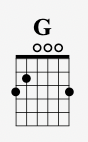
G is played using a folk-style like this:
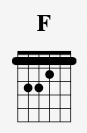
F, as mentioned above, is the one bar chord. I play it in first position like this:
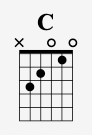
C is played from the 5th string down like so:
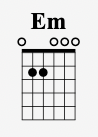
Em is a beautiful, open-sounding chord, again using all 6 strings like this:
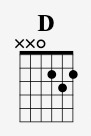
D is played as a standard cowboy chord from the 4th string down like so:
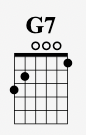
G7 is another great folk-style chord played like this:
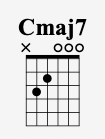
Finally, Cmaj7 takes the above C chord, and lifts up the index finger in the fretting hand like this:
If you’ve struggled to understand the fretboard for RHYTHM and LEAD guitar, and want to discover the easiest and fastest way. Then get your hands on my free Fretboard Guide PDF right here now:
Is Night Moves hard to play on guitar?
I would say playing “Night Moves” on guitar is going to require an intermediate skill level. It’s true, there are not a lot of chords. However, the syncopated rhythms and chord changes that go with those rhythms, along with the ability to bar, bring it out of beginner level into intermediate. So, take your time with this one.
What key is Night Moves in?
“Night Moves,” as recorded by Bob Seger, is in the key of G major. The primary scale for the song is the G major scale, which is built using the notes G, A, B, C, D, E, and F#.
Here’s a quick look at how the chords relate in the key.
G
Notes: G, B, D
Function: This is the I chord (tonic) in the key of G major – the “home base.” It gives a strong sense of resolution and stability. Most songs in G will feel complete when they land here.
Em
Notes: E, G, B
Function: This is the vi chord (the relative minor) in G major. It shares two notes with the tonic (G and B), so it blends nicely and gives a more melancholic contrast to the major chords.
C
Notes: C, E, G
Function: This is the IV chord (subdominant) in G major. It provides a sense of movement and departure from the tonic. Often sets up motion to the V chord (D) or back to the I (G). It can also give a folky, open feeling when used in progressions like G–C–G or C–D–G.
D
Notes: D, F♯, A
Function: This is the V chord (dominant) in G major. It creates strong tension that wants to resolve to the tonic (G). It often shows up just before a return to the I chord and gives a sense of lift and anticipation.
G7
Notes: G, B, D, F
Function: This is not diatonic to G major—it contains an F natural instead of F♯, which makes it a borrowed dominant or a secondary dominant in some contexts. G7 often acts as a V7 of IV (that is, the dominant of the C chord). In a G major context, using G7 sets up a smooth move to C, especially in blues, folk, or early rock-style progressions.
Cmaj7
Notes: C, E, G, B
Function: This is a variation of the IV chord in G major (C), with the major 7th (B) added. The note B adds a jazzy or peaceful quality while still functioning as the IV chord.
F
Notes: F, A, C
Function: F is not diatonic to G major – it contains the note F natural instead of the expected F♯. When F shows up in a song in G major, it's usually functioning as a flat VII chord (♭VII). This is commonly used in rock, folk, and blues to give a mixolydian or bluesy flavor. It adds drama.
So that’s the theory. Next, let’s look at…
What is the strumming pattern for Night Moves?
The main underlying feel for “Night Moves” is a light 8th note rock feel. In 4/4 time, 8th notes divide each beat into two equal parts, creating a steady rhythm like this:
1 & 2 & 3 & 4 &
The numbers (1, 2, 3, 4) represent the main beats in the measure, while the "&" represents the offbeats that add energy and momentum.
When counted out loud, it sounds like:
"One-and, Two-and, Three-and, Four-and."
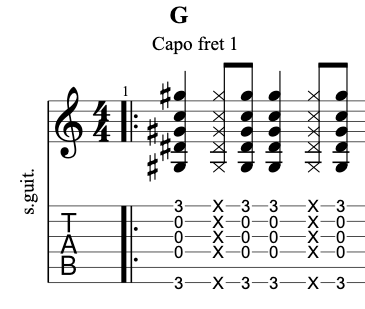
Here’s an example of a strumming pattern in the style of “Night Moves” that combines 1/4 notes, 8th notes, and percussive muting:
Conclusion
To wrap it up, “Night Moves” is a legendary story song many can relate to. The lyrics paint a picture in the listeners' minds and take them on a journey – kind of like watching a movie.
Keep practicing, and if you want to learn songs way faster, better understand the fretboard for lead and rhythm, and not waste years spinning your wheels with guitar, grab my free fretboard guide here right now:
Jon MacLennan
Like this blog post? Get Jon’s best guitar lessons straight to your inbox.
Discover the 5 easiest and fastest ways to play the blues scale anywhere on the neck with this FREE PDF GUIDE
