The ULTIMATE No Woman No Cry Chords & Guitar Lesson
Behold…
One of the greatest live recordings of all time.
Now, the original version was released in 1974 on Bob Marley’s album Natty Dread. But it’s the live version that really put the song on the map.
It also has a very interesting backstory that showcases Marley’s kind and generous character. Below, I’m going to share some insider tips for how to play it on guitar.
So grab your axe, and let’s dive into this “No Woman No Cry” chords and guitar lesson!
Who Wrote No Woman No Cry?
“No Woman No Cry” is widely believed to have been written by Bob Marley. However, the songwriting credit is officially listed as Vincent Ford. Ford was a close friend of Marley’s who ran a soup kitchen in Trench Town, Jamaica, where Marley grew up.
Marley grew up in poverty, and he intentionally gave Ford the songwriting credit so he could collect royalties. This money helped keep Ford’s soup kitchen open and was one of the many behind-the-scenes gestures of generosity Marley showed in his lifetime.
Despite what some listeners think, “No Woman, No Cry” isn't telling a woman not to cry. It's more like:
“No, woman, don’t cry.”
It’s a comforting message to a woman (or possibly to the collective people of Jamaica), reassuring her that everything’s gonna be alright, even amid struggle and pain. The lyrics reflect Marley’s memories of growing up in poverty in Trench Town, but instead of bitterness, there's warmth, resilience, and a sense of community.
“Good friends we have, oh, good friends we’ve lost / Along the way…”
“In this great future, you can’t forget your past…”
The song balances sadness and hope, rooted in Marley’s philosophy of love, unity, and endurance. The most famous version is from the 1975 live album Live!, recorded on July 17, 1975, at the Lyceum Theatre in London.
The song was originally recorded for the 1974 album Natty Dread (at Island Studios in London). The album version is great and has a very different vibe. It was the live version that truly caught fire.
That live take—with the crowd sing-along, soulful organ, and Marley's raw vocal—became the definitive version and (in my opinion) one of the greatest live recordings in music history.
It was ranked #37 on Rolling Stone’s “500 Greatest Songs of All Time”
“No Woman No Cry” is a musical photograph of a time and place—Trench Town in the '60s, and a love letter to community, memory, and resilience.
It’s a healing song, and that's probably why it still hits so hard even today.
Now, you may be wondering…
What is the tuning for No Woman No Cry?
The tuning for "No Woman No Cry", as recorded by Bob Marley is standard tuning. Standard tuning is spelled: E, A, D, G, B, and E.
Here are the strings:
- E (6th string, lowest pitch)
- A (5th string)
- D (4th string)
- G (3rd string)
- B (2nd string)
- E (1st string, highest pitch)
All right!
Now that you know the “No Woman No Cry” tuning, let’s next talk about the…
No Woman No Cry Chords
To play “No Woman No Cry,” you only need to know 5 main chords they are G, C, G/B, Am, and F. The majority of these chords can be played in open position. Let’s take a look at a few ways these shapes can be played on the fretboard.
G is played using all 6 strings like this:

C is played from the 5th string down like so:
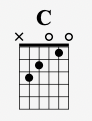
G/B is played on the middle strings and creates a nice step-wise bass line like this:

Am is played from the 5th string down like this:
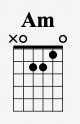
Finally, F is the one bar chord. I play it in 1st position like this:
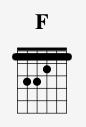
If you’ve struggled to understand the fretboard for RHYTHM and LEAD guitar and want to discover the easiest and fastest way. Then get your hands on my free Fretboard Guide PDF right here now:
Is No Woman No Cry hard to play on guitar?
I would say “No Woman No Cry” on guitar requires an intermediate skill level to play. The F bar chord and also the G/B chords are the two things that push it to an intermediate level. So, take your time with this one.
What key is No Woman No Cry in?
“No Woman No Cry” as recorded Bob Marley, is in the key of C major. The primary scale used is the C major scale, which is built using all natural notes like this:
C – D – E – F – G – A – B – C
All of the chords fit nicely into the diatonic scale, and the majority of the song is a looping chord progression. Here’s a quick look at how they all relate:
1. C major
- Notes: C, E, G
- Roman Numeral: I
- Tonic chord – this is “home base,” where the key feels resolved and at rest.
2. G major
- Notes: G, B, D
- Roman Numeral: V
- Dominant chord – creates tension and wants to resolve to the I chord (C major). Even though G7 (G, B, D, F) is the full diatonic dominant in C, G major is often used on its own in pop and folk progressions.
3. G/B
- Notes: G, B, D (with B in the bass)
- Roman Numeral: V (in first inversion)
- A G major triad with B in the bass. This acts as a passing chord between C and Am, creating a descending bass line: C → B → A. Smooth voice leading and great for emotional movement.
4. Am (A minor)
- Notes: A, C, E
- Roman Numeral: vi
- The relative minor of C major. Adds emotional color and is frequently used in progressions that want a more introspective or melancholic feel.
Finally, we have…
5. F major
- Notes: F, A, C
- Roman Numeral: IV
- Subdominant chord – gives a feeling of lift or departure before returning to G or C. It’s often used to set up a return to the tonic or to transition through the progression.
So that’s the theory. Next, let’s look at…
What is the strumming pattern for No Woman No Cry?
The main underlying feel for “No Woman No Cry” is a slight 16th-note pulse. While I don’t strum all 16th notes. This is the motor underneath the slower pulse. In 4/4 time, 16th notes divide each beat into four equal parts. This creates a tighter rhythmic subdivision against the main pulse of the song. Playing with 16th notes adds more drive and precision to the rhythm, like this:
1 e & a 2 e & a 3 e & a 4 e & a
The numbers (1, 2, 3, 4) represent the main beats in the measure.
The “e,” “&,” and “a” divide each beat into four parts, creating a rapid, continuous feel.
When counted out loud, it sounds like:
"One-e-and-a, Two-e-and-a, Three-e-and-a, Four-e-and-a."
This kind of subdivision is commonly used in funk, and groove music.
As mentioned above, I don’t recommend strumming all 16th notes. To play along with the song, I would use a combination of rhythms. For example, I might blend 8th notes with 16th notes like this:
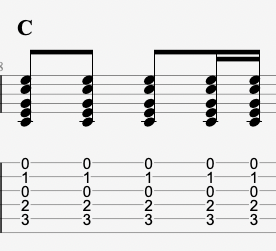
Conclusion
There ya have it! Those are some insider tips on the guitar stylings behind Bob Marley’s legendary classic “No Woman No Cry”.
Keep practicing, and if you want to learn songs way faster, better understand the fretboard, and not waste years spinning your wheels with guitar, grab my free fretboard guide here right now:
Jon MacLennan
Like this blog post? Get Jon’s best guitar lessons straight to your inbox.
Discover the 5 easiest and fastest ways to play the blues scale anywhere on the neck with this FREE PDF GUIDE
