Quick and Easy Oh! Darling Chords & Guitar Lesson
So many of The Beatles' songs are rooted in the blues.
Below, I want to share a perfect example of this.
This song’s style is reminiscent of legends like Fats Domino, Slim Harpo, and even Elmore James.
I’m going to share some insider tips for how to play in this style on guitar.
So grab your axe, and let’s dive into this “Oh! Darling” chords and guitar lesson!
Who Wrote Oh! Darling?
“Oh! Darling” was written and sung by Paul McCartney, however, it is officially credited to the Lennon-McCartney songwriting partnership. It’s a rhythm and blues, doo-wop inspired track recorded by The Beatles and featured on their legendary 1969 album Abbey Road.
The song stands out for its raw vocal delivery and nostalgic, soulful feel.
The Beatles first attempted “Oh! Darling” during the Get Back sessions in January 1969. However, the version that made it onto Abbey Road was recorded at EMI Studios (now Abbey Road Studios) in London. The basic track was laid down on April 20, 1969, with 26 takes recorded. The final take was the winner and became the foundation for the song. From there, overdubs and additional vocals were then added in July and August, with McCartney recording his final lead vocal on July 23, 1969.
Paul McCartney aimed for a vocal performance that sounded as though he had been performing the song live for a week. To get this, he arrived early at EMI Studios each day and recorded only one take per session over several days in July 1969. This approach allowed his voice to naturally wear, adding the desired grit and authenticity to the final take recorded on July 23.
Plus, he also sang the lead vocals without headphones. This was done to make the performance feel more natural and raw. McCartney felt that using headphones would create a more disconnected, artificial feel. So, this approach allowed him to focus solely on the emotional expression of the song, which contributed to the gritty and powerful quality of his voice.
According to the 50th Anniversary Super Deluxe Edition of Abbey Road, the personnel on “Oh! Darling” included:
Paul McCartney – lead and backing vocals, piano
John Lennon – backing vocals, guitar
George Harrison – backing vocals, bass guitar
Ringo Starr – drums
Billy Preston played organ on earlier takes, but his parts were not included in the final mix.
Although “Oh! Darling” wasn’t released as a single, it has been praised for its passionate vocal performance and retro flair. John Lennon admired the song but felt he could have delivered a better vocal, stating it was more his style. The song has been covered by various artists, including Robin Gibb of the Bee Gees, whose 1978 version reached number 15 on the Billboard Hot 100.
During the Get Back sessions, an impromptu version of “Oh! Darling” was performed after Lennon announced Yoko Ono's divorce had been finalized. This playful rendition is featured on Anthology 3.
Now, you may be wondering…
What is the tuning for Oh! Darling?
The tuning for "Oh! Darling", as recorded by The Beatles, is standard tuning. Standard tuning is spelled: E, A, D, G, B, and E.
Here are the strings:
- E (6th string, lowest pitch)
- A (5th string)
- D (4th string)
- G (3rd string)
- B (2nd string)
- E (1st string, highest pitch)
All right!
Now that you know the “Oh! Darling” tuning, let’s next talk about…
Oh! Darling Chords
To play “Oh! Darling”, you’ll need to know 10 main chords they are Eaug, A, E, F#m, D, Bm7, E7, A7, F7, and B7. Let’s take a look at a few ways these shapes can be played on the fretboard.
Eaug is the iconic bluesy chord that opens up the tune. It can be played in the 5th position like this:
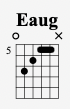
A is the tonic chord of the song and can be played from the 5th string down like so:
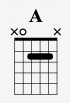
E is played using all 6 strings like so:
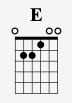
F#m is a bar chord played in 2nd position like this:
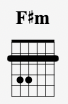
D can be played from the 4th string down like so:
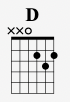
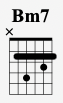
Bm7 is another bar chord with a slightly jazzier flavor played like this:
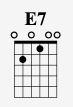
E7 is just like the E chord above; however, this time we’ll remove the ring finger:
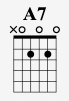
A7 is played by adding the open G string to the A chord like this:
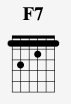
F7 has a great bluesy sound and is played in the 1st position like so:
Finally, we have another bluesy chord B7 played in 2nd position like so:
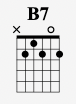
Pro tip: Take note of how many dominant seventh chords there are. This is a key indicator of the blues.
If you’ve struggled to understand the fretboard for RHYTHM and LEAD guitar and want to discover the easiest and fastest way. Then get your hands on my free Fretboard Guide PDF right here now:
Is Oh! Darling hard to play on guitar?
I would say “Oh! Darling” requires a solid intermediate to advanced skill level to play. There are many bar chord shapes to know, plus a player must be able to play in a 12/8 soulful feel to get it to sound right. So, take your time with this one.
What key is Oh! Darling in?
“Oh! Darling,” as recorded by The Beatles, is in the key of A major. This is the primary scale for the tune, and it’s built using the notes A, B, C#, D, E, F#, and G#.
Most of the chords fit into the diatonic scale. Here’s a quick look at how they all relate:
E Augmented (Eaug)
Notes: E, G#, B# (enharmonic to C)
Function: This is an augmented chord based on the V (dominant) scale degree. Typically, a V chord in a major key is a major triad (E, G#, B), but Eaug has an augmented fifth (B# instead of B). This altered dominant creates tension that wants to resolve to A, functioning as a variant of the dominant chord (V).
A Major (A)
Notes: A, C#, E
Function: The A major chord is the I (tonic) chord in the key of A major. It is the root chord and represents the "home" base of the key.
E Major (E)
Notes: E, G#, B
Function: The E major chord is the V (dominant) chord in the key of A major. It is the chord that traditionally resolves to the tonic (A), creating a sense of tension and release.
F# Minor (F#m)
Notes: F#, A, C#
Function: This is the vi (submediant) chord in the key of A major. The vi chord is often used in progressions for its minor, melancholic feel. In the key of A major, F#m acts as the minor chord built on the 6th scale degree.
D Major (D)
Notes: D, F#, A
Function: D major is the IV (subdominant) chord in the key of A major. The subdominant chord is frequently used in progressions to move away from the tonic and build toward the dominant chord.
B Minor 7 (Bm7)
Notes: B, D, F#, A
Function: This is the ii7 (supertonic) chord in the key of A major. Bm7 is the minor seventh chord built on the 2nd scale degree. It’s often used in more complex or jazzy progressions.
E7 (E Dominant 7th)
Notes: E, G#, B, D
Function: E7 is the V7 (dominant seventh) chord in the key of A major. This is the dominant chord with an added seventh, which intensifies the tension, strongly pulling toward resolving to the tonic (A major). The dominant seventh (D) adds an extra layer of dissonance, which makes the resolution to A more satisfying.
A7 (A Dominant 7th)
Notes: A, C#, E, G
Function: A7 is the I7 (tonic seventh) chord in the key of A major. Although A7 is typically associated with the dominant function in other contexts (e.g., in the key of D), in this case, it functions as a tonic with a dominant seventh flavor. This chord often appears in blues, jazz, or rock contexts, giving the A major chord a bit of extra tension or flavor.
F7 (F Dominant 7th)
Notes: F, A, C, E♭
Function: F7 is an outside chord that doesn't belong to the A major scale diatonically. In this case, it acts as a passing chord that creates tension.
B7 (B Dominant 7th)
Notes: B, D#, F#, A
Function: B7 is a secondary dominant that functions as the V7 of V. This chord is not diatonic to the key of A major, but it introduces tension and often resolves its way back to the I chord, adding a jazzy flavor to the progression.
So that’s the theory. Next, let’s look at…
What is the strumming pattern for Oh! Darling?
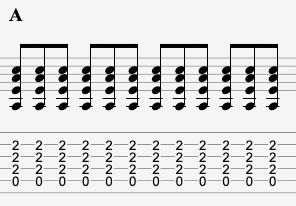
The main underlying groove for “Oh! Darling” is a waltzing 12/8 doo-wop feel. In 12/8 time, each measure is divided into 12 different 8th notes. This creates a rolling, triplet feel.
Here's how it works:
1-2-3-4-5-6-7-8-9-10-11-12
You can break it down into groups of 3 and count it out loud like this:
"One-and-a, Two-and-a, Three-and-a, Four-and-a."
Here’s an example of a strumming pattern in the style of “Oh! Darling”:
Conclusion
To wrap it up, “Oh! Darling” is one of the most soulful, “live-feeling” tunes in The Beatles' catalog. It’s also a perfect example of how much the old-school blues masters influenced rock n roll.
Keep practicing, and if you want to learn songs way faster, better understand the fretboard, and not waste years spinning your wheels with guitar, grab my free fretboard guide here right now:
Jon MacLennan
Like this blog post? Get Jon’s best guitar lessons straight to your inbox.
Discover the 5 easiest and fastest ways to play the blues scale anywhere on the neck with this FREE PDF GUIDE
