Bob Seger – “Old Time Rock And Roll” Chords & Guitar Lesson
Have you ever felt like music these days just isn’t as good as it was in the past?
Well, here’s a song about just that.
Below, I’m going to share with you some insider tips on the guitar style behind it.
So grab your axe, and let’s dive into this “Old Time Rock And Roll” chords and guitar lesson!
Who Wrote Old Time Rock And Roll?
“Old Time Rock and Roll” was originally written by George Jackson and Thomas E. Jones III. But the most famous recording of it is Bob Seger’s from his album Stranger in Town, released in 1978.
It’s a song about enjoying the simple things in life, specifically the raw, unpretentious style of early rock and roll. The narrator is frustrated with modern music and wants to harken back to the good ole days of old-time rock and roll.
Although Seger didn’t write it, he felt an immediate connection with its message and delivered an iconic performance. He said in interviews that while he didn’t write it, he felt it was one of the most “honest” songs about music and life he had ever performed.
“Old Time Rock And Roll” was recorded at Muscle Shoals Sound Studio in Alabama in 1978. This studio was known for its soulful rhythm section and distinctive sound. The Muscle Shoals musicians laid down a tight, swinging groove that perfectly captured the song’s retro-rock energy.
Seger’s raspy vocals gave it a rootsy feel.
Upon its release, “Old Time Rock and Roll” became a major hit for Seger. It peaked at number 28 on the Billboard Hot 100. Over time, it’s become one of his signature songs and a staple of classic rock radio.
Now, you may be wondering…
What is the tuning for Old Time Rock And Roll?
The tuning for "Old Time Rock And Roll” is standard tuning. Standard tuning is spelled: E, A, D, G, B, and E.
Here are the strings:
- E (6th string, lowest pitch)
- A (5th string)
- D (4th string)
- G (3rd string)
- B (2nd string)
- E (1st string, highest pitch)
All right!
Now that you know the tuning for “Old Time Rock And Roll,” let’s next talk about…
Old Time Rock And Roll Chords
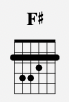
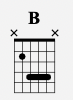
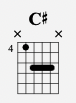
To play “Old Time Rock And Roll”, as recorded by Bob Seger, you only need to know 3 main chords they are F#, B, and C#. These chords are all bar chords. If bar chords are giving you all kinds of aches and pains, and you haven’t yet discovered how to play them effortlessly, go here: https://www.jonmaclennan.com/barchords
Let’s take a look at a few ways these shapes might show up on the fretboard.
F# is a bar chord played in 2nd position and uses all 6 strings like this:
B is played on the middle strings like this:
Finally, we have C#, which is played the same way as B major, it’s just shifted up 2 frets like this:
If you’ve struggled to understand the fretboard for RHYTHM and LEAD guitar, and want to discover the easiest and fastest way. Then get your hands on my free Fretboard Guide PDF right here now:
Is Old Time Rock And Roll hard to play on guitar?
I would say playing “Old Time Rock And Roll” on guitar is going to require an intermediate skill level. The song only has 3 chords. But they are all bar chords. On top of that, adding a cool bluesy shuffle to it (as I reveal in the video above) is going to require more limber hands to make the stretches. So, take your time with this one.
What key is Old Time Rock And Roll in?
“Old Time Rock And Roll”, as recorded by Bob Seger, is in the key of F# major. The primary scale would be the F# major scale, which is built using the notes F#, G#, A#, B, C#, D#, and E#.
Let’s take a closer look at how all these chords relate in the key of F# major. Starting with…
F#
Notes: F#, A#, C#
Function: This is the I chord in F# major. It’s “home”. All the other chords revolve around this one main key.
B
Notes: B, D#, F#
Function: This is the IV chord, built on the fourth degree of F# major. It acts as a pre-dominant chord, and can create movement away from the tonic without changing keys. B major shares the F# note with the tonic, which helps make transitions smooth.
C#
Notes: C#, E#, G#
Function: This is the V chord, the dominant in F# major. Its primary role is to create tension that resolves back to the tonic (F#). The E# (leading tone) pulls strongly toward F#.
Together, these chords make up some of the most common sets of chords in popular music.
Millions of songs use them…
All right!
That’s my theory breakdown.
Next, let’s look at…
What is the strumming pattern for Old Time Rock And Roll?
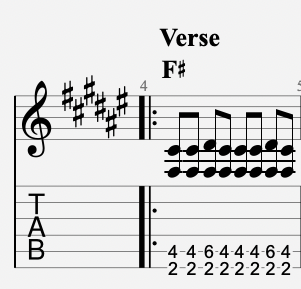
The main underlying groove for “Old Time Rock And Roll” is an 8th note rock feel. In 4/4 time, 8th notes divide each beat into two equal parts, creating a driving, steady rhythm like this:
1 & 2 & 3 & 4 &
The numbers (1, 2, 3, 4) represent the main beats in the measure, while the "&" represents the offbeats that add energy and momentum.
When counted out loud, it sounds like:
"One-and, Two-and, Three-and, Four-and."
Here’s an example of a strumming pattern in the style of “Old Time Rock And Roll”:
Conclusion
To wrap it up, “Old Time Rock And Roll” is a legendary song. It’s a great example of how the blues is the foundation of rock and roll.
Keep practicing, and if you want to learn songs way faster, better understand the fretboard for lead and rhythm, and not waste years spinning your wheels with guitar, grab my free fretboard guide here right now:
Jon MacLennan
Like this blog post? Get Jon’s best guitar lessons straight to your inbox.
Discover the 5 easiest and fastest ways to play the blues scale anywhere on the neck with this FREE PDF GUIDE
