The ULTIMATE Oye Como Va Chords & Guitar Lesson
NPR included this tune in their “100 most important American musical works of the 20th century.”
It's got a groove that makes you want to move.
When I first heard this song, I thought it was written by Santana. However, much later, I found out the truth.
Below, I’m going to share some insider tips on the guitar style behind it.
So grab your axe, and let’s dive into this “Oye Como Va” chords and guitar lesson!
Who Wrote Oye Como Va?
“Oye Como Va” was originally written by legendary American musician Tito Puente. It’s all built around a catchy keyboard groove often known as a montuno in Latin music.
The song appeared on Puente’s album El Rey Bravo. Puente led a full Latin orchestra – timbales, horns, flute, piano, bongos, congas, vocals – which crafted his signature sound.
In fact, a couple of my friends have played percussion for him.
However, Carlos Santana recorded a cover of this tune on his classic album Abraxas.
His version infused rock elements like distorted electric guitars, Leslie‑effected organ, and a driving drum/percussion foundation, all while preserving the original melody.
Santana’s version became a hit single in 1971‑72, reaching #13 on the Billboard Hot 100, #11 on Easy Listening, and #32 on the R&B chart.
Over time, Santana’s rendition has deeply influenced music culture. It was inducted into both the Latin Grammy Hall of Fame (2001) and the Grammy Hall of Fame (2002) NPR included it in their “100 most important American musical works of the 20th century,” and Rolling Stone placed it at #479 on the “500 Greatest Songs of All Time” list in 2021.
Tito Puente later expressed both pride and surprise that a rock band would record his song.
Now, you may be wondering…
What is the tuning for Oye Como Va?
The tuning for "Oye Como Va" as recorded by Carlos Santana, is standard tuning. Standard tuning is spelled: E, A, D, G, B, and E.
Here are the strings:
- E (6th string, lowest pitch)
- A (5th string)
- D (4th string)
- G (3rd string)
- B (2nd string)
- E (1st string, highest pitch)
All right!
Now that you know the tuning for “Oye Como Va”, let’s next talk about…
Oye Como Va Chords
To play “Oye Como Va”, as recorded by Carlos Santana, you only need to know two chords they are Am7 and D9. Let’s take a look at a few ways these chords can be played on the fretboard.
Am7 can be played from the 5th string down like this:
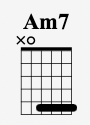
Then, to switch to D9, just make a subtle change like this:
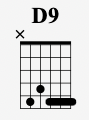
This is one way to play the chords.
However, keep in mind that any Am and any D will work. Santana uses many variations of these two chords all over the fretboard. Some are going to sound better than others, but those are the only two chords you need.
If you’ve struggled to understand the fretboard for RHYTHM and LEAD guitar, and want to discover the easiest and fastest way. Then get your hands on my free Fretboard Guide PDF right here now:
Is Oye Como Va hard to play on guitar?
I would say playing “Oye Como Va” on guitar is going to require an intermediate to advanced skill level. It only uses two chords; and the main progression is not too trick. However, if you want to nail all the rhythmic hits and solos like Santana… then that’s going to take a lot more skill. So, take your time with this one.
What key is Oye Como Va in?
“Oye Como Va,” as recorded by Carlos Santana, is in the key of G major. All the chords fit into the diatonic scale of G major. The main chord progression is what is called a ii-V chord progression.
The scale Santana uses to solo with is the G major scale, which is built from the notes G, A, B, C, D, E, and F#. Notice this key has one sharp. The key of G major has one sharp because of the specific pattern of whole steps (W) and half steps (H) in the major scale. For example:
Whole – Whole – Half – Whole – Whole – Whole – Half
(W – W – H – W – W – W – H)
Starting from G and following that pattern:
G → A (whole)
A → B (whole)
B → C (half)
C → D (whole)
D → E (whole)
E → F♯ (whole)
F♯ → G (half)
If we didn’t use F♯, the pattern would break. Using F natural would make E to F a half step, and F to G another half step. This would not gel with the major scale formula. So, F♯ is needed. Plus, Santana plays this F# note over and over in his solo.
Some may think of this song as the key of Am (like an A minor dorian). However, it’s really the key of G major and just starts on Am.
Here’s a quick look at how these chords relate in the key of G major:
Am7
Notes: A, C, E, G
Function: This is the ii7 chord in the key of G major. As a minor 7th chord built on the second degree of the scale. The progression ii–V–I is a staple in jazz, soul, and pop.
D9
Notes: D, F♯, A, C, E
Function: This is the V9 chord (a dominant 9th) in G major. As an extension of the V7 chord (D7), D9 creates even more tension and color, pushing strongly back to the tonic, G. It’s often paired with Am7 in jazz and funk progressions, completing the classic ii7–V9–I movement. However, in “Oye Como Va,” it’s actually just a ii-V without the I. It's a common “vamping” chord progression used in millions of songs.
So that’s the theory. Next, let’s look at…
What is the strumming pattern for Oye Como Va?
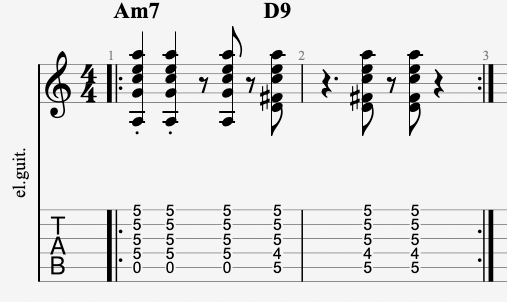
The main underlying groove for “Oye Como Va” is a funky 8th-note Latin feel.
In 4/4 time, 8th notes divide each beat into two equal parts, creating a driving, steady rhythm like this:
1 & 2 & 3 & 4 &
The numbers (1, 2, 3, 4) represent the main beats in the measure, while the "&" represents the offbeats that add energy and momentum.
When counted out loud, it sounds like:
"One-and, Two-and, Three-and, Four-and."
This is the underlying groove. However, I wouldn’t play all 8th notes. Instead, I would use a combination of 1/4 notes, 8th-notes, and some rests like this:
Conclusion
Written by Tito Puente, but made famous by Carlos Santana, “Oye Como Va” is a classic song.
The feel and guitar work are incredible on this one.
So, keep practicing, and if you want to learn songs way faster, better understand the fretboard for lead and rhythm, and not waste years spinning your wheels with guitar, grab my free fretboard guide here right now:
Jon MacLennan
Like this blog post? Get Jon’s best guitar lessons straight to your inbox.
Discover the 5 easiest and fastest ways to play the blues scale anywhere on the neck with this FREE PDF GUIDE
