Black Sabbath – Paranoid Chords & Guitar Lesson
Last month we lost a legend…
RIP Ozzy Osborne.
So below, I’m going to share with you some insider tips on the guitar style behind one of his most legendary songs with Black Sabbath.
So grab your axe, and let’s dive into this “Paranoid” chords and guitar lesson!
Who Wrote Paranoid
“Paranoid” was originally written by all four members of the English heavy metal band Black Sabbath: Ozzy Osbourne, Tony Iommi, Geezer Butler, and Bill Ward.
The story is quite interesting…
You see, they had just finished recording their second album, Paranoid. But their producer, Rodger Bain, said it wasn’t quite long enough and needed one more song.
So Tony Iommi came up with the opening guitar riff and basic structure in about 20 minutes. Then, the rest of the band came together to finish it off and record it immediately.
Here’s the kicker, though…
It was meant to be a filler track for the album, but when the label heard it, they went against the band’s wishes and renamed the whole album after it.
“Paranoid” was recorded at Regent Sound Studios and Island Studios in London in 1970, during the sessions for Paranoid. It’s all built around Iommi’s pentatonic rock riff, Geezer Butler’s pounding bass, Bill Ward’s energetic drumming, and of course, Osbourne’s iconic vocals. The tempo and feel set it apart from much of the slower, doom-laden material on the rest of the album.
Upon its release, “Paranoid” reached number 4 on the UK Singles Chart and became Black Sabbath’s first major hit. In the United States, the song helped propel the Paranoid album to number 12 on the Billboard 200, solidifying the band’s place as pioneers of heavy metal.
However, originally, critics gave the tune mixed reviews.
But it still consistently appears on lists of the greatest heavy metal songs and riffs ever written, so its impact has been pretty large.
It’s ironic how these last resort songs get added to albums, and are often ones the band members are indifferent to, end up becoming the biggest hits. Over the years, Paranoid has remained one of Black Sabbath’s most performed songs and an anthem of heavy metal.
Now, you may be wondering…
What is the tuning for Paranoid?
The tuning for "Paranoid” is standard tuning. Iommi kept things simple. Standard tuning is spelled: E, A, D, G, B, and E.
Here are the strings:
- E (6th string, lowest pitch)
- A (5th string)
- D (4th string)
- G (3rd string)
- B (2nd string)
- E (1st string, highest pitch)
All right!
Now that you know the tuning for “Paranoid”, let’s next talk about…
Paranoid Chords
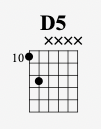
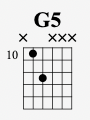
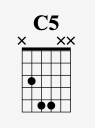
To play “Paranoid”, you only need to know 4 main chord shapes they are E5, D5, G5, and C5. All of these chords are played as power chords. A power chord is a super common chord used in rock and pop that is built on just two notes. They are most commonly played on guitar as two or three-note structures.
Let’s take a look at a few ways these shapes can be played on the fretboard:
E5 is played way up high in 12th position like this:
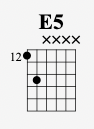
D5 simply shifts the E5 shape down 2 frets like so:
G5 is in the same position as D5. However, it’s shifted down 1 string set like this:
Finally, C5 I play as a three-note power chord in 3rd position like this:
If you’ve struggled to understand the fretboard for RHYTHM and LEAD guitar, and want to discover the easiest and fastest way. Then get your hands on my free Fretboard Guide PDF right here now:
Is Paranoid hard to play on guitar?
I would say playing “Paranoid” on guitar is going to require a late beginner to intermediate skill level. The trickiest parts are the syncopated rhythms, palm-muting, and fast hammer-ons used in the riff. So, take your time with this one.
What key is Paranoid in?
“Paranoid”, as recorded by Black Sabbath, is in the key of E minor. The primary scale for the song is the E natural minor scale, which is built using the notes E, F#, G, A, Bb, C, and D.
It’s important to note that power chords don’t commit to a specific major or minor chord because they lack the 3rd, which determines the quality. So in essence, these chords can be seen as substitutes for their full major or minor equivalents within the key.
Let’s break down the chords and how they function in the key of E minor.
E5
Notes: E and B (Root, Perfect Fifth)
Function: This is the i power chord. It is a variation of the "home" chord.
D5
Notes: D and A (Root, Perfect Fifth)
Function: This is the vii power chord, built on the seventh degree of the E natural minor scale. It is the subtonic chord and functions as a dominant substitute. This one is used in countless classic rock tunes. It creates a gritty and bluesy sound.
G5
Notes: G and D (Root, Perfect Fifth)
Function: This is the III power chord, built on the third degree, the mediant. This chord is the relative major of E minor. Black Sabbath uses this one with punchy rhythmic syncopations that create a bluesy rock feel.
C5
Notes: C and G (Root, Perfect Fifth)
Function: This is the VI power chord, built on the sixth degree, the submediant. It functions as a predominant chord, often used as a climb up progression as well.
C5 → D5 → E5
That’s one of the most classic rock chord progressions of all time.
All right!
So that’s the theory. Next, let’s look at…
What is the strumming pattern for Paranoid?
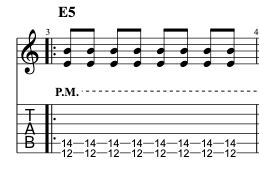
The main underlying feel for “Paranoid” is a driving 8th note rock feel. In 4/4 time, 8th notes divide each beat into two equal parts, creating a steady, walking rhythm. The counting for 8th notes in a measure looks like this:
1 & 2 & 3 & 4 &
The numbers (1, 2, 3, 4) represent the main beats in the measure. The "&" divides each beat into two evenly spaced subdivisions.
When counted out loud, it sounds like:
"One-and, Two-and, Three-and, Four-and."
Here’s an example of a strumming pattern using palm-muting in the style of “Paranoid”:
Conclusion
To wrap it up, it’s wild how what started as an incidental filler song for Black Sabbath’s second album. Became the pinnacle tune on the record, and the rest is history!
Keep practicing, and if you want to learn songs way faster, better understand the fretboard for lead and rhythm, and not waste years spinning your wheels with guitar, grab my free fretboard guide here right now:
Jon MacLennan
Like this blog post? Get Jon’s best guitar lessons straight to your inbox.
Discover the 5 easiest and fastest ways to play the blues scale anywhere on the neck with this FREE PDF GUIDE
