The ULTIMATE Pink Houses Chords & Guitar Lesson
Here’s a nostalgic song about the complexities of the American dream.
It’s also a great example of how you can blend together strumming and cool riffs to fancy up your playing.
Below, I’m going to share some insider tips on the guitar style behind it.
So grab your axe, and let’s dive into this “Pink Houses” chords and guitar lesson!
Who Wrote Pink Houses?
"Pink Houses" was originally written by American singer-songwriter John Mellencamp.
The song has an interesting contrast and has become one of Mellencamp’s biggest tunes. It’s almost a celebration and critique of American life all at once.
Mellencamp was inspired to write “Pink Houses” after driving along Interstate 65 near his hometown in Bloomington, Indiana. He saw a black man sitting in front of a pink house on a front porch, and the image inspired the first line of the tune. Mellencamp later explained that the song isn’t meant to be cynical but rather an honest reflection on how many people live good, decent lives without ever seeing the prosperity that America promises.
The song was recorded at The Shack, Mellencamp’s studio in Belmont, Indiana, with Don Gehman at the helm, producing. The arrangement is a straightforward but powerful blend of rock and folk guitars, with an anthem-like chorus.
Upon its release, “Pink Houses” became a major hit, reaching number 8 on the Billboard Hot 100 and gaining widespread acclaim. It has since become one of Mellencamp’s signature songs and a staple of his live shows.
The song was nominated for a Grammy Award for Best Male Rock Vocal Performance and is consistently ranked among the greatest rock songs of the 1980s.
Now, you may be wondering…
What is the tuning for Pink Houses?
The tuning for "Pink Houses,” as recorded by John Mellencamp, is standard tuning. Standard tuning is spelled: E, A, D, G, B, and E.
Here are the strings:
- E (6th string, lowest pitch)
- A (5th string)
- D (4th string)
- G (3rd string)
- B (2nd string)
- E (1st string, highest pitch)
However, there are live versions that also use an open G tuning. This tuning gives a very Keith Richards-style vibe and can be tuned like this:
- D (6th string, lowest pitch)
- G (5th string)
- D (4th string)
- G (3rd string)
- B (2nd string)
- D (1st string, highest pitch)
All right!
Now that you know the tuning for “Pink Houses,” let’s next talk about…
Pink Houses Chords
To play “Pink Houses”, you only need to know 5 main chords they are G, C/G, C, F/C, and D.
Let’s take a look at a few ways these shapes can be played on the fretboard.
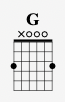
G I play in a folk/rock style using just 2 fingers in the fretting hand like this:
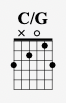
C/G keeps the 2 fingers fretting down from the previous G chord, but adds 2 more like this:
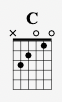
C is played as a standard (campfire) shape like so:
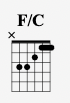
F/C is like a standard F bar chord, but only played from the 5th string down like this:
Finally, D is played from the 4th string down like so:

If you’ve struggled to understand the fretboard for RHYTHM and LEAD guitar, and want to discover the easiest and fastest way. Then get your hands on my free Fretboard Guide PDF right here now:
Is Pink Houses hard to play on guitar?
I would say playing “Pink Houses” on guitar is going to require an intermediate skill level. The most difficult parts are the riff, the rhythms, and the tuning, if you so choose to play it in an open G style. So, take your time with this one.
What key is Pink Houses in?
“Pink Houses”, as recorded by John Mellencamp, is in the key of G major. The primary scale for the song is the G major scale, which is built using the notes G, A, B, C, D, E, and F#.
All the chords fit the diatonic scale of G major except F. This chord is borrowed from the G mixolydian mode and gives the progression a bluesy grit. Let’s take a quick look at how these chords relate in the key of G major. Starting with…
G
Notes: G, B, D
Function: G is the I chord, the tonic. It is the "home" chord in the key of G major.
C/G
Notes: C, E, G, with G in the bass
Function: This is the IV chord in the second inversion. Since the bass note (G) is the tonic of the key, this voicing creates a stable but flowing movement from the I to the IV chord. It’s also a part of the Keith Richards style chord move addressed in the video above.
C
Notes: C, E, G
Function: This is just the straight-up IV chord. It’s the subdominant. The chord built on the fourth degree of the G major scale. It gives the progression a stable step away from the tonic and often leads toward the dominant (V) chord, or back to I.
F/C
Notes: F, A, C, with C in the bass
Function: This is the ♭VII chord in its second inversion. This is a non-diatonic or "borrowed" chord in the key of G major because it uses the F natural.
This chord comes from the G Mixolydian mode or the G minor key, and functions as a subtonic major chord.
D
Notes: D, F♯, A
Function: This is the V chord, the dominant. It is built on the fifth degree of the G major scale and creates a strong sense of tension or pull back to the tonic (I) chord.
All right!
That’s my theory breakdown.
Next, let’s look at…
What is the strumming pattern for Pink Houses?
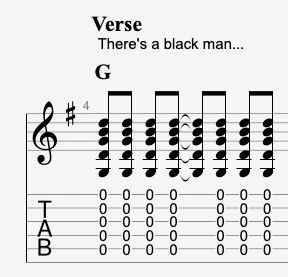
The main underlying feel for “Pink Houses” is an 8th note rock feel. In 4/4 time, 8th notes divide each beat into two equal parts, creating a steady, driving rhythm. The counting for 8th notes in a measure looks like this:
1 & 2 & 3 & 4 &
The numbers (1, 2, 3, 4) represent the main beats in the measure. The "&" divides each beat into two evenly spaced subdivisions.
When counted out loud, it sounds like:
"One-and, Two-and, Three-and, Four-and."
Here’s an example of a common strumming pattern in the style of “Pink Houses”:
Conclusion
To wrap it up, “Pink Houses” is a nostalgic song about the complexities of American life.
Keep practicing, and if you want to learn songs way faster, better understand the fretboard for lead and rhythm, and not waste years spinning your wheels with guitar, grab my free fretboard guide here right now:
Jon MacLennan
Like this blog post? Get Jon’s best guitar lessons straight to your inbox.
Discover the 5 easiest and fastest ways to play the blues scale anywhere on the neck with this FREE PDF GUIDE
