A Quick “Polly” Chords & Guitar Lesson
Here’s a raw acoustic song with a disturbing back story…
It was written from the perspective of a protagonist in a real life crime story.
Below I’m going to break down the guitar style behind it. So grab your axe and let’s dive into this “Polly” chords and guitar lesson!
Who Wrote Polly?
"Polly" was written by Kurt Cobain, the lead singer/guitarist of the American rock band Nirvana. It first appeared on their iconic album Nevermind, which was released in 1991. The tune stands out with a stark acoustic arrangement, as opposed to the heavier grunge sound heard on the rest of the album.
The inspiration came from a crime where a 14-year-old girl was kidnapped. She got into a completely random man’s car hitchhiking home after a concert. That ride did not end well. Thankfully, she managed to escape after being enslaved in his motor home for 2 days.
The lesson: teach your children to never get into cars with random strangers. But "Polly" was recorded in 1990 at Sound City Studios in Van Nuys, California during the Nevermind sessions. Butch Vig was at the helm producing, and unlike most of the Nevermind tracks. “Polly” remained acoustic—just Cobain on vocals and guitar, Krist Novoselic on bass, and Dave Grohl tapping his lap for percussion.
This raw, lo-fi quality made it one of Nirvana’s most intimate recordings. Rolling Stone and other publications have ranked it among the best acoustic songs of the grunge era.
Now, you may be wondering…
What is the tuning for Polly?
The tuning for "Polly" as recorded by Nirvana is standard tuning. This is also the same for the bass guitar. Kurt and Kris kept things simple. Standard tuning for a guitar is spelled out as EADGBE.
Here are the strings:
- E (6th string, lowest pitch)
- A (5th string)
- D (4th string)
- G (3rd string)
- B (2nd string)
- E (1st string, highest pitch)
Now that you know the “Polly” tuning, let’s next talk about the…
Polly Chords
If you want to play “Polly” on guitar, you’ll need to know 6 main chords, they are E5, G5, D5, C5, B5, and Bb5. These chords are all played as power chords. A power chord is a two-note chord built from the root note (the main note that defines the chord), and the fifth (a note five steps above the root). Power chords are written as "5" chords and are a staple in rock and pop guitar. Since power chords lack a third (the note that defines a chord as major or minor), they sound neutral and can fit in many contexts.
Let’s take a look at a few ways these chords can be played on the fretboard.
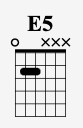
E5 is played with just the index finger in the fretting hand doing a small bar across 2 strings like this:
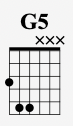
G5 is played in the 3rd position like so:
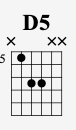
D5 shifts up to the 5th position and also places the root of the chord on the 5th string like this:
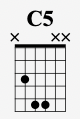
C5 shifts D5 down two frets like this:
B5 is played during the Verse section and is used almost incidentally, it looks like this:
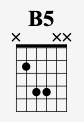
Finally, Bb5 keeps moving down the neck, it’s played in 1st position like this:
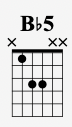
Note how all these shapes are the same they are just shifted around the fretboard.
If you’ve struggled to understand the fretboard for RHYTHM and LEAD guitar and want to discover the easiest and fastest way. Then get your hands on my free fretboard guide PDF right here now:
Is Polly hard to play on guitar?
“Polly” is a great song to learn for newer players because it is not too difficult to play. There are 2 main sections, and all the chords can be played as power chords. So I would definitely recommend it for new players to try.
What key is Polly in?
“Polly” as recorded by Nirvana is in the key of E minor. The main scale being used in the song is the E natural minor scale which uses the notes: E - F# - G - A - B - C - D. However, in the Chorus section there is also an emphasis on the blues scale as well.
Let’s take a look at how the chords relate in the key of E minor:
E5 (E - B) → Tonic (i5)
This is the home chord of the key because it’s built on the root note. Since power chords lack a third, it doesn't explicitly sound minor or major, but in context with the melody it’s an Em and serves as the foundation for the key.
G5 (G - D) → III5
Rooted on G, which is the ♭3rd of the E minor scale.
Since G major (G-B-D) is diatonic to E minor, the power chord (G-D) works well in the key. It’s used to give a strong, stable contrast to the relative minor chord (Em).
D5 (D - A) → VII5
Rooted on D, which is the ♭7th of the E minor scale.
D major (D-F#-A) is diatonic to E minor, so its power chord (D-A) fits naturally.
It’s used in countless rock progressions, and often leads back to E5 or C5.
C5 (C - G) → VI5
C5 is the ♭6th in E minor.
C major (C-E-G) would be the full chord, so C5 (C-G) works naturally in progressions.
B5 (B - F#) → V5
Rooted on B, which is the 5th degree of E minor.
B minor (B-D-F#) is diatonic, and B5 (B-F#) hints at this chord without the minor third (D). This chord is often used to build tension before resolving back to E5. It appears briefly in the Verse section.
Bb5 (Bb - F) → Borrowed (♭V5 or Chromatic)
Bb is not in the key of E minor, so this is an out-of-key or chromatic chord.
It’s used for tension in the Chorus and comes from the blues scale. It could be seen as the ♭5 of E or the ♭3 in G the relative major key.
So that’s the theory, but remember, all of that doesn’t mean a thing without a good…
Polly Strumming Pattern
The main underlying groove for “Polly” is a steady 8th-note rock feel. In 4/4 time, 8th notes divide each beat into two equal parts, creating a driving, steady rhythm like this:
1 & 2 & 3 & 4 &
The numbers (1, 2, 3, 4) represent the main beats in the measure, while the "&" represents the offbeats that add energy and momentum.
When counted out loud, it sounds like:
"One-and, Two-and, Three-and, Four-and."
This gives the tune a strong and consistent forward motion. A great option is to strum this rhythm using an alternating strumming pattern like this:
1 & 2 & 3 & 4 &
D u d u d u d u
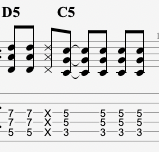
Now, while 8th notes are the fundamental rhythm, in context I may also add in some scratch strums and syncopation to spice things up. Here’s an example of a strumming pattern in the style of “Polly”:
Conclusion
There you have it! A quick look at the guitar style behind Nirvana’s haunting acoustic jam “Polly”.
Keep practicing, and if you want to learn songs way faster, better understand the fretboard, and not waste years spinning your wheels with guitar, grab my free fretboard guide here right now:
Jon MacLennan
Like this blog post? Get Jon’s best guitar lessons straight to your inbox.
Discover the 5 easiest and fastest ways to play the blues scale anywhere on the neck with this FREE PDF GUIDE
