Paul Anka – “Put Your Head On My Shoulder” Chords & Guitar Lesson
Here’s a smooth ballad that has one of my favorite types of grooves.
It’s a rolling, triplet-based rhythm that you hear all the time in the blues.
This style was super popular during the ‘50s, but it still sounds great today.
Below, I’m going to share some insider tips on the guitar style behind it.
So grab your axe, and let’s dive into this “Put Your Head On My Shoulder” chords and guitar lesson!
Who wrote Put Your Head On My Shoulder?
“Put Your Head on My Shoulder” was originally written and recorded by Paul Anka in 1959. During this time, he was emerging as one of the defining voices of late-1950s teen pop.
This song has a smooth and romantic feel to it. “Put Your Head on My Shoulder” was first released as a single by ABC-Paramount and quickly became a major hit, reaching number two on the Billboard Hot 100.
It’s a song about puppy love and embodies the innocence and sincerity of late-1950s. The combination of Anka’s smooth and youthful voice with the soft orchestral backing created a timeless sound.
Now, you may be wondering…
What is the tuning for Put Your Head On My Shoulder?
The tuning for "Put Your Head On My Shoulder” is standard tuning. Standard tuning is spelled: E, A, D, G, B, and E.
Here are the strings:
- E (6th string, lowest pitch)
- A (5th string)
- D (4th string)
- G (3rd string)
- B (2nd string)
- E (1st string, highest pitch)
All right!
Now that you know the tuning for “Put Your Head On My Shoulder,” let’s next talk about…
Put Your Head On My Shoulder Chords
To play “Put Your Head On My Shoulder”, as recorded by Paul Anka, you’ll need to know 13 main chords they are G, Em, Am, D7b9, C, D, C#7, Bm, A, Ab, Fm, Bbm, and Eb7b9. These chords are a blend of open and bar chord shapes.
If bar chords are giving you all kinds of aches and pains, and you haven’t yet discovered how to play them effortlessly, go here: https://www.jonmaclennan.com/barchords
Let’s take a look at a few ways these shapes might show up on the fretboard.
I play a simple G with all 6 strings like this:

Em is a beautiful-sounding open chord that uses all 6 strings as well like so:

Am is a very common shape played from the 5th string down like this:

D7b9 is a more sophisticated jazz chord. I play it on the middle strings like so:

C is played in a typical (campfire) style like this:

D is played from the 4th string down like this:

C#7 looks similar to a C. But I add the pinky finger in the fretting hand and shift it up one fret like so:

Bm is played as a bar chord in 2nd position like this:

For A, I use just my index finger like this:

Then we get into the chords that happen after the modulation…
Ab is a bar chord in 4th position and uses all 6 strings like this:

Fm is a bar chord in 1st position, like so:

Bbm is played from the 5th string down like this:

Finally, we have Eb7b9. This one is played just like D7b9 but shifted up one fret, like so:

If you’ve struggled to understand the fretboard for RHYTHM and LEAD guitar, and want to discover the easiest and fastest way. Then get your hands on my free Fretboard Guide PDF right here now:
Is Put Your Head On My Shoulder hard to play on guitar?
I would say playing “Put Your Head On My Shoulder” on guitar is going to require at least an intermediate skill level. The trickiest parts are the 12/8 feel, the jazzier chord shapes, and the modulation at the end. All of these things are intermediate to even advanced skills. So, take your time with this one.
What key is Put Your Head On My Shoulder in?
“Put Your Head On My Shoulder”, as recorded by Paul Anka, is in the key of G major. The primary scale for the song would be the G major scale, which is built using the notes G, A, B, C, D, E, and F#.
Let’s take a closer look at how these chords relate in the key of G major. Starting with…
G
Notes: G, B, D
Function: This is the I chord, it’s the tonic of G major or the “home chord”. All other chords in the key relate back to this tonal center.
Em
Notes: E, G, B
Function: Em is the vi chord in G major, sometimes called the relative minor. It shares two notes with G (G and B), making transitions between G and Em smooth. It adds a reflective, softer color to a progression.
Am
Notes: A, C, E
Function: Am is the ii chord in G major. It is minor and functions as a pre-dominant chord, often leading naturally to the V chord (D or D7b9 in this song), creating tension that wants to resolve back to G.
D7b9
Notes: D, F#, A, C, Eb
Function: This is the V7b9 chord in G major. As a dominant seventh with a flattened ninth, it creates intense tension that strongly pulls back to the tonic G. The b9 (Eb) adds a jazzy, dissonant flavor, increasing the sonic drama.
C
Notes: C, E, G
Function: C is the IV chord in G major. C moves away from the tonic and creates a resting point before returning back to G. It shares the note G with the tonic, so it’s a smooth motion.
D
Notes: D, F#, A
Function: D is the V chord in G major. It is the dominant and creates tension that resolves to G. Including the F# (the leading tone) strengthens this pull and makes progressions feel complete.
C#7
Notes: C#, E#, G#, B
Function: C#7 is not diatonic to G major. It functions as a secondary dominant (V7/vi). However, in the song, it resolves to Bm strangely, but it works.
Bm
Notes: B, D, F#
Function: Bm is the iii chord in G major. It shares two notes with the tonic (D and B), making it smooth in progressions.
A
Notes: A, C#, E
Function: A is not diatonic to G major. It functions as a secondary dominant (V of D), preparing the dominant chord D and adding forward motion, eventually going back to G
Then we have the modulation to Ab major one fret up. The functions of all the chords stay the same; they just move keys.
All right!
That’s my theory breakdown.
Next, let’s look at…
What is the strumming pattern for Put Your Head On My Shoulder?
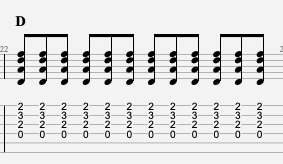
The main underlying feel for “Put Your Head On My Shoulder” is a 12/8 feel. In 12/8 time, 8th notes divide each beat into three equal parts, creating a rolling, triplet-based rhythm often found in blues and ballads.
The counting for 8th notes in a measure looks like this:
1 & a 2 & a 3 & a 4 & a
The numbers (1, 2, 3, 4) represent the four main pulse beats in the measure, which are felt as dotted quarter notes. The "&" and the "a" (pronounced "ah") divide each of those four beats into three evenly spaced subdivisions.
When counted out loud, it sounds like:
"One-and-ah, Two-and-ah, Three-and-ah, Four-and-ah."
Here’s an example of this style strumming in action:
Conclusion
Bottom line, “Put Your Head On My Shoulder” is one of the smoothest sounding ballads of the late ‘50s. This guitar style is a lot of fun to play so…
Keep practicing, and if you want to learn songs way faster, better understand the fretboard for lead and rhythm, and not waste years spinning your wheels with guitar, grab my free fretboard guide here right now:
Jon MacLennan
Like this blog post? Get Jon’s best guitar lessons straight to your inbox.
Discover the 5 easiest and fastest ways to play the blues scale anywhere on the neck with this FREE PDF GUIDE
