The Doors – “Riders on the Storm” Chords & Guitar Lesson
Here’s a haunting blues song about a hitchhiking killer.
It all started with a jam.
Robby Krieger was riffing on "Ghost Riders In The Sky" on the guitar.
And Jim Morrison said, "I got lyrics for that."
Then Ray Manzarek said, "Let me see what I can do with this."
And instead of keeping it cow-poke, he put some jazz to it.
He made it dark and came up with a bass line groove in his left hand that goes:
Em → A
Em → A
What came next was one of the most haunting songs I've ever heard.
It begins with thunder and rain sounds.
Then this groove.
I’ve always enjoyed it.
In this post, I want to share with you some insider tips on the guitar style behind it — including how to play what Manzarek calls “the rain lick.”
It’s a giant cascading run from the high notes on the piano all the way down to the low.
It sounds like falling rain.
So grab your axe, and let’s dive into this “Riders on the Storm” chords and guitar lesson!
Who wrote Riders on the Storm?
“Riders on the Storm” is one of The Doors’ most epic songs. It holds an eerie place in rock history especially because it was the closing track on the Doors iconic album L.A. Woman.
This was the final Doors album before Jim Morrison passed at the early age of 27.
Yup. He’s a member of the 27 Club.
The song is credited to all four members of The Doors: Jim Morrison, Ray Manzarek, Robby Krieger, and John Densmore.
Although it was inspired by “Ghost Riders in the Sky”, the end result sounds almost nothing like a traditional cowboy tune.
The band transformed the “riders” image into something much darker.
The most disturbing section is the famous “killer on the road” verse:
===
There's a killer on the road
His brain is squirmin' like a toad
Take a long holiday
Let your children play
If you give this man a ride
Sweet family will die
Killer on the road, yeah
===
But “Riders on the Storm” isn't entirely about death and murder.
The later section addressing a woman changes the emotional direction dramatically. Ray Manzarek said that some of those lines reflected Morrison's feelings toward his girlfriend Pamela Courson.
The band teamed up with producer Bruce Botnick and turned its own rehearsal space — the Doors Workshop at 8512 Santa Monica Boulevard in Los Angeles — into a makeshift recording studio.
It’s not too far from where I’m typing this blog.
But now, it’s a hot dog stand called the Tail o' the Pup.
L.A. Woman was released in April 1971. Morrison was still alive when the album appeared, but he had already left Los Angeles for Paris.
“Riders on the Storm” was subsequently released as a single in June 1971, shortly before his death. It therefore became the final Doors single released during Morrison's lifetime.
Upon its release, “Riders on the Storm” became another major Doors hit. It reached No. 14 on the Billboard Hot 100 in the United States and also charted internationally, including reaching No. 22 in the UK.
Now, you may be wondering…
What is the tuning for Riders on the Storm?
The tuning for "Riders on the Storm” as recorded by The Doors is standard tuning. Standard tuning is spelled: E, A, D, G, B, and E.
Here are the strings:
- E (6th string, lowest pitch)
- A (5th string)
- D (4th string)
- G (3rd string)
- B (2nd string)
- E (1st string, highest pitch)
All right!
Now that you know the tuning for “Riders on the Storm,” let’s next talk about…
Riders on the Storm Chords
To play “Riders on the Storm”, as recorded by The Doors, you only need to know 6 main chords they are Em, D, Am, Bm, G/D, and C.
These chords can be played many different ways around the fretboard, some open and some bar chords.
If bar chords are giving you all kinds of aches and pains, and you haven’t yet discovered how to play them effortlessly, go here: https://www.jonmaclennan.com/barchords
Let’s take a look at a few ways these shapes might show up on the fretboard.
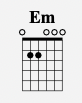
Em is a haunting chord that uses all 6 strings like this:
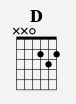
D is played from the 4th string down like this:
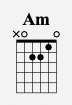
Am is played in a standard (campfire) position like this:
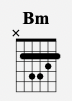
Bm is a bar chord played from the 5th string down in 2nd position like so:
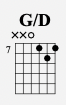
G/D is a slash chord; one way to play it is like this:
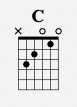
Finally, we have C, which I play in a folk-style like this:
If you’ve struggled to understand the fretboard for RHYTHM and LEAD guitar. and want to discover the easiest and fastest way. Then get your hands on my free Fretboard Guide PDF right here now:
Is Riders on the Storm hard to play on guitar?
I would say playing “Riders on the Storm” as recorded by The Doors is going to require an advanced skill level. If you play the note-for-note parts from my lesson above that Robby Krieger plays, that will make it slightly easier. However, if you do all the advanced fingerstyle moves, and keyboard licks cop’d on guitar, that’s going to take more skill. So, take your time with this one.
What key is Riders on the Storm in?
“Riders on the Storm”, as recorded by The Doors, is in the key of E minor. The primary scale for the song is the E minor scale.
Let’s next take a look at how these chords function in the key of E minor, starting with…
Em
Notes: E, G, B
Function: This is the i chord, it’s “home” and establishes the minor tonal center. The other chords create movement away from Em and eventually lead the ear back toward it.
D
Notes: D, F#, A
Function: This is the VII chord in E natural minor. It sits a whole step below the tonic and creates movement without the strong dominant pull you would get from B or B7.
Am
Notes: A, C, E
Function: This is the iv chord in E minor. It has a predominant function and creates movement away from the tonic. But still retains a strong connection to the home key while adding a darker minor sound.
Bm
Notes: B, D, F#
Function: This is the v chord in E natural minor. It acts as the minor dominant and can lead back to Em. Because it contains D natural rather than the stronger leading tone D#, its pull toward Em is softer than B or B7, which come from E harmonic minor.
G/D
Notes: D, G, B
Function: This is the III chord, G major, in second inversion with D in the bass. G is the relative major of E minor and shares two notes with the tonic Em chord (G and B). Putting D in the bass gives the chord a less settled sound and can help create a smooth bass line between the surrounding chords.
C
Notes: C, E, G
Function: This is the VI chord in E minor. It is completely diatonic to E natural minor.
Together, Em (i), D (VII), Am (iv), Bm (v), G/D (III in second inversion), and C (VI) all come directly from the E natural minor scale:
E – F# – G – A – B – C – D
All right!
That’s my theory breakdown.
Next, let’s look at…
What is the strumming pattern for Riders on the Storm?
The main feel for “Riders on the Storm” as recorded by The Doors, is an eighth-note rock feel. In 4/4 time, eighth notes divide each beat into two equal parts, creating a driving, steady rhythm like this:
1 & 2 & 3 & 4 &
The numbers (1, 2, 3, 4) represent the main beats in the measure, while the "&" represents the offbeats that add energy and momentum.
When counted out loud, it sounds like:
"One-and, Two-and, Three-and, Four-and."
However, I wouldn’t strum all eighth notes.
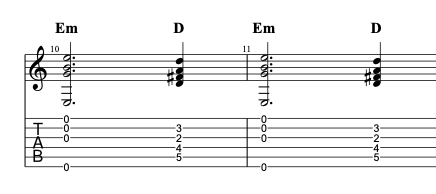
Here’s an example of a groove I might play in the style of “Riders on the Storm”:
Conclusion
To wrap it up, “Riders on the Storm” is a mighty song in rock music history. It’s also a ton of fun to play!
Keep practicing, and if you want to improve your fingerstyle guitar faster and not waste years spinning your wheels with guitar, grab my free fingerstyle cheat sheet PDF guide right here now:
Jon MacLennan
Like this blog post? Get Jon’s best guitar lessons straight to your inbox.
Discover the 5 easiest and fastest ways to play the blues scale anywhere on the neck with this FREE PDF GUIDE
