The Beatles – Rocky Raccoon Chords & Guitar Lesson (Most Accurate)
Paul McCartney sang:
===
Now, somewhere in the black mining hills of Dakota
There lived a young boy named Rocky Raccoon
And one day, his woman ran off with another guy…
===
Here’s a mighty song from The Beatles' legendary 9th studio album, also known as The White Album.
In this post, I’m going to share with you some insider tips on the guitar style behind it.
So grab your axe, and let’s dive into this “Rocky Raccoon” chords and guitar lesson!
Who Wrote Rocky Raccoon?
“Rocky Raccoon” was primarily written by Paul McCartney. However, it is credited under the Lennon/McCartney songwriting partnership, like all The Beatles’ songs. It first appeared on The Beatles' 9th studio album (commonly known as The White Album), released in 1968.
McCartney wrote “Rocky Raccoon” while on a retreat in India with Yogi Maharishi Mahesh. The rest of the band was there, along with Donovan Leitch (a Scottish folk singer).
The song tells the story of a young man named Rocky Raccoon whose woman (Nancy) ran off with another guy (Dan).
It has all the ingredients of a classic Western-style ballad: heartbreak, guns, and a hotel room doctor. The song blends folk with a ragtime swing featuring the legendary George Martin playing a saloon-style piano instrumental that perfectly fits the song. In addition to this, Paul sang lead and played acoustic guitar, John Lennon covered the harmonica, George Harrison played bass, and Ringo Starr added drums.
“Rocky Raccoon” was recorded on August 15, 1968, at EMI Studios (now Abbey Road Studios) in London. While “Rocky Raccoon” was never released as a single and didn’t chart on its own, it has become a beloved track in The Beatles’ catalog. It’s got a great folksy charm to it.
There’s also a small bit of Beatles lore connected to the song’s character name. Some fans have speculated that “Rocky Raccoon” was inspired by “Rocky Sassoon,” the original name McCartney had written down before changing it because “Raccoon” sounded more Western. Others have linked the name to the American comic book culture of the time or even to the Raccoon Lodge from The Honeymooners.
Now, you may be wondering…
What is the tuning for Rocky Raccoon?
The tuning for "Rocky Raccoon” is standard tuning. McCartney kept things simple. Standard tuning is spelled: E, A, D, G, B, and E.
Here are the strings:
- E (6th string, lowest pitch)
- A (5th string)
- D (4th string)
- G (3rd string)
- B (2nd string)
- E (1st string, highest pitch)
All right!
Now that you know the tuning for “Rocky Raccoon,” let’s next talk about…
Rocky Raccoon Chords
To play “Rocky Raccoon”, you’ll need to know 6 main chords they are Am7, D7sus4, D7, G7, C, and C/B. All of these chords can be played in open position.
Let’s take a look at a few ways these shapes might look on the fretboard.
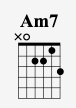
Am7 is played from the 5th string down like this:
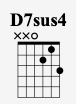
D7sus4 is played from the 4th string down like this:
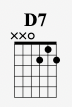
D7 just changes one note from the previous chord, like so:
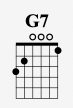
G7 is a very common folk-style chord played using all 6 strings like this:
C is played in a standard (campfire) position like so:
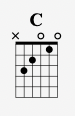
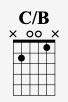
Finally, C/B is just part of a walking bass line progression. I play it like this:
If you’ve struggled to understand the fretboard for RHYTHM and LEAD guitar, and want to discover the easiest and fastest way. Then get your hands on my free Fretboard Guide PDF right here now:
Is Rocky Raccoon hard to play on guitar?
I would say playing “Rocky Raccoon” on guitar is going to require an intermediate skill level. The chords are not too difficult, but getting the strumming pattern and “feel” right are the hardest parts. The fingerstyle pattern is the same type of pattern used on “Blackbird”. So, take your time with this one.
What key is Rocky Raccoon in?
“Rocky Raccoon”, as recorded by The Beatles, is in the key of C major. The primary scale for the song is the C major scale, which is built using the notes C, D, E, F, G, A, and B.
All of the chords fit into the diatonic scale of C major except the D7. Let’s take a closer look, starting with…
Am7
Notes: A, C, E, G
Function: This is the vi7 chord (A minor 7) in the key of C major. It’s the relative minor of C and shares many of the same notes. The minor 7th (G) adds a soulful, jazzy feel and helps it flow smoothly into the D7 chord.
D7sus4
Notes: D, G, A, C
Function: This is a secondary dominant, acting as a V7sus4 of V in the key of C major (V7/V). The “sus4” replaces the third (F#) with the fourth (G), creating tension that resolves beautifully when it moves to D7.
D7
Notes: D, F#, A, C
Function: This is the V7 of V (secondary dominant). In the key of C, D7 leads strongly to G7, which in turn resolves to the tonic C. The F# note is the leading tone that gives the D7 its pull toward G7. This chord is briefly borrowed from the key of G major.
G7
Notes: G, B, D, F
Function: This is the V7 chord in the key of C major. It’s the dominant chord that naturally creates tension wanting to resolve to the tonic (C). The tritone between B and F is what drives this chord, making it one of the strongest harmonic movements in Western music.
C
Notes: C, E, G
Function: This is the I chord (tonic) in the key of C major — the “home” chord.
C/B
Notes: C, E, G, with B in the bass
Function: This is a passing chord — essentially the tonic (C) with a descending bass line. The B in the bass creates smooth voice leading between C and Am7 in the progression.
So when you break it all down, “Rocky Raccoon” is simply a I – vi – ii – V chord progression in the key of C, but it starts on the vi. It’s a very common chord progression used in millions of songs.
All right!
That’s my theory breakdown.
Next, let’s look at…
What is the strumming pattern for Rocky Raccoon?
The main underlying feel for “Rocky Raccoon” is a saloon-style 8th-note swing feel. In 4/4 time with a swing feel, 8th notes are played unevenly. The first 8th note of the beat is longer (closer to a dotted quarter note), and the second 8th note is shorter (closer to an eighth note). The counting for swung 8th notes in a measure still uses the standard notation, but the performance is based on a triplet subdivision:
1 (trip-let) 2 (trip-let) 3 (trip-let) 4 (trip-let)
The actual duration of the notes divides the beat into a triplet figure, with the first 8th note taking up two-thirds of the beat and the second 8th note taking up the final one-third.
When counted out loud, it sounds like:
"One-and, Two-and, Three-and, Four-and."
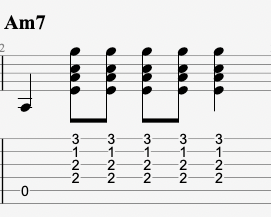
Here’s an example of a simple rock strumming pattern in the style of “Rocky Raccoon”:
Conclusion
To wrap it up, “Rocky Raccoon” is a great storytelling song. He didn’t win the girl, but he did win his freedom and went on to live his best life with Rocky’s Revival, and never looked back.
So, keep practicing, and if you want to learn songs way faster, better understand the fretboard for lead and rhythm, and not waste years spinning your wheels with guitar, grab my free fretboard guide here right now:
Jon MacLennan
Like this blog post? Get Jon’s best guitar lessons straight to your inbox.
Discover the 5 easiest and fastest ways to play the blues scale anywhere on the neck with this FREE PDF GUIDE
