Chuck Berry – Run Run Rudolph Chords & Guitar Lesson
The legendary Chuck Berry sang:
"All I want for Christmas is a rock and roll electric guitar..."
And I’ve got to agree with him.
That’s one of the coolest presents you could put on a wishlist.
Below, I’m going to share with you some insider tips on the guitar style behind it.
So grab your axe, and let’s dive into this “Run Run Rudolph” chords and guitar lesson!
Who Wrote Run Run Rudolph?
“Run Run Rudolph” is a classic rock and roll Christmas song originally written by Chuck Berry and Johnny Marks. The song tells the story of a young boy eagerly awaiting Christmas. He’s urging Rudolph the Red-Nosed Reindeer to hurry up and deliver the presents with Santa.
This concept is beautifully blended with Berry’s iconic rock and roll style. Now, the official title is “Run Rudolph Run”; however, most people call it “Run Run Rudolph” because that’s what the lyrics sing.
The song was first recorded by Chuck Berry in 1958 and has since become a standard of holiday music.
“Run Run Rudolph” was recorded in Chicago with Berry on vocals and guitar, and a tight backing band that helped create the energetic, driving feeling that’s instantly recognizable.
Over the years, “Run Run Rudolph” has been covered by countless artists, from Alvin and the Chipmunks to John Mayer. While it did not chart high originally, over time, it’s become one of the most iconic Christmas songs of all time.
Now, you may be wondering…
What is the tuning for Run Run Rudolph?
The tuning for "Run Run Rudolph” is standard tuning. Berry kept things simple. Standard tuning is spelled: E, A, D, G, B, and E.
Here are the strings:
- E (6th string, lowest pitch)
- A (5th string)
- D (4th string)
- G (3rd string)
- B (2nd string)
- E (1st string, highest pitch)
All right!
Now that you know the tuning for “Run Run Rudolph,” let’s next talk about…
Run Run Rudolph Chords
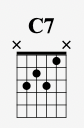
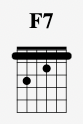
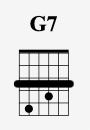
To play “Run Run Rudolph”, you only need to know 3 main chords they are C7, F7, and G7. These chords are a blend of open position and bar chords.
If bar chords are giving you all kinds of aches and pains, and you haven’t yet discovered how to play them effortlessly, go here: https://www.jonmaclennan.com/7mistakes
Let’s take a look at a few ways these shapes might appear on the fretboard.
C7 is played in a standard (campfire) position like this:
F7 is played as a bar chord in 1st position using all 6 strings like this:
Finally, G7 can be played by simply shifting F7 up 2 frets like this:
If you’ve struggled to understand the fretboard for RHYTHM and LEAD guitar, and want to discover the easiest and fastest way. Then get your hands on my free Fretboard Guide PDF right here now:
Is Run Run Rudolph hard to play on guitar?
I would say playing “Run Run Rudolph” on guitar is going to require an intermediate to advanced skill level. Chuck Berry was a phenomenal guitarist. His sound is instantly recognizable. The trickiest parts are the shuffle-rhythm patterns in C that can create some bigger stretches. Plus, the faster double-stops used for lead throughout. So, take your time with this one.
What key is Run Run Rudolph in?
“Run Run Rudolph”, as recorded by Chuck Berry, is in the key of C major. The primary scale would be the C major scale, which is built using the notes C, D, E, F, G, A, and B.
However, this song breaks the rules. It follows a common blues structure and makes all the chords dominant sevenths.
Let’s take a closer look at how all these chords relate in the key of C major. Starting with…
C7 (C dominant seventh)
Notes: C, E, G, Bb
Function: This is the I7 chord in the key of C major, acting as a dominant-style tonic. The added minor seventh (Bb) gives it a bluesy sound, which also makes it move naturally toward the IV7 chord (F7) in classic blues progressions.
F7 (F dominant seventh)
Notes: F, A, C, Eb
Function: This is the IV7 chord in C major. As the subdominant with a dominant seventh, this one creates tension which wants to resolve back to the tonic (C or C7). It’s a key chord in blues and gives the progression forward motion and character.
G7 (G dominant seventh)
Notes: G, B, D, F
Function: This is the V7 chord in C major, the dominant seventh. It creates strong tension that resolves back to the tonic C or C7. The G7 is central in blues and jazz progressions, driving the harmony toward resolution while adding a classic dominant seventh flavor.
Together, these chords form some of the most common sets of chords in blues. There are millions of songs that use them…
All right!
That’s my theory breakdown.
Next, let’s look at…
What is the strumming pattern for Run Run Rudolph?
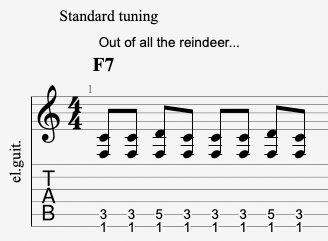
The main underlying groove for “Run Run Rudolph” is a driving 8th-note rock. In 4/4 time, 8th notes divide each beat into two equal parts, creating a steady, driving rhythm. The counting for 8th notes in a measure looks like this:
1 & 2 & 3 & 4 &
The numbers (1, 2, 3, 4) represent the main beats in the measure. The "&" divides each beat into two evenly spaced subdivisions.
When counted out loud, it sounds like:
"One-and, Two-and, Three-and, Four-and."
Berry mixes this rhythm with a classic blues guitar shuffle pattern. Here’s an example of a strumming pattern in the style of “Run Run Rudolph”:
Conclusion
To wrap it up, “Run Run Rudolph” is a classic example of how players who are familiar with the fundamental principles of the blues can learn rock songs more easily. Because, the blues led straight into rock and roll.
Keep practicing, and if you want to learn songs way faster, better understand the fretboard for lead and rhythm, and not waste years spinning your wheels with guitar, grab my free fretboard guide here right now:
Jon MacLennan
Like this blog post? Get Jon’s best guitar lessons straight to your inbox.
Discover the 5 easiest and fastest ways to play the blues scale anywhere on the neck with this FREE PDF GUIDE
