The Beatles – “She Loves You” Chords & Guitar Lesson
Let’s go back in time to the early ‘60s…
This tune is one of the highest-selling singles of all time.
And it captures the early sound of The Beatles, which led to Beatlemania. It has a very simple band-like arrangement with no extra frills.
Below, I’m going to share some insider tips on the guitar style behind it.
So grab your axe, and let’s dive into this “She Loves You” chords and guitar lesson!
Who wrote She Loves You?
“She Loves You” was written by John Lennon and Paul McCartney in early 1963. This was from a time when John and Paul would turn downtime on the road into songwriting sessions. Paul has said this song came together quickly. This is often the case with many hit songs. It’s as if they are already written in the subconscious mind, and then they just fall out of the ether.
“She Loves You” became a defining song of Beatlemania and is often linked to when the band really started to get traction.
The tune was recorded on July 1, 1963, at EMI Studios (Abbey Road) in London, specifically in Studio Two.
As opposed to many later Beatles recordings, which explored a lot of experimental recording techniques, this one was recorded on two-track equipment and mixed directly to mono. Producer George Martin worked closely with the band to help them lock in the vocal harmonies and punchy arrangement. The original master tape was later erased, as was common practice at the time, and now the song only survives through secondary copies made for singles and albums.
Upon release, “She Loves You” went straight to number one on the UK Singles Chart and became the best-selling single in Britain at that point. It held that record for years straight. In the United States, it also reached number one and helped to spark Beatlemania across the Atlantic.
By the end of 1963, "She Loves You" was one of the best-selling singles in the world and remains one of the highest-selling singles of all time.
Now, you may be wondering…
What is the tuning for She Loves You?
The tuning for "She Loves You” is standard tuning. The Beatles kept things simple. Standard tuning is spelled: E, A, D, G, B, and E.
Here are the strings:
- E (6th string, lowest pitch)
- A (5th string)
- D (4th string)
- G (3rd string)
- B (2nd string)
- E (1st string, highest pitch)
However, when you play along with the recording, you’ll hear it’s about 30 cents flat. This means you’ll have to lower each string just slightly. Many Beatles tunes were sped up or slowed down via studio techniques after the recording, and that’s why this happens.
All right!
Now that you know the tuning for “She Loves You,” let’s next talk about…
She Loves You Chords
To play “She Loves You”, as recorded by The Beatles, you’ll need to know 8 main chords they are Em, A7, C, G6, G, Bm, D, and Cm. These chords are a blend of open and bar chords.
If bar chords are giving you all kinds of aches and pains, and you haven’t yet discovered how to play them effortlessly, go here: https://www.jonmaclennan.com/barchords
Let’s take a look at a few ways these shapes might show up on the fretboard.
Em is a beautiful open-sounding chord. It uses all 6 strings like this:

A7 is a great bluesy-sounding chord played from the 5th string down like so:

C is played in a common (campfire) style like this:

G6 is a chord The Beatles used all the time. Here’s one way of playing it:

G is played in a common folk style using all 6 strings like this:

Bm is played as a bar chord in 2nd position like this:

D is played in a simple folk-style from the 4th string down like so:

Finally, we have Cm, which is the same shape as the Bm, just shifted up one fret like this:

If you’ve struggled to understand the fretboard for RHYTHM and LEAD guitar, and want to discover the easiest and fastest way. Then get your hands on my free Fretboard Guide PDF right here now:
Is She Loves You hard to play on guitar?
I would say playing “She Loves You” on guitar is going to require an intermediate skill level. The chords themselves are not too difficult. However, there are a number of changes, bar chords, and some cool bluesy riffs to nail. Because of this, I would place this one beyond a beginner level. So, take your time with it.
What key is She Loves You in?
“She Loves You”, as recorded by The Beatles, is in the key of G major. The primary scale for the song would be the G major scale, which is built using the notes G, A, B, C, D, E, and F#.
Let’s take a closer look at how these chords relate in the key of G major. Starting with…
Em
Notes: E, G, B
Function: Em is the vi chord in G major – a.k.a. the relative minor. It shares two notes with G major (G and B), and this makes transitions smooth from G to Em smooth. Em can also add a more reflective quality to the progression.
A7
Notes: A, C#, E, G
Function: A7 is a non-diatonic chord in G major. It functions as a secondary dominant. Specifically, it is the V7 of D, the V chord in the key. The C# does not belong to G major. This note pulls the harmony toward D, increasing forward tension.
C
Notes: C, E, G
Function: C is the IV chord in G major. It creates a sense of movement away from the tonic without creating strong tension. It’s a nice resting point (in the key) before returning home to G.
G6
Notes: G, B, D, E
Function: G6 is a tonic chord with an added sixth. It’s a variation on the “home” chord. The Beatles used major six chords like this all the time.
G
Notes: G, B, D
Function: This is the I chord, the tonic of G major. It’s the home chord. All the other chords and riffs revolve around this tonal center.
Bm
Notes: B, D, F#
Function: Bm is the iii chord in G major. It shares two notes with G major (D and B). This makes transitioning between them smooth and easy.
D
Notes: D, F#, A
Function: D is the V chord in G major. This is the dominant chord, and its main function is to create tension that strongly wants to resolve back to G. The F# is the leading tone of the key, pulling the ear upward toward the tonic and giving the progression forward momentum.
Cm
Notes: C, Eb, G
Function: Cm is a borrowed chord from the parallel minor key, G minor. It functions as a minor iv chord, replacing the diatonic C major with a darker, more dramatic color. The Beatles used this chord all the time as well. It creates a beautiful sound before moving back to G or D.
Taken together, these chords make up some of the most common progressions in music.
All right!
That’s my theory breakdown.
Next, let’s look at…
What is the strumming pattern for She Loves You?
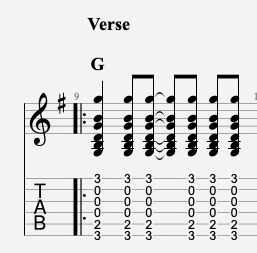
The feel for “She Loves You” is an 8th note rock feel. The main rhythm you can use for a strumming pattern would be an 8th note rhythm. In 4/4 time, 8th notes divide each beat into two equal parts, creating a steady, driving rhythm. The counting for 8th notes in a measure looks like this:
1 & 2 & 3 & 4 &
The numbers (1, 2, 3, 4) represent the main beats in the measure. The "&" divides each beat into two evenly spaced subdivisions.
When counted out loud, it sounds like:
"One-and, Two-and, Three-and, Four-and."
This gives the tune a consistent forward motion
However, instead of playing all 8th notes. I might combine them with a quarter and also a tie like this. Here’s an example of a strumming pattern in the style of “She Loves You”:
Conclusion
To wrap it up, “She Loves You” marks a moment in time of The Beatles epic music career. This is a fun tune to learn and has a lot to offer the progressing guitarist.
Keep practicing, and if you want to learn songs way faster, better understand the fretboard for lead and rhythm, and not waste years spinning your wheels with guitar, grab my free fretboard guide here right now:
Jon MacLennan
Like this blog post? Get Jon’s best guitar lessons straight to your inbox.
Discover the 5 easiest and fastest ways to play the blues scale anywhere on the neck with this FREE PDF GUIDE
