Paul Simon – “Slip Sliding Away” Chords & Guitar Lesson
“The nearer your destination, you know the more you’re slip sliding away.”
Ladies and gentlemen, here is a song with a lot of deep meaning behind it.
It’s from, in my opinion, one of the greatest songwriters of all time, Paul Simon.
Below, I’m going to share some insider tips on the guitar style behind it.
So grab your axe, and let’s dive into this “Slip Sliding Away” chords and guitar lesson!
Who wrote Slip Sliding Away?
“Slip Sliding Away” was originally written by Paul Simon and first released on his 1977 album Greatest Hits, Etc. It’s the first cut on the album. After this, a later version appeared on Paul Simon’s Concert in the Park and other compilations.
The song showcases Simon’s signature sound. He blends folk, pop, and masterful songwriting in a completely unique way. Lyrically, “Slip Sliding Away” is about the fleeting, ephemeral nature of life and love.
Lines like “Slip sliding away, you know the nearer your destination, the more you’re slip sliding away” hold a powerful emotional gravity to them.
Or how about, “He wore his passion for his woman like a thorny crown…”
Or, "A good day ain't got no rain, she said a bad day's when I lie in bed and think of things that might have been".
These lines cut like a knife.
Simon himself has said that the song reflects his contemplation of aging, lost opportunities, and the inevitability of change.
“Slip Sliding Away” was recorded at several studios in the mid-1970s, primarily in New York, during sessions that were part of Simon’s solo work following the end of Simon & Garfunkel’s regular projects.
Though it was released on a compilation rather than a standard studio album, “Slip Sliding Away” became one of Paul Simon’s most beloved tunes.
Now, you may be wondering…
What is the tuning for Slip Sliding Away?
The tuning for "Slip Sliding Away” is standard tuning. Simon kept things simple. Standard tuning is spelled: E, A, D, G, B, and E.
Here are the strings:
- E (6th string, lowest pitch)
- A (5th string)
- D (4th string)
- G (3rd string)
- B (2nd string)
- E (1st string, highest pitch)
Live, Simon often plays it without a capo.
However, to play along with the recording, he uses a capo on the 1st fret. This changes the strings too:
- F (6th string, lowest pitch)
- Bb (5th string)
- Eb (4th string)
- Ab (3rd string)
- C (2nd string)
- F (1st string, highest pitch)
All right!
Now that you know the tuning for “Slip Sliding Away,” let’s next talk about…
Slip Sliding Away Chords
To play “Slip Sliding Away”, as recorded by Paul Simon, you only need to know 7 main chords they are G, C/G, Em, D, C, C7, and F. These chords are a blend of open and bar chords.
If bar chords are giving you all kinds of aches and pains, and you haven’t yet discovered how to play them effortlessly, go here: https://www.jonmaclennan.com/barchords
Now, keep in mind, these chords are the capo chords.
Let’s take a look at a few ways these shapes might show up on the fretboard.
G is played in a common folk style using all 6 strings like this:

C/G keeps part of the previous folk-style G chord but combines it with a C shape like this:

Em is a beautiful open-sounding chord. It uses all 6 strings like this:

D is played from the 4th string down like so:

C is played in a common (campfire) style like this:

C7 adds the pinky and gets a bit bluesy like so:

Finally, we have F, a bar chord played in 1st position and uses all 6 strings like this:

If you’ve struggled to understand the fretboard for RHYTHM and LEAD guitar, and want to discover the easiest and fastest way. Then get your hands on my free Fretboard Guide PDF right here now:
Is Slip Sliding Away hard to play on guitar?
I would say playing “Slip Sliding Away” on guitar is going to require an intermediate skill level. The chords themselves are not too difficult. There is only 1 bar chord. However, getting the “feel” right (which is very light) and nailing the variations are where most of the work will be done. So, take your time with this one.
What key is Slip Sliding Away in?
“Slip Sliding Away”, as recorded by Eric Clapton, is in the key of Ab major. The primary scale for the song would be the Ab major scale, which is built using the notes Ab, Bb, C, Db, Eb, F, and G.
However, because Simon uses a capo on the 1st fret, he actually plays it in G on guitar.
So, let’s take a closer look at how these chords relate in the key of G major. Starting with…
G
Notes: G, B, D
Function: This is the I chord, the tonic of G major. It’s the home chord. All the other chords and riffs revolve around this tonal center.
C/G
Notes: C, E, G (with G in the bass)
Function: C/G is a variation on the IV chord in G major. It’s IV but with the tonic note in the bass. Harmonically, it functions exactly like C major, creating gentle movement away from G, but the G in the bass keeps the progression grounded. Simon uses this chord like a riff in the progression. Then we have…
Em
Notes: E, G, B
Function: Em is the vi chord in G major – a.k.a. the relative minor. It shares two notes with G major (G and B), and this makes transitions smooth from G to Em smooth. Em can also add a more reflective quality to the progression.
D
Notes: D, F#, A
Function: D is the V chord in G major. This is the dominant chord, and its main function is to create tension that strongly wants to resolve back to G. The F# is the leading tone of the key, pulling the ear upward toward the tonic and giving the progression forward momentum.
C
Notes: C, E, G
Function: C is the IV chord in G major. It creates a sense of movement away from the tonic without creating strong tension. It’s a nice resting point (in the key) before returning home to G.
C7
Notes: C, E, G, Bb
Function: C7 is basically a bluesy IV chord. It’s not diatonic to G major though. The added Bb note introduces a bluesy, dominant quality. This chord has a specific function of adding tension within the progression and then resolving back to the I chord (G).
F
Notes: F, A, C
Function: F major is outside the key of G major and is most commonly borrowed from the parallel minor key (G minor). It functions as a bVII chord or a sub-tonic. This is a very common sound in classic rock and folk music.
All right!
That’s my theory breakdown.
Next, let’s look at…
What is the strumming pattern for Slip Sliding Away?
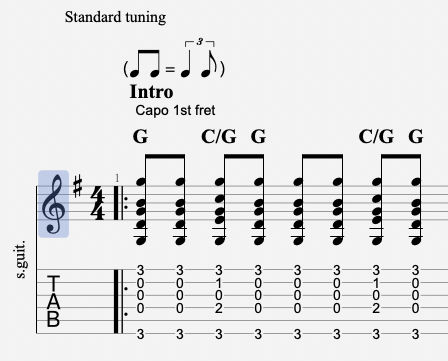
The main underlying groove for “Slip Sliding Away” is a peaceful folk style. It’s almost indifferent. The main rhythm you can use for a strumming pattern would be an 8th note rhythm. In 4/4 time, 8th notes divide each beat into two equal parts, creating a steady, driving rhythm. The counting for 8th notes in a measure looks like this:
1 & 2 & 3 & 4 &
The numbers (1, 2, 3, 4) represent the main beats in the measure. The "&" divides each beat into two evenly spaced subdivisions.
When counted out loud, it sounds like:
"One-and, Two-and, Three-and, Four-and."
This gives the tune a consistent forward motion
Here’s an example of a strumming pattern in the style of “Slip Sliding Away”:
Conclusion
Bottom line, “Slip Sliding Away” is some of Paul Simon’s best solo work. It’s a beautiful tune that has been reaching audiences around the globe since its release.
Keep practicing, and if you want to learn songs way faster, better understand the fretboard for lead and rhythm, and not waste years spinning your wheels with guitar, grab my free fretboard guide here right now:
Jon MacLennan
Like this blog post? Get Jon’s best guitar lessons straight to your inbox.
Discover the 5 easiest and fastest ways to play the blues scale anywhere on the neck with this FREE PDF GUIDE
