The ULTIMATE Smooth Chords & Guitar Lesson
Behold… a smash hit song that launched Carlos Santana’s legendary album, Supernatural, into the stratosphere.
Below, I’m going to share some insider tips on the guitar style behind it.
So grab your axe, and let’s dive into this “Smooth” chords and guitar lesson!
Who Wrote Smooth?
"Smooth" was written by Itaal Shur and Rob Thomas. The song has quite an interesting backstory. You see, in the late ‘90s, Santana was working on a comeback album, Supernatural, and looking to collaborate with younger artists to reach a newer audience. Clive Davis, then the head of Arista Records, suggested Rob Thomas, the frontman for Matchbox Twenty.
The genesis for “Smooth” began with Shur, who passed the track to Thomas, which at the time was called “Room 17”. Thomas then came up with different lyrics and melody inspired by his then-fiancée (now wife), Marisol Maldonado.
This woman is a babe.
And the song’s lyrics, like the "hot one" like "seven inches from the midday sun" to the "Spanish Harlem Mona Lisa" — paint the picture of their desire for each other. The phrase "you're so cool, my muñequita" (little doll) adds a personal touch.
Thomas was a huge fan of Santana, and the opportunity to collaborate was a dream come true. He also felt a deep connection to the Latin influence in the track because his girlfriend is Puerto Rican. Once Santana heard Thomas's demo for “Smooth,” he insisted Thomas be the one to sing the song for the album, rather than just write it.
From there, they recorded the track in just a couple of days at Record Plant studios in Sausalito, California.
"Smooth" was a massive success. I remember seeing the music video everywhere, and it became a cultural phenomenon, winning numerous accolades, including three major Grammys:
* Record of the Year
* Song of the Year
* Best Pop Collaboration with Vocals
"Smooth" spent an incredible 12 consecutive weeks at number one on the Billboard Hot 100. The success of "Smooth" launched Santana's album Supernatural into the stratosphere.
The album went on to sell over 15 million copies in the US and won eight Grammy Awards, tying Michael Jackson's record for Thriller.
Now, you may be wondering…
What is the tuning for Smooth?
The tuning for "Smooth," as recorded by Carlos Santana, is standard tuning. Standard tuning is spelled: E, A, D, G, B, and E.
Here are the strings:
- E (6th string, lowest pitch)
- A (5th string)
- D (4th string)
- G (3rd string)
- B (2nd string)
- E (1st string, highest pitch)
All right!
Now that you know the tuning for “Smooth”, let’s next talk about…
Smooth Chords
To play “Smooth”, as recorded by Carlos Santana, you’ll need to know 9 main chords they are Am, F/C, E7, Dm, Dm7/C, Bm7b5, G7, F#sus4, and F#7sus4/B. These chords are a blend of bar shapes and also open-position chords. If bar chords are giving you all kinds of aches and pains, and you haven’t yet discovered how to play them effortlessly, go here: https://www.jonmaclennan.com/7mistakes
Let’s take a look at a few ways these shapes can be played on the fretboard.
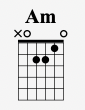
Am is played from the 5th string down in a standard (campfire) position like this:
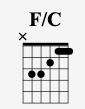
F/C is similar to an F bar chord in first position. However, on this one, we’ll just play from the 5th string down like so:
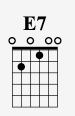
E7 is a beautiful chord and is played using all 6 strings like this:
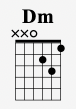
Dm is played from the 4th string down like so:
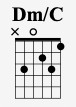
Dm7/C keeps the previous Dm shape, but lowers the bass note down to C on the 3rd fret, like this:
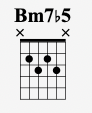
Bm7b5 is a common jazz chord played on the middle strings like this:
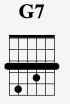
G7 is a standard dominant seventh bar chord shape played in 3rd position like this:
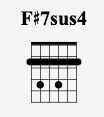
F#7sus4 is a big-sounding chord and is played using all 6 strings like this:
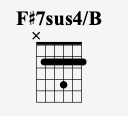
Finally, F#7sus4/B uses 2 fingers in the fretting hand, and is played from the 5th string down like so:
If you’ve struggled to understand the fretboard for RHYTHM and LEAD guitar, and want to discover the easiest and fastest way. Then get your hands on my free Fretboard Guide PDF right here now:
Is Smooth hard to play on guitar?
I would say playing “Smooth” on guitar is going to require a solid intermediate to advanced skill level. There are many hurdles a player must overcome like knowing sophisticated jazz chords, Latin-influenced sycopated rhythms, and then of course, Santana’s lead is unmistakable. So, take your time with this one.
What key is Smooth in?
“Smooth,” as recorded by Carlos Santana, is in the key of A minor. The primary scale used in the song is the A harmonic minor scale, which is built with the notes E, F#, G#, A, B, C, D, E, F, and G#.
Let’s take a look at how these chords relate in the key of A minor.
Am (A minor)
Notes: A, C, E
Function: This is the i chord (tonic) in A harmonic minor. It's the tonal center and provides a sense of "home" for the progression. All the other chords in this analysis relate back to this one.
F/C (F major with C in the bass)
Notes: F, A, C
Function: This is the bVI chord in A harmonic minor. The bVI is a common chord in minor keys, often providing a warm, contrasting sound to the minor tonic. Placing the 5th (C) in the bass gives it a root-like feel and a smoother voice-leading connection to the upcoming E7 chord.
E7 (E dominant 7th)
Notes: E, G#, B, D
Function: This is the V7 chord in A harmonic minor. The V7 is the most crucial chord for defining the key. The G# note, which is the leading tone in the A harmonic minor scale, creates strong tension that resolves naturally to the tonic (Am). This V7-i movement (E7-Am) is a defining characteristic of harmonic minor.
Dm (D minor)
Notes: D, F, A
Function: This is the iv chord in A harmonic minor. The iv chord is a standard minor key chord that usually leads to the V (E7) or i (Am).
Dm7/C (D minor 7th with C in the bass)
Notes: D, F, A, C
Function: This is the iv7 chord in A harmonic minor. The added 7th (C) adds a bit more color and melodic possibility. With the C in the bass, it acts as a passing chord, smoothly transitioning down to the…
Bm7b5 (B minor 7th flat 5)
Notes: B, D, F, A
Function: This is the iiØ7 (half-diminished) chord in A harmonic minor. In minor keys, the ii chord is often half-diminished and functions as a pre-dominant chord, meaning it's used to set up the V7. Its relationship to the V7 (Bm7b5 - E7 - Am) is a classic ii-V-i progression in the key of A minor.
F#sus4 (F sharp suspended 4th)
Notes: F#, B, C#
Function: This chord is a bit outside of the A harmonic minor scale. The F# and C# are not in the key. It's likely used as a borrowed chord and comes in the pre-chorus before the solo.
F#7sus4/B (F sharp 7th suspended 4th with B in the bass)
Notes: F#, B, C#, E
Function: This chord is linked to the previous chord and is part of a cycle of 4ths, getting back to the Am chord. F# → B → E – Am.
All right!
So that’s the theory. Next, let’s look at…
What is the strumming pattern for Smooth?
The main underlying feel for “Smooth” is a Latin-inspired 8th note rock. In 4/4 time, 8th notes divide each beat into two equal parts, creating a steady, walking rhythm like this:
1 & 2 & 3 & 4 &
The numbers (1, 2, 3, 4) represent the main beats in the measure. The "&" (pronounced "and") divides each beat into two evenly spaced subdivisions.
When counted out loud, it sounds like:
"One-and, Two-and, Three-and, Four-and."
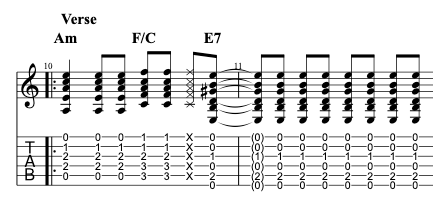
However, I don’t strum all 8th notes. Here’s an example of a “Smooth” style strumming pattern demonstrating different rhythms:
Smooth Guitar Lesson (SOLO)
A powerful scale Carlos Santana uses in the lead for this song is the harmonic minor scale. Here’s a lesson diving deeper into the lead guitar solo:
Conclusion
To wrap it up, “Smooth” was a smash hit. The powerful synergy of Santana’s masterful guitar work with Shur and Rob Thomas’ writing, plus, throw in a beautiful muñequita, and as they say, the rest is history.
Keep practicing, and if you want to learn songs way faster, better understand the fretboard for lead and rhythm, and not waste years spinning your wheels with guitar, grab my free fretboard guide here right now:
Jon MacLennan
Like this blog post? Get Jon’s best guitar lessons straight to your inbox.
Discover the 5 easiest and fastest ways to play the blues scale anywhere on the neck with this FREE PDF GUIDE
