Sade – Smooth Operator Chords & Guitar Lesson
Behold… One of the smoothest songs of the ‘80s.
It’s about a Playboy who's got a shiny exterior but leaves behind a trail of broken hearts.
Below, I’m going to share with you some insider tips on the guitar style behind it.
So grab your axe, and let’s dive into this “Smooth Operator” chords and guitar lesson!
Who Wrote Smooth Operator?
“Smooth Operator” was originally written by Nigerian-British singer-songwriter Sade Adu and Ray St. John. The song sings the story of a smooth and sophisticated man who travels the world and seduces women.
It was recorded in London during sessions for Sade’s debut album Diamond Life. “Smooth Operator” was released in 1984 as a single and quickly became one of the band’s most famous tunes. The track is heavily jazz-based. The chords have a sophisticated sound blending elements of soul, pop, and R&B. The production is also features Stuart Matthewman on saxophone. This combination of understated instrumentation and Sade’s warm, controlled voice created a distinctive sound that set the band apart from other 1980s pop acts.
“Smooth Operator” was a commercial and critical success, reaching the top five on the Billboard Hot 100 in the United States and topping charts internationally.
It solidified Sade’s reputation as a sophisticated and innovative band, earning praise for its cinematic quality and elegance.
Over the years, “Smooth Operator” has been etched into popular culture after being covered, sampled, and featured in numerous films and TV shows. The track’s success also helped launch Diamond Life to multi-platinum status, making Sade a household name.
Now, you may be wondering…
What is the tuning for Smooth Operator?
The tuning for "Smooth Operator” is standard tuning. Standard tuning is spelled: E, A, D, G, B, and E.
Here are the strings:
- E (6th string, lowest pitch)
- A (5th string)
- D (4th string)
- G (3rd string)
- B (2nd string)
- E (1st string, highest pitch)
All right!
Now that you know the tuning for “Smooth Operator”, let’s next talk about…
Smooth Operator Chords
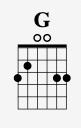
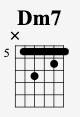
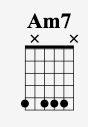
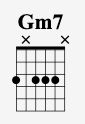
To play “Smooth Operator”, you only need to know 8 main chord shapes they are Dm, Dm/C#, Dm/C, G/B, G, Dm7, Am7, and Gm7. The majority of these chords are played as bar chords. If bar chords are giving you all kinds of aches and pains, and you haven’t yet discovered how to play them effortlessly, go here: https://www.jonmaclennan.com/7mistakes
Let’s take a look at a few ways these shapes can be played on the fretboard:
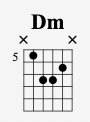
Dm is played on the middle strings in 5th position like this:
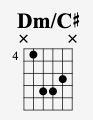
Dm/C# simply moves the root note down one fret from the previous chord:
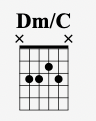
Dm/C is a tricky one. I play it on the middle strings like so:
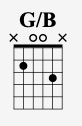
G/B is played as an open chord on the middle strings like this:
G uses all 6 strings like so:
Dm7 makes just a subtle change from the first chord Dm. Simply remove the pinkie and bar like this:
Am7 I play using my fretting hand thumb (Jimi Hendrix) style on the 6th string. However, the same chord can be played without the fretting hand thumb as well, like so:
Finally, Gm7 is the same as Am7, just shifted down two frets like this:
If you’ve struggled to understand the fretboard for RHYTHM and LEAD guitar, and want to discover the easiest and fastest way. Then get your hands on my free Fretboard Guide PDF right here now:
Is Smooth Operator hard to play on guitar?
I would say playing “Smooth Operator” on guitar is going to require an intermediate to advanced skill level. The trickiest parts are syncopated rhythms and sophisticated jazz-style chord voicings. These difficulties place it out of the beginner level and into a strong intermediate range. So, take your time with this one.
What key is Smooth Operator in?
“Smooth Operator”, as recorded by Sade, is in the key of D minor. The primary scale for the song is the D natural minor scale, which is built using the notes D, E, F, G, A, Bb, and C.
Let’s break down the chords and how they function in the key of D minor:
Dm
Notes: D, F, A
Function: This is the i chord, the tonic minor. It is "home”.
Dm/C♯
Notes: D, F, A, with C♯ in the bass
Function: This chord is not diatonic (it uses a note, C♯, that is not in the D natural minor scale). However, the point is to create a chromatic descending bass line from D all the way to B in the progression. This is part of what gives the progression its smooth sound.
Dm/C
Notes: D, F, A, with C in the bass
Function: This is the i chord in the first inversion, or a Dm7 chord with the root omitted. Again, this continues the descending bass line.
G/B
Notes: G, B, D, with B in the bass
Function: This chord is not diatonic as it uses a B natural (the major sixth), which is not in the D natural minor scale (which has B♭). However, it concludes the descending bass line.
D → C# → C → B
G
Notes: G, B, D
Function: This chord is not diatonic as it uses a B, but is a major chord built on the fourth degree. This is often seen as a borrowed chord from the D Dorian mode (which is very close to D natural minor).
Am7
Notes: A, C, E, G
Function: This is the v7 chord, the minor dominant 7th. It is the diatonic chord built on the fifth degree. While it functions as the dominant (V), the minor triad quality of Am gives it a less forceful, tension to go back to the tonic (Dm) than a major dominant chord would.
Gm7
Notes: G, B♭, D, F
Function: This is the iv7 chord, the subdominant minor 7th. It is the diatonic chord built on the fourth degree.
All right!
So that’s the theory. Next, let’s look at…
What is the strumming pattern for Smooth Operator?
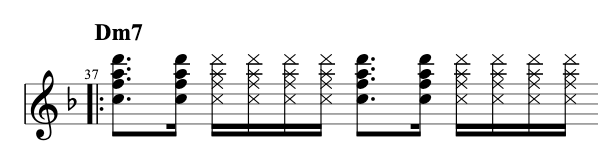
The main underlying feel for “Smooth Operator” is a funky 16th note groove. In 4/4 time, 16th notes divide each beat into four equal parts, creating a quicker, more flowing rhythm. The counting for 16th notes in a measure looks like this:
1 e & a 2 e & a 3 e & a 4 e & a
The numbers (1, 2, 3, 4) represent the main beats in the measure. The "e," "&," and "a" divide each beat into four evenly spaced subdivisions.
When counted out loud, it sounds like:
"One-ee-and-a, Two-ee-and-a, Three-ee-and-a, Four-ee-and-a."
Here’s an example of a strumming pattern in the style of “Smooth Operator”:
Conclusion
There ya have it!
A legendary song from the ‘80s that catapulted Sade’s career.
Keep practicing, and if you want to learn songs way faster, better understand the fretboard for lead and rhythm, and not waste years spinning your wheels with guitar, grab my free fretboard guide here right now:
Jon MacLennan
Like this blog post? Get Jon’s best guitar lessons straight to your inbox.
Discover the 5 easiest and fastest ways to play the blues scale anywhere on the neck with this FREE PDF GUIDE
