Red Hot Chili Peppers – “Snow” Chords & Guitar Lesson
Here’s one of the coolest rapid-fire guitar riffs from the 2000s…
It’s a song guitarists often spend months trying to master.
The flurry of hammer-ons and pull-offs make it quite exciting and challenging.
Below, I want to share with you some insider tips on the guitar style behind it.
So grab your axe, and let’s dive into this “Snow” chords and guitar lesson!
Who wrote Snow (Hey Oh)?
“Snow (Hey Oh)” was originally written by the four members of the Red Hot Chili Peppers — Anthony Kiedis, John Frusciante, Flea, and Chad Smith.
It’s all based around a simple guitar riff played by Frusciante. It’s a flurry of notes and instantly recognizable.
“Snow” first appeared on the band’s double album Stadium Arcadium released in 2006.
The song is about personal transformation and a clean slate. Given the band’s long history with addiction and recovery, many listeners interpret the song as reflecting those experiences, although its message is broad enough to apply to anyone trying to reinvent themselves.
“Snow” was recorded during the Stadium Arcadium sessions in 2005. Much of this album was done at The Mansion recording studio in Los Angeles with legendary producer Rick Rubin at the helm.
Rubin worked with the Chilis on several of their most successful records. The sessions stretched across much of 2005 and produced an enormous amount of material, eventually resulting in a 28-song double album.
Upon its release, the song became a major success. It was the Red Hot Chili Peppers’ third consecutive number-one hit from Stadium Arcadium on Billboard’s Modern Rock chart. It was also the band's eleventh song to reach number one on that chart.
Today, “Snow (Hey Oh)” remains one of the most-played and most-loved songs in the band's catalog.
Now, you may be wondering…
What is the tuning for Snow?
The tuning for "Snow” as recorded by the Red Hot Chili Peppers is standard tuning. John Frusciante kept things simple on the tuning. Standard tuning is spelled: E, A, D, G, B, and E.
Here are the strings:
- E (6th string, lowest pitch)
- A (5th string)
- D (4th string)
- G (3rd string)
- B (2nd string)
- E (1st string, highest pitch)
All right!
Now that you know the tuning for “Snow,” let’s next talk about…
Snow Chords
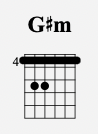
To play “Snow”, as recorded by the Red Hot Chili Peppers, you only need to know 5 main chords they are G#m, E, B, F#, and C#m9. The chords are primarily played as bar chord and Jimi Hendrix style thumb chord shapes.
If bar chords are giving you all kinds of aches and pains, and you haven’t yet discovered how to play them effortlessly, go here: https://www.jonmaclennan.com/barchords
Let’s take a look at a few ways these shapes might show up on the fretboard.
G#m can be played as a bar chord in the 4th position like this:
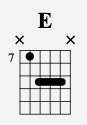
E can be played from the 5th string down like this:
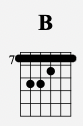
B is a bar chord in 7th position and uses all 6 strings like so:
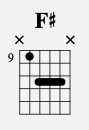
F# simple takes the E chord and moves it up 2 frets like this:
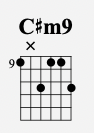
Finally, we have C#m9. This chord is played from the 4th string down like this:
If you’ve struggled to understand the fretboard for RHYTHM and LEAD guitar. and want to discover the easiest and fastest way. Then get your hands on my free Fretboard Guide PDF right here now:
Is Snow hard to play on guitar?
I would say playing “Snow” as recorded by the Red Hot Chili Peppers on guitar is going to require an advanced skill level. Now you can simplify it and just strum the song or use a capo to make it easier. But to play the arpeggio picking style used by John Frusciante with all the embellishments and at tempo, is quite difficult. So, take your time with this one.
What key is Snow in?
“Snow”, as recorded by the Red Hot Chili Peppers, is in the key of G# minor. The primary scale for the song is the G# minor scale, which is built using the notes G#, A#, B, C#, D#, E, and F#.
Let’s take a look at how these chords all function in the key of G# minor, starting with…
G#m
Notes: G#, B, D#
Function: This is the i chord, the tonic of G# minor. It’s the “home” chord everything else is based around. Because this is a minor key, G#m carries a darker, more introspective quality than a major-key tonic.
E
Notes: E, G#, B
Function: This is the VI chord in G# minor. It is one of the most common and stable supporting chords in a minor key. Because it shares two notes with G#m (G# and B), it feels closely related to the tonic while adding warmth and a subtle lift.
B
Notes: B, D#, F#
Function: This is the III chord in G# minor. It is the relative major chord and often serves as a bright contrast to the tonic minor. Since it shares two notes with G#m (B and D#), it feels connected to the key while providing a more major quality.
F#
Notes: F#, A#, C#
Function: This is the VII chord in G# natural minor. It’s a subtonic. Unlike a traditional dominant chord, it does not strongly pull back to the tonic. Instead, it creates a smooth, modal sound that is common in rock, pop, and alternative music.
C#m9
Notes: C#, E, G#, B, D#
Function: This is the iv chord in G# minor with an added 9th. The basic C#m harmony functions as the subdominant in the key. But this one has the added 9th (D#). It’s very Jimi Hendrix style.
Together, these chords form a classic natural minor progression built around i–VI–III–VII harmony.
All the chords are diatonic.
All right!
That’s my theory breakdown.
Next, let’s look at…
What is the strumming pattern for Snow?
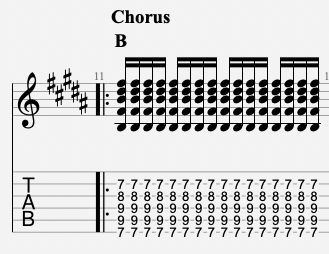
Here’s where things get a bit tricky. “Snow,” has a 16th note subdivision. In 4/4 time, 16th notes divide each beat into four equal parts, creating a faster, more detailed rhythmic subdivision like this:
1 e & a 2 e & a 3 e & a 4 e & a
The numbers (1, 2, 3, 4) represent the main beats in the measure, while the "e," "&," and "a" are the subdivisions that fall between the beats. These extra subdivisions add motion, precision, and rhythmic complexity to the groove.
When counted out loud, it sounds like:
"One-ee-and-uh, Two-ee-and-uh, Three-ee-and-uh, Four-ee-and-uh."
Here’s an example of a “Snow” style strumming pattern:
Conclusion
Bottom line, “Snow” is a spectacular guitar song. While challenging to play, the guitar part has a lot to offer the advancing guitarist.
Keep practicing, and if you want to learn songs way faster, better understand the fretboard for lead and rhythm, and not waste years spinning your wheels with guitar, grab my free fretboard guide here right now:
Jon MacLennan
Like this blog post? Get Jon’s best guitar lessons straight to your inbox.
Discover the 5 easiest and fastest ways to play the blues scale anywhere on the neck with this FREE PDF GUIDE
