The ULTIMATE Space Oddity Chords & Guitar Lesson
Here’s an example of “They just don’t make 'em like they used to!”
David Bowie was a musical genius, and below I want to share with you some insider tips on one of his most famous songs.
It’s got storytelling, drama, and an unparalleled emotion. Still to this day, it’s an incredibly unique and musical rollercoaster.
So grab your axe, and let’s dive into this “Space Oddity” chords and guitar lesson!
Who Wrote Space Oddity?
“Space Oddity” was written by the legend David Bowie. It was released first as a single in 1969, and then later included on his self-titled album in the U.S.
One thing I love about many great songs is…
THEIR STORIES.
“Space Oddity” tells the story of Major Tom, an astronaut who launches into space and has quite the journey. He experiences isolation and wonder, and the dangers of space to boot.
The song was recorded at Trident Studios in London in 1969, and the acoustic guitar drives a pretty big production. With instruments like Mellotron, stylophone, bass, electric guitars, and drums. The unique instrumentation and arrangement give the song an extraterrestrial sound.
When “Space Oddity” was released, it became Bowie’s first major hit, reaching number five on the U.K. singles chart.
Now, you may be wondering…
What is the tuning for Space Oddity?
The tuning for "Space Oddity” as recorded by David Bowie is standard tuning. Standard tuning is spelled: E, A, D, G, B, and E.
Here are the strings:
- E (6th string, lowest pitch)
- A (5th string)
- D (4th string)
- G (3rd string)
- B (2nd string)
- E (1st string, highest pitch)
All right!
Now that you know the tuning for “Space Oddity,” let’s next talk about…
Space Oddity Chords
To play “Space Oddity”, you’ll need to know 12 main chords they are Fmaj7/E, Em, C/G, Am, Am/G, D/F#, E7, F, Fm, Bb, G, and A. Some of these chords will be played as open chords and others as bar chord shapes. If bar chords are giving you all kinds of aches and pains, and you haven’t yet discovered how to play them effortlessly, go here: https://www.jonmaclennan.com/7mistakes
Let’s take a look at a few ways these shapes can be played on the fretboard:
Fmaj7/E is an interesting chord that kicks off the entire song. I play it like this:
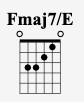
Em is played using all 6 strings like so:

C/G is played like a standard (campfire) chord. However, we'll add the low G note on the 3rd fret of the 6th string like this:

Am is played from the 5th string down like so:

Am/G walks the bass down from the previous chord. This is a move you’ll see many times throughout the song.

D/F# continues the descending bass idea. I play it like this:
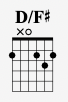
E7 is a great bluesy chord using all 6 strings like this:

F is a bar chord played in 1st position like so:

Fm is played using all 6 strings like this:

Bb comes in during the bridge section and is played as a bar chord like so:

G can be played in open position like this:

Finally, A is played 5th position as a bar chord like this:

If you’ve struggled to understand the fretboard for RHYTHM and LEAD guitar, and want to discover the easiest and fastest way. Then get your hands on my free Fretboard Guide PDF right here now:
Is Space Oddity hard to play on guitar?
I would say playing “Space Oddity” on guitar is going to require an intermediate to advanced skill level. The trickiest parts are all the different sections, bar chords, time signature changes, and unique harmony to piece together. It may appear simple. But simple doesn’t mean easy. So, take your time with this one.
What key is Space Oddity in?
“Space Oddity”, as recorded by David Bowie, is in the key of C major. The primary scale for the song is the C major scale, which is built using the notes C, D, E, F, G, A, and B.
However, not all the chords fit the diatonic scale of C major. It wanders around quite a bit. Let’s look at a quick breakdown of how all the chords relate in the key of C major. Starting with…
Fmaj7/E (F major 7th with E in the bass)
Notes: F, A, C, E (E in the bass)
Function: The core chord is an Fmaj7, which is the IVmaj7 chord (subdominant major 7th). By putting the E (the major 3rd of the C scale) in has a very interesting sound. This is the first chord in the song.
Em (E minor)
Notes: E, G, B
Function: This is the iii chord, the mediant. It is a diatonic chord and provides a sense of contrast from the I chord.
C/G (C major with G in the bass)
Notes: C, E, G (G in the bass)
Function: This is the I chord (tonic) in its second inversion. Placing the G (the perfect 5th) in the bass makes the chord feel extremely stable and grounded, almost like a strong anchor. This is ground control and feels like “home”.
Am (A minor)
Notes: A, C, E
Function: This is the vi chord, the relative minor. It shares two notes with the tonic (C). It sounds slightly melancholic and is a very common substitution for the I chord.
Am/G (A minor with G in the bass)
Notes: A, C, E (G in the bass)
Function: The core chord is the vi chord (Am). But this one is part of a descending bass line.
D/F♯ (D major with F♯ in the bass)
Notes: D, F♯, A (F♯ in the bass)
Function: The core chord is D major, which is not diatonic to C major (D minor is the ii chord). This chord is a secondary dominant, and is again a part of the descending bass line progression.
E7 (E dominant 7th)
Notes: E, G♯, B, D
Function: The core chord is E dominant 7th, which is not diatonic to C major (E minor is the iii chord). This chord is a secondary dominant, specifically the V/vi (Dominant of the submediant). The G♯ is the leading tone to A minor, and it creates a strong, temporary pull toward the A minor (vi) chord, making it feel briefly like the tonic, before returning to the home key of C.
F (F major)
Notes: F, A, C
Function: This is the IV chord, the subdominant. It is a stable, diatonic chord that is essential for movement away from the I chord.
Fm (F minor)
Notes: F, A♭, C
Function: This chord is a form of chromatic harmony called the Plagal Minor Subdominant or borrowed chord. The Beatles used it all the time.
B♭ (B♭ major)
Notes: B♭, D, F
Function: This chord is a borrowed chord from the parallel key of C minor, where B♭ is the VII chord (subtonic). It is also known as a flat-VII chord. It has a distinct "rock" or "pop" sound. This one comes in during the bridge.
G (G major)
Notes: G, B, D
Function: This is the V chord, the dominant. It is the most functionally critical chord after the tonic. The B is the leading tone of the C scale, giving this chord an extremely powerful drive to resolve back to the tonic (C).
A (A major)
Notes: A, C♯, E
Function: The core chord is A major, which is not diatonic to C major (A minor is the vi chord). This chord is a secondary dominant, specifically the V/ii (Dominant of the supertonic).
All right!
So that would be my theory breakdown. Next, let’s look at…
What is the strumming pattern for Space Oddity?
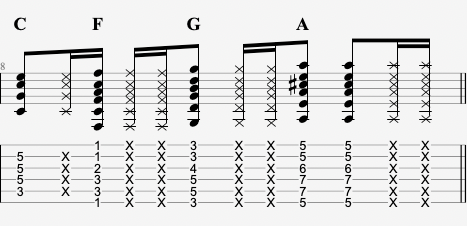
The main underlying feel for “Space Oddity” is a slow, percolating 16th note rock feel. In 4/4 time, 16th notes divide each beat into four equal parts, creating a quicker, more flowing rhythm. The counting for 16th notes in a measure looks like this:
1 e & a 2 e & a 3 e & a 4 e & a
The numbers (1, 2, 3, 4) represent the main beats in the measure. The "e," "&," and "a" divide each beat into four evenly spaced subdivisions.
When counted out loud, it sounds like:
"One-ee-and-a, Two-ee-and-a, Three-ee-and-a, Four-ee-and-a."
The guitar style blends a 16th-note rhythm with percussive strums and syncopations throughout. Here’s an example of a rhythm pattern in the style of “Space Oddity”:
Conclusion
Bottom line: “Space Oddity” is one of the most incredible songs I’ve ever heard. It showcases Bowie’s musical genius, and it’s still garnering new fans to this day.
So keep practicing, and if you want to learn songs way faster, better understand the fretboard for lead and rhythm, and not waste years spinning your wheels with guitar, grab my free fretboard guide here right now:
Jon MacLennan
Like this blog post? Get Jon’s best guitar lessons straight to your inbox.
Discover the 5 easiest and fastest ways to play the blues scale anywhere on the neck with this FREE PDF GUIDE
