The ULTIMATE Spooky Chords & Guitar Lesson
While not originally a Halloween song, this tune’s haunting title has made it a staple of countless Halloween playlists.
It also has a surprising and complex backstory to boot.
Below, I’m going to share some insider tips on the guitar style behind it.
So grab your axe, and let’s dive into this ULTIMATE “Spooky” chords and guitar lesson!
Who Wrote Spooky?
"Spooky" was originally written by saxophonist Mike Shapiro (who recorded under the name Mike Sharpe). It began as a jazzier, instrumental piece. But the song has a pretty interesting backstory.
You see, the first instrumental version recorded by Sharpe was a minor success. It reached number 57 on the U.S. pop charts in 1967. However, shortly after the rock group Classics IV got hold of it, and took the haunting melody and added lyrics. Their version became the most popular and brought the song to a whole new audience.
The song's lyrics describe a relationship with a "spooky little girl." The line, "love is kinda crazy with a spooky little girl like you," sums up the main theme of the song. The new words gave the song a completely different character, turning it into a psychedelic soul and pop hit. The vocalist on this version was Dennis Yost.
Upon release, the Classics IV version of “Spooky” reached number 3 on the U.S. Billboard Hot 100 in 1968 and number 1 in Canada.
It doesn’t end there, though…
After the Classics IV broke up, J.R. Cobb and another band member, Dean Daughtry, went on to form the Atlanta Rhythm Section (ARS). The Atlanta Rhythm Section also recorded “Spooky” in 1979, and it again became a hit, reaching number 17 on the Billboard Hot 100.
There was also another famous cover that flipped the gender and sang a "spooky little boy", and that was Dusty Springfield as well.
The song has quite a history.
Now, you may be wondering…
What is the tuning for Spooky?
The tuning for "Spooky” is standard tuning.
Standard tuning is spelled: E, A, D, G, B, and E.
Here are the strings:
- E (6th string, lowest pitch)
- A (5th string)
- D (4th string)
- G (3rd string)
- B (2nd string)
- E (1st string, highest pitch)
All right!
Now that you know the tuning for “Spooky”, let’s next talk about…
Spooky Chords
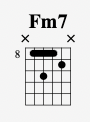
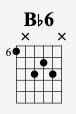
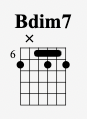
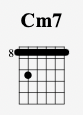
To play “Spooky”, you only need to know 4 main chords. Since the Classics IV version is the most famous, let’s take a look at the chords in that key they are Fm7, Bb6, Bdim7, and Cm7. For other versions, simply move the chords around the fretboard to change the key. Now, all of these chords are played as closed-position chords (bar chords).
If bar chords are giving you all kinds of aches and pains, and you haven’t yet discovered how to play them effortlessly, go here: https://www.jonmaclennan.com/7mistakes
Let’s take a look at a few ways these shapes can be played on the fretboard.
Fm7 is played on the middle strings in 8th position like this:
Bb6 I play with my fretting hand thumb on the 6th string. However, if that is uncomfortable for you, you can fret it with the index finger instead, like this:
Bdim7 is a beautiful chord that comes in halfway through the progression and is played like this:
Finally, Cm7 uses all 6 strings like this:
If you’ve struggled to understand the fretboard for RHYTHM and LEAD guitar, and want to discover the easiest and fastest way. Then get your hands on my free Fretboard Guide PDF right here now:
Is Spooky hard to play on guitar?
I would say playing “Spooky” on guitar is going to require a solid intermediate skill level. The progression is not too long or confusing. However, the chords are played as bar chords. And, there are also specific rhythms to nail. So these things push it beyond beginner level. So, take your time with this one.
What key is Spooky in?
“Spooky”, as recorded by the Classics IV, is in the key of F minor. However, the version recorded by Dusty Springfield is in the key of A minor. The version recorded by Atlanta Rhythm Section is in the key of Em. Let’s focus on the Classics IV version. For this one, the primary scale used in the song is the F natural minor scale, which is built with the notes F, G, Ab, Bb, C, Db, and Eb.
Let’s take a look at how these chords relate in the key of F minor.
Fm7 (F minor 7th)
Notes: F, A♭, C, E♭
Function: This is the i7 chord (tonic) in F natural minor. It’s the tonal center and provides a sense of "home" for the progression. All the other chords in this analysis relate back to this one.
Bb6 (B♭ major 6th)
Notes: B♭, D, F, G
Function: This chord is a bit outside of the F natural minor scale. The D natural is not in the key of F natural minor (which has D♭). It functions as a ii-V in the key of Eb major. However, I still would call the key F minor. The 6th (G) adds a brighter, more open sound than a standard B♭ major chord.
Bdim7 (B diminished 7th)
Notes: B, D, F, A♭
Function: This chord is used as a chromatic passing chord. You move from the Bb up to the B, and there is a break. It creates tension partway through the progression.
Cm7 (C minor 7th)
Notes: C, E♭, G, B♭
Function: This is the v7 chord in F natural minor. The v chord is a stable chord that is a common part of many minor key progressions. It has a smooth sound and often resolves back to the tonic.
All right!
So that’s the theory. Next, let’s look at…
What is the strumming pattern for Spooky?
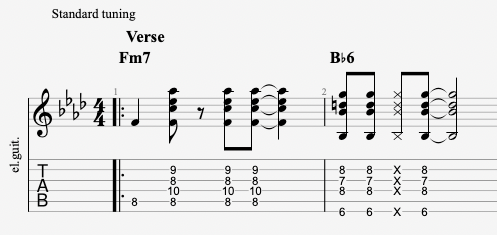
The main underlying feel for “Spooky” is a groovy 8th note rock feel. In 4/4 time, 8th notes divide each beat into two equal parts, creating a steady, walking rhythm like this:
1 & 2 & 3 & 4 &
The numbers (1, 2, 3, 4) represent the main beats in the measure. The "&" (pronounced "and") divides each beat into two evenly spaced subdivisions.
When counted out loud, it sounds like:
"One-and, Two-and, Three-and, Four-and."
Here’s an example of a strumming pattern in the style of “Spooky”:
Spooky Guitar Lesson (Atlanta Rhythm Section Version)
As mentioned above, ARS also covered this song. Their version moves the progression to the key of Em. Here’s a lesson on it:
Spooky Guitar Lesson (Dusty Springfield Version)
Spooky Guitar Lesson (Original Instrumental Version: Mike Sharpe)
Conclusion
To wrap it up, “Spooky” has a surprising backstory. Yet through all its twists & turns, each version has still had quite a bit of success. Once you start playing it, I think you'll see why.
So keep practicing, and if you want to learn songs way faster, better understand the fretboard for lead and rhythm, and not waste years spinning your wheels with guitar, grab my free fretboard guide here right now:
Jon MacLennan
Like this blog post? Get Jon’s best guitar lessons straight to your inbox.
Discover the 5 easiest and fastest ways to play the blues scale anywhere on the neck with this FREE PDF GUIDE
