The ULTIMATE – “Stand By Me” Chords & Guitar Lesson
Here's one of the most defining songs of the early ‘60s soul era.
It’s got a smooth vocal, incredible groove, and you only need 4 chords total to play it.
So, it’s a great song for newer players.
In this post, I’m going to share some insider tips on the guitar style behind it.
So grab your axe, and let’s dive into this “Stand By Me” chords and guitar lesson!
Who wrote Stand By Me?
“Stand by Me” was originally written by Ben E. King along with Jerry Leiber and Mike Stoller. The song is anchored in a groovy bass line and a simple chord progression, while the lyrics sing of love and devotion even in tumultuous times.
Released in 1961, “Stand By Me” became one of the defining songs of the early soul era. King’s smooth voice and spiritual music background gave the song depth.
The recording session took place at Atlantic Studios in New York City, with production by Leiber and Stoller. Reportedly, Stoller came up with the bass line. That repeating pattern, paired with Latin-tinged percussion and a silky string arrangement, created a timeless sound.
Upon its release, “Stand by Me” reached number four on the Billboard Hot 100 and number one on the R&B chart. It became King’s signature song and one of the most recognized tracks in American popular music. The song received further acclaim when it was included in the Stand by Me film, directed by Rob Reiner. This introduced the song to a new generation, and it was re-released, charting again in the late 1980s.
“Stand by Me” has been inducted into the Grammy Hall of Fame and preserved in the National Recording Registry by the Library of Congress for being culturally, historically, or aesthetically significant.
The song has also been covered hundreds of times by artists across genres, including John Lennon, whose 1975 version gave it a more relaxed, rootsy feel, and Tracy Chapman, among many others.
Now, you may be wondering…
What is the tuning for Stand By Me?
The tuning for "Stand By Me” as recorded by Ben E. King is standard tuning. Standard tuning is spelled: E, A, D, G, B, and E.
Here are the strings:
- E (6th string, lowest pitch)
- A (5th string)
- D (4th string)
- G (3rd string)
- B (2nd string)
- E (1st string, highest pitch)
All right!
Now that you know the tuning for “Stand By Me,” let’s next talk about…
Stand By Me Chords
To play “Stand By Me ”, as recorded by Ben E. King, you only need to know 4 main chords they are A, F#m, D, and E. These chords are a mix of bar and non-bar chord shapes.
If bar chords are giving you all kinds of aches and pains, and you haven’t yet discovered how to play them effortlessly, go here: https://www.jonmaclennan.com/barchords
Let’s take a look at a few ways these shapes might show up on the fretboard.
A is played from the 5th string down like so:

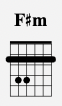
F#m is a bar chord played in 2nd position and uses all 6 strings like this:
D is played from the 4th string down in a simple (campfire) style like this:

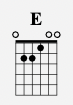
Finally, we have E. It's a beautiful-sounding open chord that uses all 6 strings like this:
If you’ve struggled to understand the fretboard for RHYTHM and LEAD guitar, and want to discover the easiest and fastest way. Then get your hands on my free Fretboard Guide PDF right here now:
Is Stand By Me hard to play on guitar?
I would say playing “Stand By Me” on guitar, as recorded by Ben E. King, is going to require an intermediate skill level. Now, if you play it with a capo, then that can make it a beginner level. But without, the trickiest parts are going to be the bar chord F#m, and also getting the bassline and strumming groove. So, take your time with this one.
What key is Stand By Me in?
“Stand By Me”, as recorded by Ben E. King, is in the key of A major. The primary scale for the song would be the A major scale, which is built using the notes A, B, C#, D, E, F#, and G#.
Let’s take a closer look at how these chords relate in the key of A major. Starting with…
A
Notes: A, C♯, E
Function: This is the I chord, the tonic of A major. It is the “home” chord. All other chords in the key ultimately relate back to this one tonal center.
F#m
Notes: F♯, A, C♯
Function: This is the vi chord in A major (a.k.a. the relative minor). F#m shares two notes with the tonic (A and C♯), which makes transitions smooth. The vi chord adds a slightly darker, more introspective color while still feeling connected to A.
D
Notes: D, F♯, A
Function: This is the IV chord, the subdominant in A major. It creates a gentle sense of movement away from the tonic without introducing strong tension.
E
Notes: E, G♯, B
Function: This is the V chord, the dominant of A major. E brings in tension with the leading tone G♯, which pulls strongly back to the tonic A. The V chord creates forward motion and resolves satisfyingly to the I chord.
This combination of I–vi–IV–V forms a classic progression in A major that’s used in millions of songs.
All right!
That’s my theory breakdown.
Next, let’s look at…
What is the strumming pattern for Stand By Me?
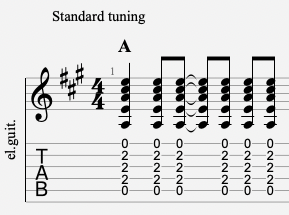
The main underlying groove for “Stand By Me” is a light ‘60s soul feel. The primary rhythm would be 8th notes. Remember, in 4/4 time, 8th notes divide each beat into two equal parts, creating a driving, steady rhythm like this:
1 & 2 & 3 & 4 &
The numbers (1, 2, 3, 4) represent the main beats in the measure, while the "&" represents the offbeats that add energy and momentum.
When counted out loud, it sounds like:
"One-and, Two-and, Three-and, Four-and."
This, along with the Latin percussion and backbeat give the song a strong and consistent forward motion.
Here’s an example of a strumming pattern in the style of “Stand By Me” :
Conclusion
Bottom line, “Stand By Me” is a classic. It works great playing solo, duo, or with a full band.
Keep practicing, and if you want to learn songs way faster, better understand the fretboard for lead and rhythm, and not waste years spinning your wheels with guitar, grab my free fretboard guide here right now:
Jon MacLennan
Like this blog post? Get Jon’s best guitar lessons straight to your inbox.
Discover the 5 easiest and fastest ways to play the blues scale anywhere on the neck with this FREE PDF GUIDE
