Brian Setzer – “Stray Cat Strut” Chords & Guitar Lesson
Here’s a song that carries with it the spirit of Rock & Roll.
It’s about a confident, independent man who's got style and class.
The guitar parts are also quite sophisticated, with fancy augmented and half-diminished chords.
Below, I want to share with you some insider tips on the guitar style behind it.
So grab your axe, and let’s dive into this “Stray Cat Strut” chords and guitar lesson!
Who wrote Stray Cat Strut?
“Stray Cat Strut” was originally written by Brian Setzer and recorded by his group, the Stray Cats. It first appeared in 1981 on their self-titled album. The song carries with it the spirit of Rock & Roll. It’s about an independent man who's got style and swagger.
Brian Setzer wrote this ditty when he was just eighteen years old.
While rehearsing in his parents' garage on Long Island, he wanted to write something slower than the band's usual high-energy rockabilly material.
At the time, the group was still called the Tomcats. But after moving to England, they changed their name to the Stray Cats. Setzer later joked that although the band was called the Stray Cats, all three members were actually dog lovers.
“Stray Cat Strut” was recorded in London after the band signed with Arista Records.
Their debut album was produced by Dave Edmunds, one of the great champions of roots rock and rockabilly. Edmunds understood both the authenticity of the 1950s sound and how to present it to a modern audience.
They struck gold.
Commercially, the song became one of the band's biggest successes. It reached No. 11 on the UK Singles Chart in 1981. In the United States, the first release barely registered, but after "Rock This Town" became a Top 10 hit, the record label re-released "Stray Cat Strut." The second time around, it became a major success, climbing to No. 3 on the Billboard Hot 100 in 1983.
Over the years, "Stray Cat Strut" has become one of Brian Setzer's signature performances.
Now, you may be wondering…
What is the tuning for Stray Cat Strut?
The tuning for "Stray Cat Strut” as recorded by the Stray Cats is standard tuning. Brian Setzer kept things simple on the tuning. Standard tuning is spelled: E, A, D, G, B, and E.
Here are the strings:
- E (6th string, lowest pitch)
- A (5th string)
- D (4th string)
- G (3rd string)
- B (2nd string)
- E (1st string, highest pitch)
Now, one thing to keep in mind with this song is the heavy use of the Bigsby whammy bar. It has a very unique sounds and bends all the strings at once. So, it can appear to sound in an alternate tuning.
But in fact, it’s just standard.
All right!
Now that you know the tuning for “Stray Cat Strut,” let’s next talk about…
Stray Cat Strut Chords
To play “Stray Cat Strut”, as recorded by the Stray Cats, you only need to know 8 main chords they are Cm, Bb7, Ab7, G7, Fm, Eb, Db, and C7. These chords are primarily played as bar chords.
If bar chords are giving you all kinds of aches and pains, and you haven’t yet discovered how to play them effortlessly, go here: https://www.jonmaclennan.com/barchords
Also, keep in mind that of these main chords, Setzer plays many variations up and down the neck.
Let’s take a look at a few ways these shapes might show up on the fretboard.
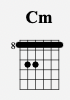
Cm is a bar chord using all 6 strings and can be played in 8th position like this:
Bb7 shifts down 2 frets, lifts off the pinky finger, and adds the middle finger on the 3rd string, like so:

Ab7 takes Bb7 and moves it down 2 more frets like this:

G7 does the same thing again, this time moving only 1 fret like so:

All right.
The next set of chords is the same type of progression. However, for these, the root notes have shifted down 1 string, beginning with Fm like this:

Eb shifts to a major chord like this:

Db is simply Eb, but two frets lower like so:

Finally, we have C7, which is played like this:

If you’ve struggled to understand the fretboard for RHYTHM and LEAD guitar. and want to discover the easiest and fastest way. Then get your hands on my free Fretboard Guide PDF right here now:
Is Stray Cat Strut hard to play on guitar?
I would say playing “Stray Cat Strut” as recorded by Brian Setzer on guitar is going to require an advanced skill level. The trickiest parts are the bar chords, the sophistication in harmony – meaning all the augmented and half-diminished chords he uses up and down the neck as variations on the main chords - and finally the solos. So, take your time with this one.
What key is Stray Cat Strut in?
“Stray Cat Strut”, as recorded by the Stray Cats, is in the key of C minor. The primary scale for the song is the C minor scale, which is built using the notes C, D, Eb, F, G, Ab, and Bb.
Let’s take a look at how these chords all function in the key of C minor, starting with…
Cm
Notes: C, Eb, G
Function: This is the i chord, the tonic of C minor. It’s the home base all the other chords are built around.
Bb7
Notes: Bb, D, F, Ab
Function: This is the VII7 chord in C natural minor. It’s a sub-tonic. The basic Bb chord is diatonic, but the added Ab creates a dominant seventh color used in the bluesy walkdown.
Ab7
Notes: Ab, C, Eb, Gb
Function: This is the VI7 chord. While Ab major is diatonic to C natural minor, the added Gb makes this a borrowed dominant-seventh color. Again, it’s just continuing the descending bass line progression.
G7
Notes: G, B, D, F
Function: This is the V7 chord in C harmonic minor. The B natural is borrowed from the harmonic minor scale and acts as a leading tone that strongly pulls upward to C.
Fm
Notes: F, Ab, C
Function: Fm is the iv chord in C minor. It functions as the subdominant. This chord moves the harmony away from the i chord but without traveling too far or creating tension.
Eb
Notes: Eb, G, Bb
Function: This is the III chord in C minor, also known as the relative major. It shares two notes with Cm (Eb and G). This makes switching between them flow easily.
Db
Notes: Db, F, Ab
Function: This is the bII chord, commonly known as the Neapolitan chord when used in first inversion, although in popular music it often appears in root position.
C7
Notes: C, E, G, Bb
Function: This is the I7 chord, a blues-inflected tonic chord. But it functions as a secondary dominant for the iv chord (Fm) as well.
Together, these chords combine elements of natural minor, harmonic minor, blues, and borrowed harmony.
All right!
That’s my theory breakdown.
Next, let’s look at…
What is the strumming pattern for Stray Cat Strut?
The main feel for “Stray Cat Strut” as recorded by the Stray Cats is an eighth-note swing feel. In 4/4 time, swing eighth notes divide each beat into a long-short pattern rather than two perfectly equal parts. Instead of feeling straight and even, the rhythm has a relaxed, bouncing groove to it.
The basic count still looks like this:
1 & 2 & 3 & 4 &
The numbers (1, 2, 3, 4) represent the main beats in the measure, while the "&" represents the offbeats. However, unlike straight 8th notes, the "&" is played slightly later, creating the characteristic swing feel.
When counted out loud, it sounds more like:
"One...and, Two...and, Three...and, Four...and."
or, more naturally,
"One-uh, Two-uh, Three-uh, Four-uh."
The key is that the first 8th note of each beat is held a little longer, while the second 8th note is played a little shorter. This long-short relationship creates the laid-back, swinging feel heard in blues, jazz, shuffle, and many classic rock and roll recordings.
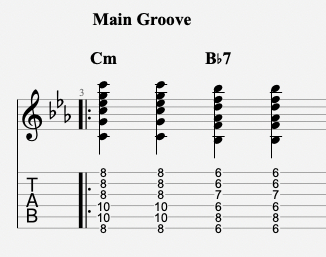
Now, that’s the feel. As far as strumming goes, a great place to start is to use a quarter note rhythm.
Here’s an example of a strumming pattern in the style of “Stray Cat Strut”:
Conclusion
Bottom line, “Stray Cat Strut” is one of Brian Setzer’s most iconic songs. The guitar is legendary and virtuosic all at once.
Keep practicing, and if you want to learn songs way faster, better understand the fretboard for lead and rhythm, and not waste years spinning your wheels with guitar, grab my free fretboard guide here right now:
Jon MacLennan
Like this blog post? Get Jon’s best guitar lessons straight to your inbox.
Discover the 5 easiest and fastest ways to play the blues scale anywhere on the neck with this FREE PDF GUIDE
