Sweet Dreams Chords & Guitar Lesson (Most Accurate)
True story:
The first version of this song I learned on guitar was actually the cover version done by Marilyn Manson.
But it’s a haunting song, touching on the complexities of human relationships and the music industry.
Below, I want to share some insider tips on the guitar style behind it.
So grab your axe, and let’s dive into this “Sweet Dreams” chords and guitar lesson!
Who Wrote Sweet Dreams?
“Sweet Dreams (Are Made of This)” was originally written by Annie Lennox and Dave Stewart – the British duo also known as Eurythmics. It’s one of the most iconic synth-pop songs of the 80s.
The song came about during a chaotic period following the breakup of their previous band, The Tourists, and their personal relationship. Lennox and Stewart were together however, they didn’t work out, but still remained musically active together.
Lennox described the lyrics as reflecting a sense of disillusionment and vulnerability, stating, "I was feeling very vulnerable. The song was an expression of how I felt: hopeless and nihilistic."
“Sweet Dreams” was recorded in a makeshift studio in the attic of an old warehouse in Chalk Farm, London. The duo used a Tascam 8-track recorder, a Soundcraft mixer, and various synthesizers, including a Roland SH-101 and a borrowed Oberheim OB-X. They had only one microphone, typically used for hi-hats, which they used for all recordings, including vocals.
That’s pretty incredible to make the whole track with one mic!
After losing access to their initial studio, they completed the recording in a small room at The Church Studios in Crouch End, London, which was then owned by animators and later became a renowned recording studio.
Despite initial skepticism from their record label, "Sweet Dreams" became a massive hit and climbed to #1 on the U.S. Billboard Hot 100.
In 2022, Eurythmics were inducted into the Rock & Roll Hall of Fame, performing "Sweet Dreams" at the ceremony.
Now, you may be wondering…
What is the tuning for Sweet Dreams?
The tuning for "Sweet Dreams" as recorded by Eurythmics is standard tuning. Standard tuning is spelled: E, A, D, G, B, and E.
Here are the strings:
- E (6th string, lowest pitch)
- A (5th string)
- D (4th string)
- G (3rd string)
- B (2nd string)
- E (1st string, highest pitch)
All right!
Now that you know the tuning for “Sweet Dreams”, let’s next talk about…
Sweet Dreams Chords
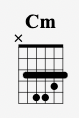
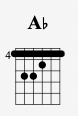
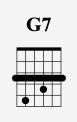
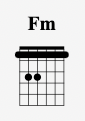
To play “Sweet Dreams”, as recorded by Eurythmics, you’ll only need to know 5 main chords they are Cm, Ab, G7, Fm, and F7. All of these chords are played as bar chords. If you have not discovered how to play effortless bar chords yet, go here: https://www.jonmaclennan.com/7mistakes
Let’s take a look at a few ways they can be played on the fretboard.
Cm is played in the 3rd position and from strings 5 down like this:
Ab is a similar shape, but this one shifts to the 4th position and uses all 6 strings like this:
G7 is played in 3rd position like this:
Fm is down on the 1st fret and uses all 6 strings like this:
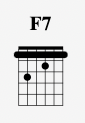
Finally, to play F7 from Fm, simply remove your pinky finger, and add the middle finger down on the 2nd fret 3rd string like this:
If you’ve struggled to understand the fretboard for RHYTHM and LEAD guitar. and want to discover the easiest and fastest way. Then get your hands on my free Fretboard Guide PDF right here now:
Is Sweet Dreams hard to play on guitar?
I would say playing “Sweet Dreams” on guitar requires a solid intermediate skill level. You’ll need to have competent single-note picking skills to play the riff. This includes several string skips and position changes. Plus, all the chords are bar chords. So if you haven’t learned to play effortless bar chords yet, you might want go here and read this free download: https://www.jonmaclennan.com/7mistakes
What key is Sweet Dreams in?
“Sweet Dreams,” as recorded by Eurythmics, is in the key of C minor. The primary scale I would use would be the C harmonic minor scale, which is built using the notes C, D, Eb, F, G, Ab, and B.
Here’s a quick look at how the chords relate in the key of C minor:
C minor (Cm)
Notes: C, Eb, G
Function: This is the i chord in the key of C minor.
It’s the tonic, or “home” chord. Everything in the key revolves around this sound. It has a melancholic, grounded feel typical of minor keys.
Ab major
Notes: Ab, C, Eb
Function: This is the VI chord in the key of C minor.
It brings a sense of warmth and lift. It shares two notes with Cm (C and Eb), which helps it sound smooth when moving between the two. Often used to break up the tension of the tonic.
G7
Notes: G, B, D, F
Function: This is the V7 chord in harmonic minor (borrowed from the C harmonic minor scale).
It’s the dominant chord and wants to resolve back to Cm. The B natural (instead of Bb) gives it a stronger pull back to the tonic.
F minor (Fm)
Notes: F, Ab, C
Function: This is the iv chord in the key of C minor.
It’s a minor subdominant, giving a mellow and introspective sound. It often leads to G7 or back to Cm, creating a gentle tension and release cycle.
F7
Notes: F, A, C, Eb
Function: This is a secondary dominant – specifically, the V7 of the ♭VII chord (F7 → Bb major). This chord only gets introduced in the C section of the song. This change creates a bluesy or jazzy color.
So that’s the theory. Next, let’s look at…
What is the strumming pattern for Sweet Dreams?
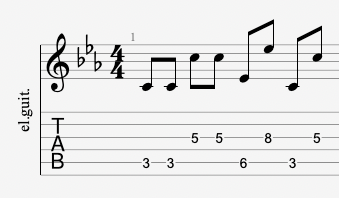
The main underlying groove for “Sweet Dreams” is a driving 8th-note rock feel. In 4/4 time, 8th notes divide each beat into two equal parts, creating a driving, steady rhythm like this:
1 & 2 & 3 & 4 &
The numbers (1, 2, 3, 4) represent the main beats in the measure, while the "&" represents the offbeats that add energy and momentum.
When counted out loud, it sounds like:
"One-and, Two-and, Three-and, Four-and."
This gives a strong and consistent forward motion to the tune. Here’s an example of a riff demonstrating this rhythm:
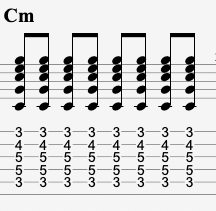
Now, here’s an example of a strumming pattern in the style of “Sweet Dreams”:
Conclusion
There you have it!
That’s a quick look at the guitar style behind the legendary song “Sweet Dreams”.
Keep practicing, and if you want to learn songs way faster, better understand the fretboard for lead and rhythm, and not waste years spinning your wheels with guitar, grab my free fretboard guide here right now:
Jon MacLennan
Like this blog post? Get Jon’s best guitar lessons straight to your inbox.
Discover the 5 easiest and fastest ways to play the blues scale anywhere on the neck with this FREE PDF GUIDE
