The ULTIMATE Sympathy for the Devil Chords & Guitar Lesson
Here’s a legendary song that began as a folk arrangement.
But later in the studio, The Rolling Stones brought in a pianist and a percussionist, and the song took on a whole new life.
Below, I’m going to share some insider tips on the RHYTHM & LEAD guitar style behind it.
So grab your axe, and let’s dive into this “Sympathy for the Devil” chords and guitar lesson!
Who Wrote Sympathy for the Devil?
“Sympathy for the Devil” was written by Mick Jagger, although it’s credited to the Jagger/Richards partnership. It’s the opening track on the Rolling Stones’ iconic album Beggars Banquet. Jagger came up with both the chords and the lyrics. He said later that Keith Richards helped shape the groove and was responsible for taking it from a folk ballad to an electric rocker.
That’s a pretty big contribution.
The song was recorded at Olympic Sound Studios in London in June 1968. Producer Jimmy Miller was at the helm and helped them develop it through a series of takes. In addition to The Rolling Stones, Miller brought in Nicky Hopkins on piano and Ghanaian percussionist Rocky Dzidzornu. The “woo‑woos” were all sung around one microphone. This gave them a killer “live” feel. They were filmed by Jean‑Luc Godard for the movie One Plus One (released in the US as Sympathy for the Devil).
Upon its release on December 6th, 1968, Beggars Banquet reached the Top 5 in both the US and UK. “Sympathy for the Devil” drew quite a bit of controversy and praise at the same time. Religious communities accused the band of being satanists, while many others described the song as “uplifting”.
Rolling Stone magazine ranked the track at #32 on its 2004 list of The 500 Greatest Songs of All Time (later #106 in 2021). And one other interesting fact is this…
During the production of this tune, a fire broke out in the studio and almost destroyed the tapes. Luckily, the engineer saved them.
Now, you may be wondering…
What is the tuning for Sympathy for the Devil?
The tuning for "Sympathy for the Devil," as recorded by The Rolling Stones, is standard tuning. Standard tuning is spelled: E, A, D, G, B, and E.
Here are the strings:
- E (6th string, lowest pitch)
- A (5th string)
- D (4th string)
- G (3rd string)
- B (2nd string)
- E (1st string, highest pitch)
However, Keith Richards often removed his 6th string. That would look more like this:
- A (5th string)
- D (4th string)
- G (3rd string)
- B (2nd string)
- E (1st string, highest pitch)
All right!
Now that you know the tuning for “Sympathy for the Devil”, let’s next talk about…
Sympathy for the Devil Chords
To play “Sympathy for the Devil”, as recorded by The Rolling Stones, you’ll need to know 7 main chords they are E, D, A, Esus4, B, Bsus4, and A/C#. However, you can break it down even further to just 4 core chords: E, D, A, and B. But these other variations add a little extra flavor to the sound. Let’s take a look at a few ways these shapes can be played on the fretboard.
E is played using all 6 strings like so:

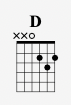
D is played from the 4th string down like this:
A is played from the 5th string down like this:

Esus4 just changes one note from E:

I play B as a bar chord in second position:

By the way... if bar chords are giving you all kinds of aches and pains, and you haven’t yet discovered how to play them effortlessly, go here: https://www.jonmaclennan.com/7mistakes
Bsus4 changes just one note from the previous B chord. This one goes like this:

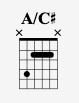
Finally, we have A/C#. This is like the open A chord above, but with the note C# as the bass note played on the 5th string, 4th fret like this:
If you’ve struggled to understand the fretboard for RHYTHM and LEAD guitar, and want to discover the easiest and fastest way. Then get your hands on my free Fretboard Guide PDF right here now:
Is Sympathy for the Devil hard to play on guitar?
I would say playing “Sympathy for the Devil” on guitar is going to require an intermediate skill level. There are quite a few roadblocks guitarists will need to overcome to play it. For example, bar chords, syncopated rhythms, and fast licks during the solo. So, take your time with this one.
What key is Sympathy for the Devil in?
“Sympathy for the Devil,” as recorded by The Rolling Stones, is in the key of E major. The primary scale used in the song is the E major scale, which is built with the notes E, F#, G#, A, B, C#, and D#.
Let’s break down how the core chords to “Sympathy for the Devil” function in the key of E major:
E (E major)
Notes: E, G♯, B
Function: This is the I chord in E major. This is the tonic and key center. It provides a strong sense of resolution. It sounds like “home”.
D (D major)
Notes: D, F♯, A
Function: This chord is not diatonic to E major. It functions as a ♭VII chord, or a sub-tonic. It’s a borrowed chord from the Mixolydian mode. D adds a raw and bluesy sound common in tons of classic rock.
A (A major)
Notes: A, C♯, E
Function: This is the IV chord in E major. It creates movement away from the tonic and often sets up a return to E or leads into the V chord (B).
B (B major)
Notes: B, D♯, F♯
Function: This is the V chord in E major—the dominant. It creates strong forward momentum and wants to resolve back to the tonic (E), especially when used at the end of a phrase.
So that’s the theory. Next, let’s look at…
What is the strumming pattern for Sympathy for the Devil?
The main underlying groove for “Sympathy for the Devil” is a funky 16th note groove. In 4/4 time, 16th notes divide each beat into four equal parts, creating a fast, intricate rhythm like this:
1 e & a 2 e & a 3 e & a 4 e & a
The numbers (1, 2, 3, 4) represent the main beats in the measure. The syllables “e,” “&,” and “a” divide each beat into evenly spaced subdivisions, giving the rhythm a more detailed and energetic feel.
When counted out loud, it sounds like:
“One-e-and-a, Two-e-and-a, Three-e-and-a, Four-e-and-a.”
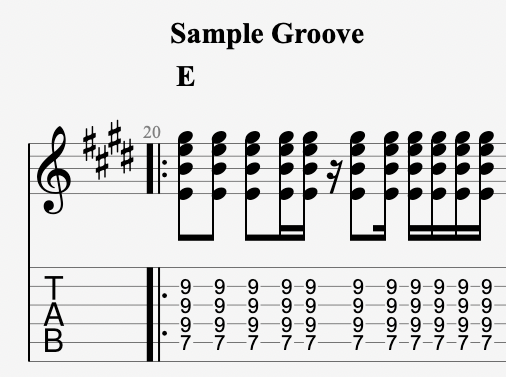
However, I wouldn’t strum all 16th notes. That’s going to be overkill. Instead, use a combination of rhythms and follow the percussion. Here’s an example of a strumming pattern in the style of “Sympathy for the Devil”:
Conclusion
To wrap it up, “Sympathy for the Devil” is a legendary yet controversial tune. Either way, the groove and guitar work are fantastic and great for improving your rock guitar playing.
Keep practicing, and if you want to learn songs way faster, better understand the fretboard for lead and rhythm, and not waste years spinning your wheels with guitar, grab my free fretboard guide here right now:
Jon MacLennan
Like this blog post? Get Jon’s best guitar lessons straight to your inbox.
Discover the 5 easiest and fastest ways to play the blues scale anywhere on the neck with this FREE PDF GUIDE
