The Champs – “Tequila” Chords & Guitar Lesson
Here's one of the most instantly recognizable instrumental hits in rock and roll history.
This one is all based around a simple Latin-inspired groove and a great saxophone melody.
In this post, I’m going to share some insider tips on the guitar style behind it.
So grab your axe, and let’s dive into this “Tequila” chords and guitar lesson!
Who wrote Tequila?
“Tequila” was originally written by saxophonist Danny Flores and recorded in 1957 by The Champs. It’s a catchy song that blends a pseudo-Latin groove with a rock and roll saxophone riff, and then just a single spoken word, “Tequila!”
This one word gives the track a playful, party-ready personality.
The origin story of “Tequila” is famously accidental. In December 1957, The Champs were at Gold Star Studios in Los Angeles, recording a song called “Train to Nowhere,” intended as the A-side of a single. They needed something quick to fill out the B-side, so Danny Flores suggested an instrumental he had written. The band ran through it a few times, and the recording was completed in about ten minutes. The spontaneous shout of “Tequila!” was reportedly improvised during the session.
When the single was released in early 1958, radio stations flipped the record and began playing the B-side, “Tequila”, instead. The song quickly caught fire and climbed to number one on the Billboard Hot 100 in March 1958. It became one of the first rock-and-roll instrumentals to top the charts and remains one of the most successful instrumental singles ever recorded.
“Tequila” won the Grammy Award for Best Rhythm & Blues Recording at the very first Grammy Awards ceremony in 1959. It has since been inducted into the Grammy Hall of Fame and continues to appear on lists of the greatest rock instrumentals of all time.
Now, you may be wondering…
What is the tuning for Tequila?
The tuning for "Tequila” as recorded by The Champs is standard tuning. Standard tuning is spelled: E, A, D, G, B, and E.
Here are the strings:
- E (6th string, lowest pitch)
- A (5th string)
- D (4th string)
- G (3rd string)
- B (2nd string)
- E (1st string, highest pitch)
All right!
Now that you know the tuning for “Tequila,” let’s next talk about…
Tequila Chords
To play “Tequila”, as recorded by The Champs, you only need to know 6 main chords they are F, Eb (or Cm7), Fdim7, F6/9, G7, and C7. These are a mix of bar and non-bar chords.
If bar chords are giving you all kinds of aches and pains, and you haven’t yet discovered how to play them effortlessly, go here: https://www.jonmaclennan.com/barchords
Let’s take a look at a few ways these shapes might show up on the fretboard.
F is a bar chord played with a root on the 5th string and in 8th position like this:

Eb (or Cm7) simply shifts the F chord down 2 frets. The reason why I say Eb (or Cm7) is because the guitar plays an Eb chord. But the bassist plays the note C. This changes the chord to a Cm7. In context, the bass player has the final say.

Fdim7 stays on those same middle strings like this:

F6/9 is a fun jazzy chord that hits higher up the neck as a stab in the Chorus section. I play it like this:

G7 looks like a C chord (just higher up the neck) and then adding a pinky finger like so:

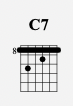
Finally, we have C7. This one is a bar chord using all 6 strings like this:
If you’ve struggled to understand the fretboard for RHYTHM and LEAD guitar, and want to discover the easiest and fastest way. Then get your hands on my free Fretboard Guide PDF right here now:
Is Tequila hard to play on guitar?
I would say playing “Tequila” on guitar, as recorded by The Champs, is going to require an intermediate skill level. The trickiest parts are the bar chords, the more sophisticated jazz shapes, and then, of course, getting the groove right, which is no easy feat. So, take your time with this one.
What key is Tequila in?
“Tequila”, as recorded by The Champs, is in the key of F. The primary scale for the song would be the F major scale, which is built using the notes F, G, A, Bb, C, D, and E.
Let’s take a closer look at how these chords relate in the key of F major. Starting with…
F
Notes: F, A, C
Function: F is the I chord, the tonic in the key of F major. It is the “home” chord, and all other chords in the progression relate back to this tonal center.
Cm7
Notes: C, Eb, G, Bb
Function: Cm7 is not diatonic to F major because it contains Eb instead of E natural. In the key of F major, C would normally be C7 (the V chord). Cm7 acts as a borrowed chord, most naturally from F minor (the parallel minor), where C minor is the v chord. This introduces a bluesier sound. It’s super common in rock and roll as well.
Fdim7
Notes: F, Ab, B, D
Function: Fdim7 is a fully diminished seventh chord built on the tonic. Again, this one is not diatonic to F major. Many songs use this idea, though. It’s very common in blues and jazz songs. It adds tension and instability, then resolves quickly back to I.
F6/9
Notes: F, A, C, D, G
Function: F6/9 is an embellished tonic chord. It is still functioning as I, but with added color tones: the 6th (D) and the 9th (G).
G7
Notes: G, B, D, F
Function: G7 is not diatonic to F major because of the B natural. In the key of F, G would normally be Gm (the ii chord). G7 is a secondary dominant, specifically V7 of V. Since C is the V chord in F major, and G7 is the dominant of C, this chord strongly pushes toward C7.
C7
Notes: C, E, G, Bb
Function: C7 is the V7 chord in F major. It contains the leading tone E, which strongly pulls to F. The tritone between E and Bb creates the characteristic dominant tension that resolves to the tonic.
Taken together, these chords create a beautiful sound that fits the song.
All right!
That’s my theory breakdown.
Next, let’s look at…
What is the strumming pattern for Tequila?
The main underlying groove for “Tequila” is a pseudo-Latin rock feel. The primary rhythm would be 8th notes. Remember, in 4/4 time, 8th notes divide each beat into two equal parts, creating a driving, steady rhythm like this:
1 & 2 & 3 & 4 &
The numbers (1, 2, 3, 4) represent the main beats in the measure, while the "&" represents the offbeats that add energy and momentum.
When counted out loud, it sounds like:
"One-and, Two-and, Three-and, Four-and."
This gives a strong and consistent forward motion to the tune.
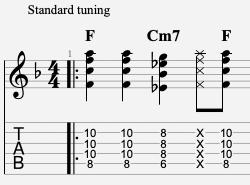
Here’s an example of a strumming pattern in the style of “Tequila” :
Conclusion
Bottom line, “Tequila” is one of the most instantly recognizeable instrumentals hits in rock and roll history. The guitar part is a total blast to play, and it’s easy to get the crowd singing along.
Keep practicing, and if you want to get better at this bluesy style, then grab my FREE blues scale PDF guide here right now:
Like this blog post? Get Jon’s best guitar lessons straight to your inbox.
Discover the 5 easiest and fastest ways to play the blues scale anywhere on the neck with this FREE PDF GUIDE
