The ULTIMATE “The Letter” Chords & Guitar Lesson
Here’s one of the most defining songs of late ‘60s rock…
It’s an extremely short song, but it's had a HUGE impact.
Below, I’m going to share some insider tips on the guitar style behind it.
So grab your axe, and let’s dive into this “The Letter” chords and guitar lesson!
Who wrote The Letter?
“The Letter” was originally written by American musician and songwriter Wayne Carson. It was first recorded and released in 1967 by the American rock band The Box Tops.
It’s now considered one of the defining singles of the late ‘60s. “The Letter” clocks in at 1:57 seconds, so it’s incredibly concise but still packs a punch. The premise of the song is simple: a man receives a letter from his lover asking him to come home. He bolts into action, buys a ticket for an aeroplane, and can’t leave fast enough.
The rhythm section also mirrored this energy in a driving, brisk feel.
The version that became famous was recorded at American Sound Studio in Memphis, Tennessee. This studio became a big part of shaping the Southern soul sound.
Dan Penn and Chips Moman produced it, and they used the studio’s house musicians, who later became known as the Memphis Boys.
One of the most incredible parts of this recording is the vocal performance laid down by Alex Chilton, who was only sixteen years old at the time. But he sang a raspy, soulful take that instantly had a vibe.
Upon its release in 1967, “The Letter” shot up to number one on the Billboard Hot 100. It also topped charts internationally, selling over four million copies. Its success helped establish The Box Tops as a major act during the late ‘60s.
Over the years, the song has endured. It’s caught the ear of many younger generations and was also inducted into the Grammy Hall of Fame, acknowledging its historical and artistic significance.
Joe Cocker later recorded a famous cover of “The Letter” as well in 1969. His version mixed it up a bit. He changed the chords, added a more funky boogaloo rhythm to it, and also a riff.
Here’s a quick lesson on his version as well:
Now, you may be wondering…
What is the tuning for The Letter?
The tuning for "The Letter” is standard tuning. Standard tuning is spelled: E, A, D, G, B, and E.
Here are the strings:
- E (6th string, lowest pitch)
- A (5th string)
- D (4th string)
- G (3rd string)
- B (2nd string)
- E (1st string, highest pitch)
However, to play along with the Joe Cocker version, you’ve got to capo on the 1st fret. This then changes the strings too:
- F (6th string, lowest pitch)
- Bb (5th string)
- Eb (4th string)
- Ab (3rd string)
- C (2nd string)
- F (1st string, highest pitch)
All right!
Now that you know the tuning for “The Letter,” let’s next talk about…
The Letter Chords
To play “The Letter”, as recorded by The Box Tops, you’ll need to know 6 main chords they are Am, F, G, D, E, and C. These chords are a blend of open and bar chord shapes. Then, you can use all bar chords to handle the fadeout modulation.
If bar chords are giving you all kinds of aches and pains, and you haven’t yet discovered how to play them effortlessly, go here: https://www.jonmaclennan.com/barchords
Let’s take a look at a few ways these shapes might show up on the fretboard.
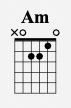
Am is a very common shape played from the 5th string down like this:
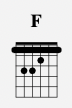
F is a bar chord played in 1st position and uses all 6 strings like this:
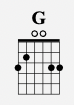
G is played in a folk style using all 6 strings like this:
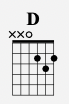
D is played from the 4th string down like this:
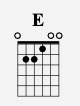
E is a beautiful open-sounding chord. It uses all 6 strings like this:
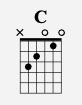
Finally, we have C. This one is played in a typical (campfire) style like this:
If you’ve struggled to understand the fretboard for RHYTHM and LEAD guitar, and want to discover the easiest and fastest way. Then get your hands on my free Fretboard Guide PDF right here now:
Is The Letter hard to play on guitar?
I would say playing “The Letter” on guitar is going to require an intermediate skill level. The trickiest parts are the fast rhythm, bar chords, and then the modulation at the end. However, all of these things are great skills to practice and acquire. So, take your time with this one.
What key is The Letter in?
“The Letter”, as recorded by The Box Tops, is in the key of A minor/C major. The primary scale for the song would be the C major scale, which is built using the notes C, D, E, F, G, A, and B.
The verse tends to lean more to the relative minor, A minor. While the chorus section is clearly in C major.
Let’s take a closer look at how these chords relate in the key of C major. Starting with…
Am
Notes: A, C, E
Function: Am is the vi chord in the key of C major. It is sometimes called the relative minor and shares two notes with the tonic (C and E). This makes transitions between C and Am smooth and easy.
F
Notes: F, A, C
Function: F is the IV chord in C major. F moves the harmony away from the tonic without creating strong tension. It gives you a lift and an alternate resting place, before moving back to C or toward the dominant chord G.
G
Notes: G, B, D
Function: G is the V chord in C major. G creates tension that strongly wants to resolve back to C. The B note is the leading tone and pulls the harmony towards the tonic. G can also be called the dominant chord.
D
Notes: D, F#, A
Function: D is not diatonic to C major because of the F# note. However, it’s a sound very common to this era – think “House of the Rising Sun” style.
E
Notes: E, G#, B
Function: E is also non-diatonic in C major due to the G#. It typically functions as V of Am (V/vi). This creates a feeling of A minor instead of C major, which happens momentarily in the verse.
C
Notes: C, E, G
Function: C is the I. It’s the “home” chord – everything else revolves around this main tonal center.
At the very end of the tune, on the fadeout, there is a modulate. The song goes up ½ step to Db major. If you want to play along with the recording, keep that in mind and use bar chords to do this.
If bar chords are giving you all kinds of aches and pains, and you haven’t yet discovered how to play them effortlessly, go here: https://www.jonmaclennan.com/barchords
All right!
That’s my theory breakdown.
Next, let’s look at…
What is the strumming pattern for The Letter?
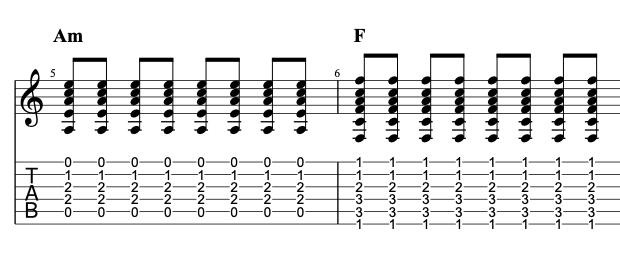
The main underlying feel for “The Letter” is a brisk 8th note rock feel. It’s not a bashing rock feel but more of a ‘60s rock. Remember in 4/4 time, 8th notes divide each beat into two equal parts, creating a steady, walking rhythm. The counting for 8th notes in a measure looks like this:
1 & 2 & 3 & 4 &
The numbers (1, 2, 3, 4) represent the main beats in the measure. The "&" divides each beat into two evenly spaced subdivisions.
When counted out loud, it sounds like:
"One-and, Two-and, Three-and, Four-and."
Conclusion
Bottom line, at just 16 years old, Alex Chilton and the Box Tops created history in “The Letter”. This tune is a ton of fun to play and has so much in it that guitarists can learn from.
So, keep practicing, and if you want to learn songs way faster, better understand the fretboard for lead and rhythm, and not waste years spinning your wheels with guitar, grab my free fretboard guide here right now:
Jon MacLennan
Like this blog post? Get Jon’s best guitar lessons straight to your inbox.
Discover the 5 easiest and fastest ways to play the blues scale anywhere on the neck with this FREE PDF GUIDE
