The Beatles – “The Long And Winding Road” Chords & Guitar Lesson
Here’s one of Paul McCartney’s most moving ballads.
He plays it on the piano, but below, I’m going to share some insider tips on the guitar style behind it.
So grab your axe, and let’s dive into this “The Long And Winding Road” chords and guitar lesson!
Who wrote The Long And Winding Road?
“The Long and Winding Road” was written primarily by Paul McCartney but credited under the Lennon/McCartney songwriting partnership. It’s widely regarded as one of Paul McCartney’s most emotional ballads.
The song is a slow metaphorical journey with themes of heartache, pain, and a sense of exhaustion. But it also has a hint of positivity as well.
The song was recorded during the Let It Be sessions at Apple Studios and later at EMI Studios (now Abbey Road Studios) in London in early 1969. It was produced by Phil Spector, who ended up adding a larger orchestration with a full choir and strings. McCartney was hesitant at first because he didn’t want the song to lose it’s intimate, piano-based essence.
Upon its release, “The Long and Winding Road” became a number one hit on the Billboard Hot 100 in the United States in 1970. It also reached number one in several other countries.
It has also inspired a number of great cover versions as well like, Aretha Franklin’s take:
And George Benson’s:
It’s a masterful composition with a bittersweet feeling that has resonated with many.
Now, you may be wondering…
What is the tuning for The Long And Winding Road?
The tuning for "The Long And Winding Road” as recorded by The Beatles is standard tuning. Standard tuning is spelled: E, A, D, G, B, and E.
Here are the strings:
- E (6th string, lowest pitch)
- A (5th string)
- D (4th string)
- G (3rd string)
- B (2nd string)
- E (1st string, highest pitch)
All right!
Now that you know the tuning for “The Long And Winding Road,” let’s next talk about…
The Long And Winding Road Chords
To play “The Long And Winding Road”, as recorded by The Beatles, you’ll need to know 11 main chords they are Cm, Ab/Bb, Eb, Eb7, Ab, Gm, Fm, Bb7, Db/Eb, Eb/Bb, and Eb/G. These chords are all bar chord shapes.
If bar chords are giving you all kinds of aches and pains, and you haven’t yet discovered how to play them effortlessly, go here: https://www.jonmaclennan.com/barchords
Let’s take a look at a few ways these shapes might show up on the fretboard.
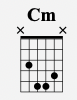
Cm is played in 3rd position with a root on the 5th string like this:
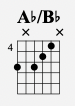
Ab/Bb is a great slash chord. I play it like this:
Eb is another bar chord with a root on the 5th string. I play it in 6th position like so:

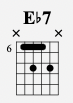
Eb7 gets a little bluesy. I play it like this:
Ab uses all 6 strings and has a root on the 6th string as well:

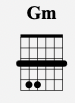
Gm is bar chord played in 3rd position like this:
Fm shifts the Cm shape above up to the 8th position like this:
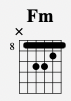
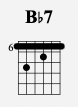
Bb7 is played using all 6 strings like this:
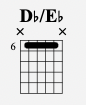
Db/Eb sounds complicated, but you only need 1 finger (in the fretting hand) to play it:
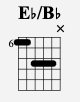
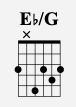
Finally, we have two more slash chords Eb/Bb and Eb/G like this:
If you’ve struggled to understand the fretboard for RHYTHM and LEAD guitar, and want to discover the easiest and fastest way. Then get your hands on my free Fretboard Guide PDF right here now:
Is The Long And Winding Road hard to play on guitar?
I would say playing “The Long And Winding Road” on guitar, as recorded by The Beatles, is going to require an intermediate skill level. The song itself is only 2 sections; however, the trickiest parts are all the bar chords. The song is very piano-driven, and when translating that over to guitar (without a capo) often requires more fluency with the fretboard. So, take your time with this one.
What key is The Long And Winding Road in?
“The Long And Winding Road”, as recorded by The Beatles, is in the key of Eb major. The primary scale for the song would be the Eb major scale, which is built using the notes Eb, F, G, Ab, Bb, C, and D.
Let’s take a look at how the main chords all function in the key of Eb major.
Cm
Notes: C, Eb, G
Function: Cm is the vi chord in the key of Eb major (sometimes called the relative minor). Cm shares two notes with the tonic chord (Eb and G), so it feels closely connected while adding an introspective sound.
Ab/Bb
Notes: Bb, Ab, C, Eb
Function: This is simply an Ab major chord over a Bb bass note. It functions much like a suspended dominant chord, similar to Bb11 or Bb7sus4. In the key of Eb, it acts as a V-sus type sound.
Eb
Notes: Eb, G, Bb
Function: This is the I chord, the tonic of Eb major. It’s “home”, and has a restful sound.
Eb7
Notes: Eb, G, Bb, Db
Function: This is a dominant seventh built on the tonic note, making it non-diatonic in strict Eb major because of the Db. It’s a secondary dominant chord leading to Ab, which is the IV chord. It’s a V7/IV.
Ab
Notes: Ab, C, Eb
Function: Ab is the IV chord in Eb major. This one provides a stable sound away from the tonic while still staying in the key.
Gm
Notes: G, Bb, D
Function: Gm is the iii chord in Eb major. It shares two notes with the tonic chord (G and Bb), making it great for smooth transitions. It often works as a passing chord between Eb and Cm or as a bridge to Fm and Bb7 (like it does in “The Long And Winding Road”).
Fm
Notes: F, Ab, C
Function: This is the ii chord in Eb major, or the supertonic. It’s used in a very common chord progression called a ii–V–I movement.
Bb7
Notes: Bb, D, F, Ab
Function: Bb7 is the V7 chord, the dominant in Eb major. This one builds a strong tension that resolves naturally back to Eb. The note D acts as the leading tone, pulling the energy toward Eb.
Db/Eb
Notes: Eb, Db, F, Ab
Function: This is simply a Db major triad over an Eb bass note. Functionally, it acts very much like an Eb7sus4. It’s another secondary dominant not in the key of Eb major diatonically.
Eb/Bb
Notes: Bb, Eb, G
Function: This is the tonic chord in second inversion, with the fifth in the bass. This chord comes in during the bridge and has a very strong sound.
And finally…
Eb/G
Notes: G, Bb, Eb
Function: Eb/G is simply a variation on the tonic chord. It’s the I chord in first inversion, which means the third is in the bass. It still functions as the I chord but gives a softer and more flowing bass line.
Taken together, these chords create a rich palette to choose from in the key of Eb major.
All right!
That’s my theory breakdown.
Next, let’s look at…
What is the strumming pattern for The Long And Winding Road?
The main underlying groove for “The Long And Winding Road” is a rock power ballad. In 4/4 time, 8th notes divide each beat into two equal parts, creating a driving, steady rhythm like this:
1 & 2 & 3 & 4 &
The numbers (1, 2, 3, 4) represent the main beats in the measure, while the "&" represents the offbeats that add energy and momentum.
When counted out loud, it sounds like:
"One-and, Two-and, Three-and, Four-and."
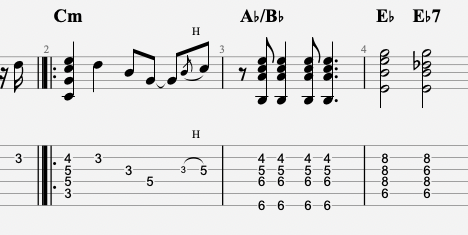
However, instead of strumming all of these 8th notes, what I would do is play a combination of rhythms. Here’s an example of how I might play in the style of “The Long And Winding Road”:
Conclusion
To wrap it up, “The Long And Winding Road” is one of Paul McCartney’s most moving ballads and was a big part of making the iconic album Let It Be so successful.
So keep practicing, and if you want to learn songs way faster, better understand the fretboard for lead and rhythm, and not waste years spinning your wheels with guitar, grab my free fretboard guide here right now:
Jon MacLennan
Like this blog post? Get Jon’s best guitar lessons straight to your inbox.
Discover the 5 easiest and fastest ways to play the blues scale anywhere on the neck with this FREE PDF GUIDE
