AC/DC – TNT Chords & Guitar Lesson
Is this the EASIEST AC/DC riff?
AC/DC has some of the best fist-pumping stadium riffs I’ve ever done heard, and this tune is a shining example.
You only need 3 chords to play it.
Below, I’m going to share some insider tips on the guitar style behind it.
So grab your axe, and let’s dive into this “TNT” chords and guitar lesson!
Who Wrote TNT?
“TNT” was written by brother guitarists Angus and Malcolm Young, plus AC/DC’s lead singer at the time, Bon Scott.
This song is pure rock and roll energy. The “Oi! Oi! Oi!” chant became one of AC/DC’s most epic stadium anthems. The recording for “TNT” took place in 1975 at Albert Studios in Sydney, Australia, with producers Harry Vanda and George Young at the helm.
It was released that same year in December on AC/DC’s album ”TNT”. The next year (1976), it was featured on their first international release, High Voltage.
In Australia, it was a major hit, reaching #11 on the Kent Music Report Singles Chart.
The riff itself is a perfect example of AC/DC’s “less is more” approach: simple power chords, huge groove, unstoppable raw energy. In the U.S. and worldwide, it became one of AC/DC’s signature songs, though it wasn’t initially released as a single outside Australia.
To this day, it’s considered one of the greatest hard rock songs of all time.
Now, you may be wondering…
What is the tuning for TNT?
The tuning for "TNT," as recorded by AC/DC, is standard tuning. The band kept things simple. Standard tuning is spelled: E, A, D, G, B, and E.
Here are the strings:
- E (6th string, lowest pitch)
- A (5th string)
- D (4th string)
- G (3rd string)
- B (2nd string)
- E (1st string, highest pitch)
However, it sounds like the recording was slightly slowed down. So this makes the instruments a little flat.
But, when you listen to the live versions, it’s E standard.
All right!
Now that you know the tuning for “TNT”, let’s next talk about…
TNT Chords
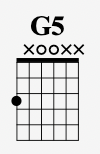
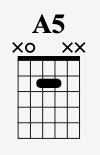
To play “TNT”, as recorded by AC/DC, you’ll need to know 3 main chords they are E, G5, and A5. These chords are all played in the first 3 frets.
Let’s take a look at a few ways these shapes can be played on the fretboard.
E is played from the 6 string down like so:
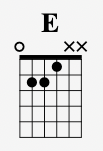
G5 is played with some sneaky muting in the fretting hand like this:
Finally, A5 is played with just the index finger of the fretting hand like this:
If you want to get better at this bluesy style and master the fretboard for rhythm and lead, then grab my FREE blues scale PDF guide here right now:
Is TNT hard to play on guitar?
I would say playing “TNT” on guitar is going to require a late beginner to intermediate skill level. The song only uses 3 chords, so from that perspective, it’s great for beginners. However, the rhythms and muting can make it a bit tricky. So, take your time with this one.
What key is TNT in?
“TNT,” as recorded by AC/DC, is in the key of E major. The primary scale used in the song is the E minor blues scale, which is built with the notes E, G, A, Bb, B, and D.
There are a couple of ways of thinking about the blues scale in terms of formulas. You could think of it in intervals in relation to a root note, or you could also build the scale through a series of half-steps and whole-steps.
Let’s look at each, starting with intervals. The 6 notes of a blues scale in intervals would go like this:
1 (root note)
b3 (minor third)
4 (perfect fourth)
b5 (diminished fifth)
5 (perfect fifth)
b7 (minor seventh)
Now this could be played starting on the open 6th string for an E minor blues scale like this:
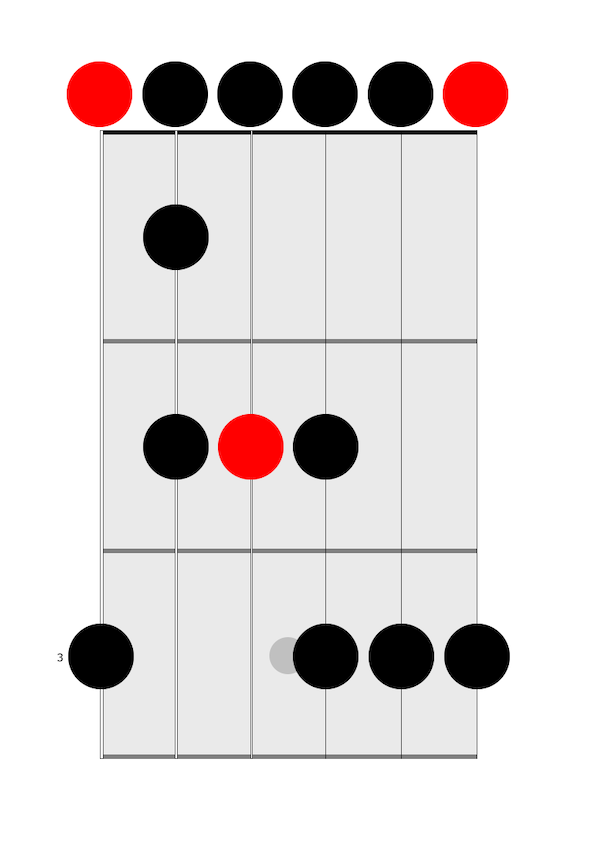
Here’s another way using a combination of whole and half steps.
- Root note
- A step and a half
- Whole-step
- Half-step
- Half-step
- A step and a half
- Whole-step
If we take a look at how these chords relate in the key of E major, you’ll see it’s simply a I to a IV with the flat III in between…
E (E major)
Notes: E, G♯, B
Function: This is the I chord (tonic) in E major. It’s the tonal center and provides a strong sense of stability and “home.”
G5 (G power chord)
Notes: G, D
Function: G natural is not diatonic to E major (it contains G♯ normally). This makes G5 a borrowed flat III chord from the parallel minor (E minor). In rock, it often gives a gritty, bluesy sound. Again, think of the E minor blues scale referenced above.
A5 (A power chord)
Notes: A, E
Function: This is the IV chord (subdominant) in E major. Even in power chord form, it provides lift and motion away from the tonic. In rock contexts, it often resolves back to E (I).
All right!
So that’s the theory. Next, let’s look at…
What is the strumming pattern for TNT?
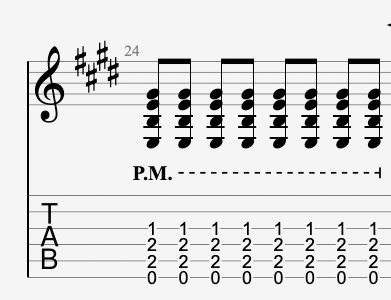
The main underlying feel for “TNT” is a bashing 8th-note rock feel. In 4/4 time, 8th notes divide each beat into two equal parts, creating a driving, steady rhythm like this:
1 & 2 & 3 & 4 &
The numbers (1, 2, 3, 4) represent the main beats in the measure, while the "&" represents the offbeats that add energy and momentum.
When counted out loud, it sounds like:
"One-and, Two-and, Three-and, Four-and."
This gives a strong and consistent forward motion to the tune. Here’s an example of a “TNT” style strumming pattern on an E chord:
Conclusion
To wrap it up, “TNT” is an epic rock song that’s a blast to crank up your speakers and play along with.
Keep practicing, and if you want to get better at this bluesy style and master the fretboard for rhythm and lead, then grab my FREE blues scale PDF guide here right now:
Jon MacLennan
Like this blog post? Get Jon’s best guitar lessons straight to your inbox.
Discover the 5 easiest and fastest ways to play the blues scale anywhere on the neck with this FREE PDF GUIDE
