Red Hot Chili Peppers – “Under the Bridge” Chords & Guitar Lesson
Anthony Kiedis sang:
===
Sometimes I feel like I don't have a partner
Sometimes I feel like my only friend
Is the city I live in, The City of Angels
Lonely as I am, together we cry...
===
Look, it ain’t easy out here! I get it.
And this song has some dark undertones.
But I think loneliness is good for a human.
In fact, I’d say it’s even mandatory.
It’s mandatory to embrace, because chances are, for long periods of life, you might be alone physically.
Now, guess what can make this whole process easier?
Yup!
You guessed it!
Guitar.
That’s right.
(Joey the Juggernaut sits to my left and nods with excitement…)
So below, I want to share with you some insider tips on one of the most monumental Red Hot Chili Peppers tunes.
So grab your axe, and let’s dive into this “Under the Bridge” chords and guitar lesson!
Who wrote Under the Bridge?
“Under the Bridge” was originally written by the 4 members of the Red Hot Chili Peppers – Anthony Kiedis, Flea, John Frusciante, and Chad Smith. The lyrics were primarily written by Anthony Kiedis. They reflect his experiences in Los Angeles, and also his drug addiction.
The tune first appeared on the band’s 1991 album Blood Sugar Sex Magik, produced by the legendary Rick Rubin.
I would say it’s become one of the most important tunes of their career. Before this, the Red Hot Chili Peppers were primarily known as a wild, sexually charged funk-rock band. But when they released “Under the Bridge,” it revealed a new side of the band. It was vulnerable and melodic. This track helped transform the Chili Peppers from a cult alternative band into mainstream rock stars.
The song has some dark undertones. Kiedis has deliberately refused to identify exactly which bridge he meant in Los Angeles. In a 1992 Rolling Stone interview, he would only say that it was downtown and specifically said he didn't want people going looking for it.
But years later, writer Mark Haskell Smith investigated clues from Kiedis’s memoir and interviews and argued that the location was most likely a pedestrian tunnel beneath Wilshire Boulevard around MacArthur Park. That identification has been widely repeated ever since…
And that’s not too far from where I’m typing this letter…
(OOOOOoooooo Los Angeles creaks…)
John Frusciante was instrumental in turning Kiedis’s words and melody into the music we know. Kiedis brought him the vocal idea, and Frusciante began finding chords that would support it.
The recording took place at “The Mansion”, a large house at 2451 Laurel Canyon Boulevard in Los Angeles, owned by Rubin. The Chili Peppers lived and worked there for roughly two months during the Blood Sugar Sex Magik sessions in 1991. They created much of the album in this unusually immersive environment.
The record was engineered by Brendan O’Brien, who also mixed it later at the Record Plant in Los Angeles.
The album itself arrived on September 24, 1991, coincidentally the same day Nirvana released Nevermind. That makes the date a pretty extraordinary moment in alternative-rock history.
Upon its release, “Under the Bridge” exploded as a single. It reached number two on the Billboard Hot 100, becoming the Chili Peppers’ highest-charting U.S. single at the time. It spent 26 weeks on the Hot 100 and finished at number eight on Billboard’s year-end Hot 100 for 1992. In other words, this wasn't merely a successful alternative-rock single; it became one of the biggest pop records in America that year. Its U.S. certification has since reached six-times Platinum.
Now, you may be wondering…
What is the tuning for Under the Bridge?
The tuning for "Under the Bridge” as recorded by the Red Hot Chili Peppers is standard tuning. Frusciante kept things simple on the tuning. Some people think it’s played with a capo on fret 2. But that’s just not the case. Standard tuning is spelled: E, A, D, G, B, and E.
Here are the strings:
- E (6th string, lowest pitch)
- A (5th string)
- D (4th string)
- G (3rd string)
- B (2nd string)
- E (1st string, highest pitch)
All right!
Now that you know the tuning for “Under the Bridge,” let’s next talk about…
Under the Bridge Chords
To play “Under the Bridge”, as recorded by the Red Hot Chili Peppers, you’ll need to know 13 main chords they are D, F#, E, B, C#m, G#m, A, Emaj7/B, F#m, Am9, G6, Fmaj7, and E7. These chords are played as a blend of open chords, bar chords, and Jimi Hendrix-style thumb chords.
If bar chords are giving you all kinds of aches and pains, and you haven’t yet discovered how to play them effortlessly, go here: https://www.jonmaclennan.com/barchords
Also, keep in mind that of these main chords, Frusciante plays many variations up and down the neck.
Let’s take a look at a few ways these shapes might show up on the fretboard.
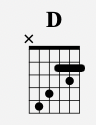
D is played from the 5th string down like so:
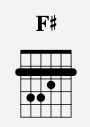
F# is a bar chord using all 6 strings and played in 2nd position like this:
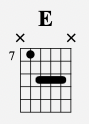
E is played in the 7th position like so:
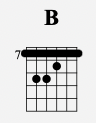
B is similar to F#; it’s just shifted up the fretboard to position 7 like this:
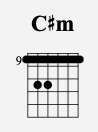
C#m is a bar chord played in 9th position like so:
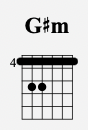
G#m is the same grip as C#m; it’s just relocated to the 4th fret like this:
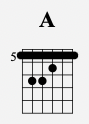
A is played using all 6 strings like this:
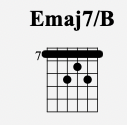
Emaj7/B gets a jazzier sound; I play it like this:
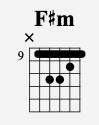
F#m is played with a root on the 5th string and in 9th position like so:
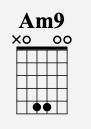
Am9 comes in at the very end like this:
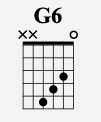
G6 is a classic Beatles chord. I play it like this:
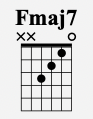
Fmaj7 simply moves those fretted notes from the previous chord down 2 frets like this:
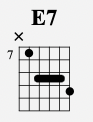
Finally, we have E7, which is played like this:
If you’ve struggled to understand the fretboard for RHYTHM and LEAD guitar. and want to discover the easiest and fastest way. Then get your hands on my free Fretboard Guide PDF right here now:
Is Under the Bridge hard to play on guitar?
I would say playing “Under the Bridge” as recorded by the Red Hot Chili Peppers is going to require an advanced skill level. The guitar parts are quite tricky, from the opening fingerstyle bit with bar chords to the Jimi Hendrix rock at the end of the song. So, take your time with this one.
What key is Under the Bridge in?
“Under the Bridge”, as recorded by the Red Hot Chili Peppers, is in the key of E major. The primary scale for the song is the E major scale, which is built using the notes E, F#, G#, A, B, C#, and D#.
Let’s simplify the chords and take a look at their root function in the key of E major, starting with…
D
Notes: D, F#, A
Function: This is the ♭VII chord in the key of E major. D major is not diatonic to E major because the key normally contains D#. The lowered seventh gives the chord a strong rock or Mixolydian flavor. The ♭VII is extremely common in rock music and sometimes called the sub-tonic.
F#
Notes: F#, A#, C#
Function: This is the II chord in E major. However, the diatonic ii chord would normally be F#m, so the A# makes this a major chord borrowed from outside the key. It’s a major II chord.
E
Notes: E, G#, B
Function: This is the I chord, the tonic of E major. It’s “home”. The other chords either move away from E or create tension that eventually leads back toward it.
B
Notes: B, D#, F#
Function: B is the V chord, the dominant of E major. B creates strong harmonic tension that naturally wants to resolve back to E. The D# is particularly important because it is the leading tone of E major and sits only a half-step below the tonic E.
C#m
Notes: C#, E, G#
Function: This is the vi chord in E major, sometimes called the relative minor. It shares two notes with the tonic E chord (E and G#), making the transition between the two smooth as butter.
G#m
Notes: G#, B, D#
Function: This is the iii chord in E major. It is another diatonic minor chord and shares two notes with E major (G# and B). The iii chord generally has a softer harmonic function than the tonic, dominant, or subdominant chords and is often used to connect other chords smoothly.
A
Notes: A, C#, E
Function: This is the IV chord, the subdominant of E major. It creates movement away from the tonic without the strong tension associated with the dominant. A is one of the fundamental chords in the key and frequently moves to B before resolving back to E.
F#m
Notes: F#, A, C#
Function: This is the ii chord in E major. This is used in the Chorus and is varied from the opening intro with the major II chord.
Am
Notes: A, C, E
Function: Am9 pared down to its basic triad becomes Am. This is the minor iv chord. But really at this point, the key changes to A minor, which would suddenly make this a minor i chord.
G
Notes: G, B, D
Function: G6 pared down to its basic triad becomes G major. This is the vii chord in A minor.
F
Notes: F, A, C
Function: Fmaj7 pared down to its basic triad becomes F major. This is the vi chord in A minor.
E
Notes: E, G#, B
Function: E7 pared down to its basic triad becomes E major, the V of A.
Together, these chords combine elements of major, natural minor, harmonic minor, blues, and borrowed harmony.
All right!
That’s my theory breakdown.
Next, let’s look at…
What is the strumming pattern for Under the Bridge?
The main feel for “Under the Bridge” as recorded by the Red Hot Chili Peppers is a sixteenth-note groove. In 4/4 time, a 16th-note groove divides each beat into four equal parts, creating a more active and detailed rhythmic feel than 8th notes.
The basic subdivision looks like this:
1 e & a 2 e & a 3 e & a 4 e & a
The numbers 1, 2, 3, and 4 represent the four main beats in the measure, while the “e,” “&,” and “a” divide the space between each beat into equal parts.
When counted out loud, it sounds like:
“One-ee-and-uh, Two-ee-and-uh, Three-ee-and-uh, Four-ee-and-uh.”
That gives you four 16th notes per beat and sixteen 16th notes in one measure of 4/4.
On guitar, a great way to feel this is to keep your strumming hand moving continuously down and up:
1 e & a 2 e & a 3 e & a 4 e & a
D U D U D U D U D U D U D U D U
You don't necessarily have to strike the strings on every subdivision. Your hand can maintain that continuous 16th-note motion while you selectively hit certain subdivisions.
That's where the actual groove comes from.
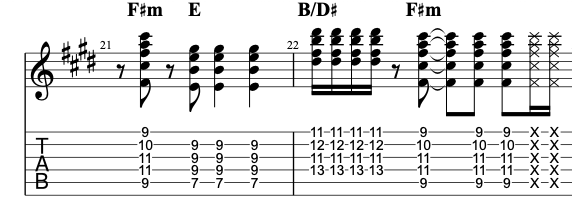
Here’s an example of a strumming pattern in the style of “Under the Bridge”:
Conclusion
Bottom line, “Under the Bridge” is one of the Red Hot Chili Peppers most monumental songs. It’s also a ton of fun to play!
Keep practicing, and if you want to learn songs way faster, better understand the fretboard for lead and rhythm, and not waste years spinning your wheels with guitar, grab my free fretboard guide here right now:
Jon MacLennan
Like this blog post? Get Jon’s best guitar lessons straight to your inbox.
Discover the 5 easiest and fastest ways to play the blues scale anywhere on the neck with this FREE PDF GUIDE
