Quick & Easy Waiting On A Friend Chords & Guitar Lesson
Here’s a song from an interesting period during the Rolling Stones’ career.
It has a slightly mellow feel to it in contrast to many of their more high-energy tunes. But the groove is deep and the song also features legendary jazz saxophonist Sonny Rollins
Grab your axe and let’s dive into this “Waiting On A Friend” chords and guitar lesson!
Who Wrote Waiting On A Friend?
“Waiting On A Friend” was written by Mick Jagger and Keith Richards. But like many Rolling Stones songs, it was a collaborative effort. It all came together with significant contributions from the other band members and also some guest musicians.
Lyrically, the song is a departure from the Stones’ usual themes of love, sex, and rebellion. Instead, it leans more into the value of friendship and companionship. Mick Jagger has said in interviews that the song isn’t about waiting for a woman but rather about the camaraderie between friends. Given the Stones’ turbulent history, particularly in the 1970s, many interpret it as a reflection on the deep bond between Jagger and Richards.
The origins of Waiting on a Friend go all the way back to 1972 during the Goats Head Soup sessions in Kingston, Jamaica. The band recorded an instrumental demo at Dynamic Sound Studios, but it remained unfinished for years. When they were compiling material for Tattoo You (1981), they revisited this older track. Jagger wrote the lyrics and made it into what became one of the Stones’ more mellow and introspective tunes.
At the time of the final recording, the Stones were going through a lot of drama and internal tensions. Keith Richards had largely cleaned up his act after years of drug addiction, and Mick Jagger was trying to steer the band toward a more polished, radio-friendly sound. Despite their personal differences, the song reflects a sense of reconciliation.
More:
Legendary jazz saxophonist Sonny Rollins played the solo on this jam. He admitted to not being a fan of the Rolling Stones at first. He didn’t quite "get" the group at first but later warmed up to their style after playing on multiple Tattoo You tracks.
The music video for “Waiting On A Friend” was shot in New York City’s East Village, specifically at 96-98 St. Mark’s Place. This same location is famous for being the cover image of Led Zeppelin’s Physical Graffiti. The video shows Mick Jagger hanging out on the stoop of the building, soon joined by Keith Richards before they head to a bar.
“Waiting On A Friend” was released as a single in 1981 and reached #13 on the Billboard Hot 100 and #8 on the Mainstream Rock chart.
Tattoo You, the album it appears on, was also a massive success, reaching #1 on the Billboard 200 and becoming one of the Stones’ most celebrated albums of the ‘80s.
Now, you may be wondering…
What is the tuning for Waiting On A Friend?
The tuning for "Waiting On A Friend" by the Rolling Stones is standard tuning. Mick and Keith kept things simple.
Standard tuning for a guitar is spelled out as EADGBE.
Here are the strings:
- E (6th string, lowest pitch)
- A (5th string)
- D (4th string)
- G (3rd string)
- B (2nd string)
- E (1st string, highest pitch)
Now that you know the “Waiting On A Friend” tuning, let’s next talk about the…
Waiting On A Friend Chords
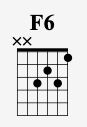
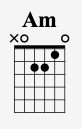
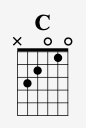
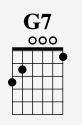
If you want to play “Waiting On A Friend” on guitar you’ll need to know 7 main chord shapes they are Cadd9, F6, F, Am, G, C, and G7. The main groove just moves between a C and an F chord. Let’s take a look at a few ways these chords can be played on the fretboard.
Cadd9 is played in open position on the middle strings like so:

F6 is played by making a slight shift on the top 4 strings like this:
Am is played from the 5th string down like this:
G is played using all 6 strings like so:

C is played in open position from the 5th string down like this:
Finally, we have the last chord G7. This chord is played in a folk-style using all 6 strings like this:
Is Waiting On A Friend hard to play on guitar?
To play “Waiting On A Friend” on guitar players need to have some basic rhythmic skills and chords down. It’s all based around 2 parts that are not super advanced to play. However, the trickiest part is being able to follow along with the song and know when each part comes in so players don’t get lost.
What key is Waiting On A Friend in?
“Waiting On A Friend” as recorded by the Rolling Stones is in the key of C major. The C major scale is built from the following notes: C – D – E – F – G – A – B – C
Let’s first take a look at the core chords – without the extensions. Meaning we’ll analyze the chords C, F, Am, and G first:
C Major (C - E - G) → I (Tonic)
Root chord in the key of C major.
This is the most stable chord and it provides a sense of resolution.
F Major (F - A - C) → IV (Subdominant)
Creates movement away from the tonic.
Often leads to the V chord (G major) or back to the I chord.
A Minor (A - C - E) → vi (Relative Minor)
The relative minor of C major.
Adds an emotional or melancholic touch.
Can lead smoothly back to the I chord or to the IV chord.
G Major (G - B - D) → V (Dominant)
The strongest chord leading back to the I chord (C major).
Often creates tension and wants to resolve back to C.
Those are the core chords. From there, the extended chords just spice up the progression a bit. Let’s take a look at those next.
- Cadd9 (C - E - G - D)
Cadd9 is a C major chord with the addition of the 9th (D).
This creates a sound that adds a layer of complexity and color to the tonic chord. The addition of the 9th enhances the tension and richness without altering the basic function of the chord as the tonic (I). It can be thought of as maintaining the same root but expanding the harmonic vocabulary, making the progression feel more modern and lush.
- F6 (F - A - C - D)
F6 includes the F major triad plus the 6th (D).
This introduces a new tone that brightens the subdominant chord, and also keeps the D note from the Cadd9 which happens right before in the progression. The F6 chord still serves as the IV chord but now carries an added richness and a feeling of motion .
- G7 (G - B - D - F)
G7 is a G major chord with the addition of the minor 7th (F).
This gives the chord a dominant function, creating tension that resolves nicely back to the tonic (C).
So that’s the theory, but all of that doesn’t mean a thing without a good…
Waiting On A Friend Strumming Pattern
The main underlying groove for “Waiting On A Friend” is a light 8th note rock feel.
In 4/4 time, 8th notes divide each beat into two equal parts, creating a driving, steady rhythm like this:
1 & 2 & 3 & 4 &
The numbers (1, 2, 3, 4) represent the main beats in the measure, while the "&" represents the offbeats that add energy and momentum.
When counted out loud, it sounds like:
"One-and, Two-and, Three-and, Four-and."
This gives a strong and consistent forward motion to the tune. However, if I were to strum this song I would not play all 8th notes continuously. Instead I would mix a combination of 8th notes, quarters notes, and rests like this:

Conclusion
“Waiting On A Friend” gives us a unique insight into a specific time period in the Rolling Stones’ legendary history.
Keep practicing, and if you want to learn songs way faster, better understand the fretboard, and not waste years spinning your wheels with guitar, grab my free fretboard guide here right now:
Jon MacLennan
Like this blog post? Get Jon’s best guitar lessons straight to your inbox.
Discover the 5 easiest and fastest ways to play the blues scale anywhere on the neck with this FREE PDF GUIDE
