The ULTIMATE Walk This Way Chords & Guitar Lesson
I may die on this hill… but I’ll keep saying it.
The blues is the foundation of rock n roll, and those who master the fundamental principles will only play rock better than those who don't.
Below is another perfect example of this.
It’s a legendary song from a band that’s been together for (as of this writing) 55 years.
That’s an incredible feat.
Below, I’m going to share some insider tips on the guitar style behind it.
So grab your axe, and let’s dive into this “Walk This Way” chords and guitar lesson!
Who Wrote Walk This Way?
“Walk This Way” was originally written by Steven Tyler and Joe Perry. Two founding members of the legendary American rock band Aerosmith. It was first released in 1975 on the album Toys in the Attic and has gone on to become one of their most popular songs.
It’s a unique blend of rock and blues.
The guitars are gritty and funky.
Combined with Tyler’s incredible vocals and sexual lyrics, this song became a huge hit. Tyler has explained the lyrics were inspired by his early encounters with romance. It captures both the innocence and the mischief of adolescence.
The song was recorded at Record Plant Studios in New York City in 1975, with producer Jack Douglas at the helm. Douglas became a longtime collaborator with Aerosmith. The band spent considerable time perfecting the groove, particularly Perry’s guitar riff, which became one of the most recognizable riffs in rock history. And again, it’s based on an old-school blues rhythm.
Later, in 1986, “Walk This Way” gained even more notoriety when it was re-recorded as a collaboration between Aerosmith and the hip-hop group Run-D.M.C.
This version was produced by Rick Rubin and fused rock and rap in a way that was groundbreaking at the time. The single became a massive commercial success, reaching number four on the Billboard Hot 100 and helping to revive Aerosmith’s career after a period of declining popularity. The collaboration is now widely credited with bridging the gap between rock and hip-hop and influencing countless artists across genres.
It was one of the first rock riffs I ever learned, and it’s been placed on many “greatest songs” lists, including Rolling Stone’s 500 Greatest Songs of All Time.
Now, you may be wondering…
What is the tuning for Walk This Way?
The tuning for "Walk This Way” as recorded by Aerosmith is standard tuning. Joe Perry and Brad Whitford kept things simple with the guitar tunings. Standard tuning is spelled: E, A, D, G, B, and E.
Here are the strings:
- E (6th string, lowest pitch)
- A (5th string)
- D (4th string)
- G (3rd string)
- B (2nd string)
- E (1st string, highest pitch)
All right!
Now that you know the tuning for “Walk This Way,” let’s next talk about…
Walk This Way Chords
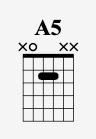
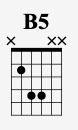
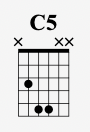
To play “Walk This Way”, you only need to know 3 main chords they are A5, B5, and C5. All of these chords are power chords. Power chords on guitar are typically played as a 2 or 3-note chord.
Let’s take a look at a few ways these shapes can be played on the fretboard:
A5 is played using just the index finger in the fretting hand in open position, like this:
B5 shifts up to 2nd position and is played like this:
Finally, C5 is played in the 3rd position like so:
If you’ve struggled to understand the fretboard for RHYTHM and LEAD guitar, and want to discover the easiest and fastest way. Then get your hands on my free Fretboard Guide PDF right here now:
Is Walk This Way hard to play on guitar?
I would say playing “Walk This Way” on guitar is going to require an intermediate to advanced skill level. The trickiest parts are the speed of the riff and the bluesy rhythm part on the C chord. “Walk This Way” uses a lot of 16th note rhythms, plus it can be a bit stretchy at times on the fretting hand. So, take your time with this one.
What key is Walk This Way in?
If we needed to label the key for “Walk This Way”, as recorded by Aerosmith, you could say C major. This would mean the primary scale for the song is the C major scale, which is built using the notes C, D, E, F, G, A, and B.
However, I would go a little bit deeper and call it a one-chord blues, which happens in 2 different keys.
Meaning it starts off in an A one-chord blues, then in the verse shifts to a C one-chord blues.
That’s all that’s happening. It’s the I7#9 chord on A, which is the main chord for the key. Then shifts to I7 in the key of C.
All right!
So that would be my theory breakdown. Next, let’s look at…
What is the strumming pattern for Walk This Way?
The main underlying feel for “Walk This Way” is a funky 16th note rock groove. In 4/4 time, 16th notes divide each beat into four equal parts, creating a quicker, more flowing rhythm. The counting for 16th notes in a measure looks like this:
1 e & a 2 e & a 3 e & a 4 e & a
The numbers (1, 2, 3, 4) represent the main beats in the measure. The "e," "&," and "a" divide each beat into four evenly spaced subdivisions.
When counted out loud, it sounds like:
"One-ee-and-a, Two-ee-and-a, Three-ee-and-a, Four-ee-and-a."
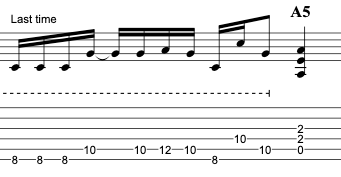
The guitar style blends a 16th-note rhythm with some palm muting and a blues rhythm pattern. Here’s an example of a rhythm pattern in the style of “Walk This Way”:
Conclusion
To wrap it up: “Walk This Way” is one of the most iconic classic rock songs from the '70s. It’s a great storytelling song with exciting and fun guitar parts – all based in the blues.
So keep practicing, and if you want to learn songs way faster, better understand the fretboard for lead and rhythm, and not waste years spinning your wheels with guitar, grab my free fretboard guide here right now:
Jon MacLennan
Like this blog post? Get Jon’s best guitar lessons straight to your inbox.
Discover the 5 easiest and fastest ways to play the blues scale anywhere on the neck with this FREE PDF GUIDE
