4 Non Blondes – “What's Up?” Chords & Guitar Lesson
Here’s one of the biggest one-hit wonders of all time.
It has quite an interesting backstory to it.
Below, I want to share with you some insider tips on the guitar style behind it.
So grab your axe, and let’s dive into this “What's Up?” chords and guitar lesson!
Who wrote What's Up?
“What’s Up?” was originally written by Linda Perry. It was recorded by the San Francisco rock band 4 Non Blondes for their only studio album, Bigger, Better, Faster, More!
Interestingly, the song never sings the lyrics “What’s Up?”, instead it sings over and over “What’s going on?”. However, Perry didn’t want to name it that because she was afraid the song would be too close to Marvin Gaye’s “What’s Going On?”. The title became “What’s Up?” as a practical way to distinguish the two songs.
The origins of the song go back to Linda Perry's struggling musician days in San Francisco, California. This was well before 4 Non Blondes had a record deal. Perry has recalled playing early versions of the song for fellow local musicians, including an unknown Stephan Jenkins, who would later form Third Eye Blind. Years afterward, Jenkins joked that the two of them unknowingly sat in a room sharing songs that would eventually sell millions upon millions of records.
The story behind the recording is also quite fascinating. You see, the band originally recorded “What’s Up?” at Groove Masters Studios with producer David Tickle. However, Perry hated the finished version.
She complained about it to the record label, but they dismissed her. That was until she got support from Interscope co-founder Jimmy Lovine. With this support, she booked time at The Plant Studios in Sausalito, California, and essentially re-recorded the entire song. This second version is the one listeners know today. Perry has often said that if she hadn't fought for the new recording, the song probably would never have become what it did.
Upon its release, “What’s Up?” became a massive international success. It reached the Top 20 on the Billboard Hot 100 in the United States and climbed to No. 1 in numerous countries across Europe and elsewhere. The single helped Bigger, Better, Faster, More! achieve platinum status and established 4 Non Blondes as one of the breakout alternative rock acts of the early 1990s.
The band broke up just a year later when Linda Perry said, “I’m not happy”.
And that’s that.
Now, you may be wondering…
What is the tuning for What's Up?
The tuning for "What's Up?” as recorded by 4 Non Blondes is standard tuning. Perry kept things simple on the tuning. Standard tuning is spelled: E, A, D, G, B, and E.
Here are the strings:
- E (6th string, lowest pitch)
- A (5th string)
- D (4th string)
- G (3rd string)
- B (2nd string)
- E (1st string, highest pitch)
All right!
Now that you know the tuning for “What's Up?” let’s next talk about…
What's Up? Chords
To play “What's Up?”, as recorded by the 4 Non Blondes, you only need to know 3 main chords they are A, Bm, and D. These chords are played as a combination of open chords and also bar chords.
If bar chords are giving you all kinds of aches and pains, and you haven’t yet discovered how to play them effortlessly, go here: https://www.jonmaclennan.com/barchords
Let’s take a look at a few ways these shapes might show up on the fretboard.
A is played from the 5th string down in open position like so:

Bm is played as a bar chord in 2nd position like this:

Finally, D is played from the 4th string down like this:

That’s it!
If you’ve struggled to understand the fretboard for RHYTHM and LEAD guitar. and want to discover the easiest and fastest way. Then get your hands on my free Fretboard Guide PDF right here now:
Is What's Up? hard to play on guitar?
I would say playing “What's Up?” as recorded by Linda Perry on guitar is going to require an intermediate skill level. The trickiest part are the bar chords and the strumming pattern. The progression itself is quite simple. Now, you could use a capo to make an easy version. But to play it like she does, I would rank it as intermediate. So, take your time with this one.
What key is What's Up? in?
“What's Up?”, as recorded by the 4 Non Blondes, is in the key of A major. The primary scale for the song is the A major scale, which is built using the notes A, B, C#, D, E, F#, and G#.
Let’s take a look at how these chords all function in the key of A major, starting with…
A
Notes: A, C#, E
Function: This is the I chord, the tonic of A major. It is the harmonic home base and provides the sense of stability and resolution in the key. Every other chord in the progression either moves away from this center or creates motion that eventually returns to it.
Bm
Notes: B, D, F#
Function: Bm is the ii chord in A major. It functions as a super-tonic and naturally prepares the ear for movement toward the dominant (E). Bm adds a softer, more reflective quality to the progression while remaining completely diatonic.
D
Notes: D, F#, A
Function: This is the IV chord in A major, also known as the subdominant. It creates movement away from the tonic without introducing strong tension. It shares two notes with Bm (D and F#), so transitions between these two chords feel especially smooth.
Together, these chords form some of the most common chords in the key of A major.
All of them are diatonic.
All right!
That’s my theory breakdown.
Next, let’s look at…
What is the strumming pattern for What's Up?
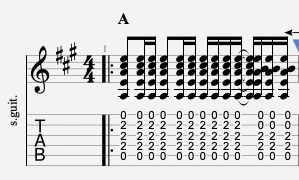
Here’s where things get a bit tricky. “What's Up?” has a sixteenth-note subdivision. In 4/4 time, 16th notes divide each beat into four equal parts, creating a faster, more detailed rhythmic subdivision like this:
1 e & a 2 e & a 3 e & a 4 e & a
The numbers (1, 2, 3, 4) represent the main beats in the measure, while the "e," "&," and "a" are the subdivisions that fall between the beats. These extra subdivisions add motion, precision, and rhythmic complexity to the groove.
When counted out loud, it sounds like:
"One-ee-and-uh, Two-ee-and-uh, Three-ee-and-uh, Four-ee-and-uh."
Here’s an example of a “What's Up?” style strumming pattern:
Conclusion
To wrap it up, “What's Up?” is one of the biggest rock hits of the early ‘90s. The simple 3-chord progression launched it into the stratosphere and the rest is history.
Keep practicing, and if you want to learn songs way faster, better understand the fretboard for lead and rhythm, and not waste years spinning your wheels with guitar, grab my free fretboard guide here right now:
Jon MacLennan
Like this blog post? Get Jon’s best guitar lessons straight to your inbox.
Discover the 5 easiest and fastest ways to play the blues scale anywhere on the neck with this FREE PDF GUIDE
