The ULTIMATE "Whipping Post" Chords & Guitar Lesson
Here’s one of the gutsiest, bluesiest rock songs ever recorded.
Check out these lyrics Gregg Allman sang:
===
I've been run down
I've been lied to
And I don't know why
I let that mean woman make me a fool
She took all my money
Wrecked my new car
Now she's with one of my good time buddies
They're drinkin' in some crosstown bar…
===
Below, I’m going to share some insider tips on the guitar style behind it.
So grab your axe, and let’s dive into this “Whipping Post,” chords and guitar lesson!
Who Wrote Whipping Post?
“Whipping Post” was originally written by Gregg Allman and first performed by The Allman Brothers Band. It’s a song about betrayal. Gregg Allman was married 7 times.
He drew heavily on the blues in this song, and it’s gone on to become one of the Allman Brothers' most beloved songs.
“Whipping Post” was first recorded in 1969 for The Allman Brothers Band’s debut album, produced by Adrian Barber at the legendary Capricorn Studios in Macon, Georgia. It features beautiful dual guitar interplay, with Duane Allman and Dickey Betts weaving harmonized lines and improvised riffs. This gives the track an immediately recognizable sound.
Then Gregg Allman’s soulful vocals, coupled with the band’s tightly knit rhythm section, including Berry Oakley on bass and Butch Trucks and Jaimoe Johanson on drums, create a hypnotic tension that builds throughout the song.
The studio version is already powerful, but the live performances elevated “Whipping Post” even higher.
The most famous live version was recorded at the Fillmore East in New York City in 1971, and it appeared on the band’s acclaimed double live album At Fillmore East. In this version, the song stretches to over 23 minutes! Duane Allman’s slide guitar and Dickey Betts’ melodic phrasing elevate the song to a near-spiritual level.
Over the years, “Whipping Post” achieved both critical and commercial recognition, though not as a mainstream single hit. The song became a centerpiece of The Allman Brothers Band’s concerts and a benchmark for southern rock. It has been ranked in numerous “greatest songs” and “best guitar performances” lists by publications such as Rolling Stone and Guitar World. The live album itself has been inducted into the Grammy Hall of Fame and remains a landmark of epic classic rock performance.
Now, you may be wondering…
What is the tuning for Whipping Post?
The tuning for "Whipping Post” is standard tuning. Duane Allman and Dickey Betts kept things simple. Standard tuning is spelled: E, A, D, G, B, and E.
Here are the strings:
- E (6th string, lowest pitch)
- A (5th string)
- D (4th string)
- G (3rd string)
- B (2nd string)
- E (1st string, highest pitch)
All right!
Now that you know the tuning for “Whipping Post,” let’s next talk about…
Whipping Post Chords
To play “Whipping Post”, as recorded by the Allman Brothers Band, you’ll need to know 8 main chords they are A, Bm/A, C/A, A7, D7, C, E7, and Am9. These chords are a mix of open chords and bar chords.
If bar chords are giving you all kinds of aches and pains, and you haven’t yet discovered how to play them effortlessly, go here: https://www.jonmaclennan.com/barchords
Let’s take a look at a few ways these shapes might show up on the fretboard.
A is played in a standard open position from the 5th string down like this:

Bm/A keeps the 5th string open but shifts the middle part of the chord up like so:

C/A follows suit and shifts up the middle strings again like this:

A7 is a great bluesy-sounding chord. I play it like this:

D7 is played from the 4th string down like so:

C is a bar chord played in the 3rd position like this:

E7 is another bluesy chord (the V7 chord in the key). I play it like this:

Finally, we have Am9. This chord is the final chord in the song and sounds beautiful.

If you’ve struggled to understand the fretboard for RHYTHM and LEAD guitar, and want to discover the easiest and fastest way. Then get your hands on my free Fretboard Guide PDF right here now:
Is Whipping Post hard to play on guitar?
I would say playing “Whipping Post” on guitar is going to require an advanced skill level. There are time signature changes, tricky rhythms, hard licks, and mind-bending solos. It’s definitely not for the weak. So, take your time with this one.
What key is Whipping Post in?
“Whipping Post”, as recorded by the Allman Brothers Band, is essentially a blues in the key of A. Some might write the key signature as G major. But this song just beautifully points out how the blues does not fit into traditional Western music theory.
The song constantly fluctuates between an A major sound using bluesy chords like A7, D7, and E7 – the I, IV, and V of A major. But also chords like C, and Am hinted at constantly in Gregg Allman’s vocal line.
This puts us in a catch-22.
That’s why I would say it’s just a blues in A. It can sway either way at any time. That’s the blues. You’re left in limbo with one constantly clashing on top of the other.
The blues is a play between major and minor.
Let’s take a closer look at how all these chords relate in the key of A. Starting with…
A
Notes: A, C#, E
Function: This is the I chord, the tonic of A major. It’s the harmonic home base where everything feels stable and resolved.
Bm/A
Notes: B, D, F#, A
Function: This is a Bm chord in first inversion, meaning the A (tonic) is in the bass. In the key of A major, Bm is the ii chord or supertonic. With the A in the bass it creates smooth bass-line movement.
C/A
Notes: C, E, G, A
Function: This chord is non-diatonic in A major, since the key contains C#, not C natural. It’s a borrowed chord from the parallel minor Am. It’s a flat III or a passing color chord. With A in the bass, it creates tension while maintaining grounding.
A7
Notes: A, C#, E, G
Function: This is the dominant seventh built on the tonic, which introduces a minor seventh (G) to the I chord. This is textbook blues guitar.
D7
Notes: D, F#, A, C
Function: This is the IV7 chord, a dominant seventh built on the fourth degree of A major. D7 is non-diatonic in a strict sense because D major in A major is normally major without the C. Adding the C (minor seventh) gives it a dominant-function flavor, again this is textbook blues.
C
Notes: C, E, G
Function: This is a non-diatonic flat III chord, since the key of A major contains C#. It is borrowed from the parallel minor. In pop or rock, it’s commonly used to create a mixolydian or “rock-blues” feel.
E7
Notes: E, G#, B, D
Function: This is the V7 chord, the dominant seventh in A major. It creates the strongest tension in the key, pulling decisively back to the tonic (A).
Am9
Notes: A, C, E, G, B
Function: This is the final chord in the song and it’s the parallel minor of the I chord. So instead of A major it’s Am. The added 9th creates a sophistication and elegance for the final chord.
Taken together, these chords combine A major and A minor. Again, pointing to the blues influence.
All right!
That’s my theory breakdown.
Next, let’s look at…
What is the strumming pattern for Whipping Post?
The main underlying groove for “Whipping Post” is a driving 6/8 groove. In 6/8 time, there are six 8th-notes per measure like this:
1 2 3 4 5 6
You can accent 1 and 4 like this:
> >
1 2 3 4 5 6
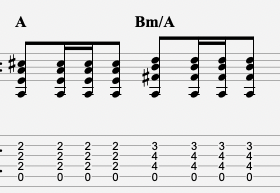
This gives a strong and consistent forward motion to the tune. Here’s an example of a “Whipping Post” style strumming pattern that blends these driving 8th notes with also some 16th notes in between:
Conclusion
To wrap it up, “Whipping Post” is a soul-bearing song. A gem from back when music was made by hand.
Keep practicing, and if you want to learn songs way faster, better understand the fretboard for lead and rhythm, and not waste years spinning your wheels with guitar, grab my free fretboard guide here right now:
Jon MacLennan
Like this blog post? Get Jon’s best guitar lessons straight to your inbox.
Discover the 5 easiest and fastest ways to play the blues scale anywhere on the neck with this FREE PDF GUIDE
