Eric Clapton – “Wonderful Tonight” Chords & Guitar Lesson
Does this dress make me look fat?
Should I wear this?
How do I look?
Here’s a song about something many men have experienced… waiting for a woman to get ready.
It takes a lot of work to put on all the makeup and body shaping undergarments.
Clapton wrote this song while he was waiting.
Below, I’m going to share some insider tips on the guitar style behind it.
So grab your axe, and let’s dive into this “Wonderful Tonight” chords and guitar lesson!
Who wrote Wonderful Tonight?
“Wonderful Tonight” was originally written by Eric Clapton in 1976 and released in 1977 on his album Slowhand. It’s one of his most tender ballads. The inspiration came from his good friend’s wife, Pattie Boyd. Clapton famously fell in love with Pattie while she was still married to George Harrison, and it caused a lot of heartache.
As the lyrics sing, Boyd was taking a long time choosing what to wear, trying on different outfits, and asking for his opinion. Rather than being impatient, Clapton sat with a guitar and began writing lyrics about the whole experience. Lines like asking if she feels wonderful tonight underline the soft emotional tone of the song. It’s not about grand declarations of love, but about quiet presence and shared moments.
“Wonderful Tonight” was recorded at Olympic Studios in London, with producer Glyn Johns at the helm. The arrangement is sparse. For the guitars, it features Clapton’s clean rhythm playing an arpeggiated style, and an overdubbed lead playing B.B. King-style blues licks. The blend of the blues and contemporary pop got a great sound. It’s also masterclass in restraint. Clapton played exactly what the song needed and nothing more.
Upon its release, “Wonderful Tonight” became a major hit, reaching the Top 20 on the Billboard Hot 100 in the United States and performing strongly in the UK as well.
One of the more bittersweet aspects of the song is how its meaning changed over time. Clapton and Boyd eventually divorced, and he later admitted that the song reflected an idealized moment rather than the full reality of their relationship. People can go blind in love.
Now, you may be wondering…
What is the tuning for Wonderful Tonight?
The tuning for "Wonderful Tonight” is standard tuning. Clapton kept things simple. Standard tuning is spelled: E, A, D, G, B, and E.
Here are the strings:
- E (6th string, lowest pitch)
- A (5th string)
- D (4th string)
- G (3rd string)
- B (2nd string)
- E (1st string, highest pitch)
All right!
Now that you know the tuning for “Wonderful Tonight,” let’s next talk about…
Wonderful Tonight Chords
To play “Wonderful Tonight”, as recorded by Eric Clapton, you only need to know 4 main chords they are G, D/F#, C, and Em. All of these chords can be played in open position.
Let’s take a look at a few ways these shapes might show up on the fretboard.
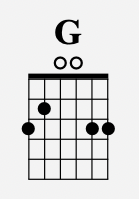
G can be played using all 6 strings like this:
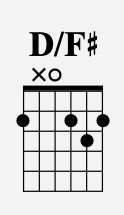
D/F# is played in an open position. However, I use my fretting hand thumb on the 6th string bass note like so:
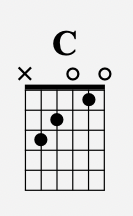
C is played in a typical (campfire) style like this:
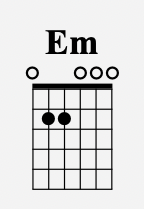
Finally, we have Em, a beautiful open-sounding chord. It uses all 6 strings like this:
If you’ve struggled to understand the fretboard for RHYTHM and LEAD guitar, and want to discover the easiest and fastest way. Then get your hands on my free Fretboard Guide PDF right here now:
Is Wonderful Tonight hard to play on guitar?
I would say playing “Wonderful Tonight” on guitar is going to require an advanced guitar skill level. There are only a couple of chords, but getting the guitar part right can take a lifetime of control and command. Sure, an intermediate player can learn the notes. But being able to play a slow ballad and have it feel like this, as well as nail the lead so clean, is not easy. So, take your time with this one.
What key is Wonderful Tonight in?
“Wonderful Tonight”, as recorded by Eric Clapton, is in the key of G major. The primary scale for the song would be the G major scale, which is built using the notes G, A, B, C, D, E, and F#.
Let’s take a closer look at how these chords relate in the key of G major. Starting with…
G
Notes: G, B, D
Function: This is the I chord, the tonic of G major. It’s the home chord. All the other chords and riffs revolve around this tonal center.
D/F#
Notes: F#, A, D
Function: This is a first-inversion D major chord, the V chord in G major. The F# in the bass gives it a smoother, stepwise connection from G or Em which is used in the Bridge section. Functionally, it’s still the dominant, but this inversion makes the bass movement more melodic and flowing.
C
Notes: C, E, G
Function: C is the IV chord in G major. It creates a sense of movement away from the tonic without creating strong tension. It’s a nice resting point (in the key) before returning home to G.
Em
Notes: E, G, B
Function: Em is the vi chord in G major – a.k.a. the relative minor. It shares two notes with G major (G and B), and this makes transitions smooth from G to Em smooth. Em can also add a more reflective quality to the progression.
All right!
That’s my theory breakdown.
Next, let’s look at…
What is the picking pattern for Wonderful Tonight?
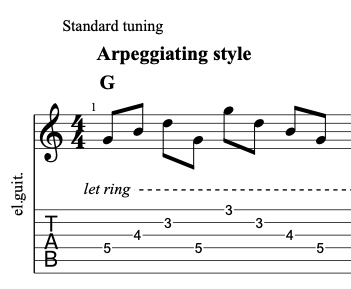
The main underlying groove for “Wonderful Tonight” is a calm, pop ballad. Because of the slow tempo, it is a good idea to subdivide the main quarter note pulse into 8th notes. In 4/4 time, 8th notes divide each beat into two equal parts, creating a steady, driving rhythm. The counting for 8th notes in a measure looks like this:
1 & 2 & 3 & 4 &
The numbers (1, 2, 3, 4) represent the main beats in the measure. The "&" divides each beat into two evenly spaced subdivisions.
When counted out loud, it sounds like:
"One-and, Two-and, Three-and, Four-and."
This gives the tune a consistent forward motion
From there, Clapton takes this 8th note rhythm and plays an arpeggiated rhythm. Here’s an example of this type of rhythm in the style of “Wonderful Tonight”:
Conclusion
To wrap it up, “Wonderful Tonight” is some of Eric Clapton’s best work. It’s a beautiful ballad that has been reaching audiences around the globe since its release.
Keep practicing, and if you want to learn songs way faster, better understand the fretboard for lead and rhythm, and not waste years spinning your wheels with guitar, grab my free fretboard guide here right now:
Jon MacLennan
Like this blog post? Get Jon’s best guitar lessons straight to your inbox.
Discover the 5 easiest and fastest ways to play the blues scale anywhere on the neck with this FREE PDF GUIDE
