The ULTIMATE Your Love Chords & Guitar Lesson (The Outfield)
Tony Lewis sang:
===
Josie's on a vacation far away
Come around and talk it over…
===
Here’s one of the most famous tunes from the epic English pop-rock band The Outfield.
It’s chock-full of mighty rock guitar techniques. In this post, I’m going to share with you some insider tips on the guitar style behind it.
So grab your axe, and let’s dive into this “Your Love” chords and guitar lesson!
Who Wrote Your Love?
“Your Love” was written by John Spinks, guitarist for the English rock band The Outfield.
Like many legendary tunes, it came together fast when Spinks, living in East London at this time, invited the lead singer for the band, Tony Lewis, to his flat to work on some song ideas.
The song sprang to life when, according to Lewis, the opening line “Josie’s on a vacation far away” came together in about twenty minutes on Spinks’ porch. The song tells a promiscuous tale of a young man inviting an older woman over while his main girl is away. Although the song blatantly names a girl named Josie, according to the band, she was not real, and the lyrics are entirely fictional.
“Your Love” was recorded at Air Studios in London on July 26, 1985, with producer William Wittman at the helm. He guided the band from an original, softer demo to the more pop-rock sound inspired sound you hear on the final recording.
The arrangement features Tony Lewis’ mighty high tenor vocals and driving rock guitar that caught the era’s attention.
Upon its release, “Your Love” peaked at number six on the U.S. Billboard Hot 100 and number seven on the Album Rock Tracks chart in 1986. While it didn’t reach the same heights in their native U.K., it achieved multi-platinum status in the U.S. as part of the success of the album it was included on Play Deep.
It re-emerged in pop culture after it was included in the soundtrack for the video game Grand Theft Auto: Vice City in 2002. This introduced the song to a whole new generation. It’s also become a go-to walk-up song in baseball stadiums. Now, “Your Love” stands as one of the most popular rock anthems of the ‘80s.
Now, you may be wondering…
What is the tuning for Your Love?
The tuning for "Your Love” is standard tuning. Spinks kept things simple. Standard tuning is spelled: E, A, D, G, B, and E.
Here are the strings:
- E (6th string, lowest pitch)
- A (5th string)
- D (4th string)
- G (3rd string)
- B (2nd string)
- E (1st string, highest pitch)
All right!
Now that you know the tuning for “Your Love,” let’s next talk about…
Your Love Chords
To play “Your Love”, you’ll need to know 9 main chords they are E5, C#5, B5, A5, G5, A, C#m7, Asus2, and Bsus4. Now, the majority of these chords are played as power chords. However, there are some cool variations, especially during the bridge as well.
Let’s take a look at a few ways these shapes might appear on the fretboard.
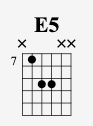
E5 is a simple 3-note power chord played in 7th position like this:
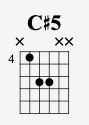
C#5 shifts down to the 4th position like this:
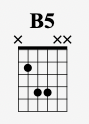
B5 shifts down 2 more frets from C#5, like so:
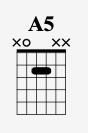
A5 is an open position power chord played like this:
G5 comes in during the bridge/instrumental section. I play it like this:
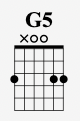
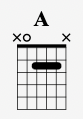
A is a standard rock-type voicing played with the index finger only in the fretting hand, like this:
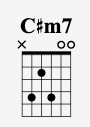
C#m7 is a beautiful chord blending fretted notes and open notes in a unique way, like this:
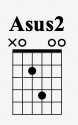
Asus2 makes the 5th string open (from the previous chord C#m7) like so:
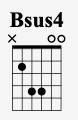
Finally, Bsus4 is a common power chord shape, but this one brings in some open strings with it for a mighty sound:
If you’ve struggled to understand the fretboard for RHYTHM and LEAD guitar, and want to discover the easiest and fastest way. Then get your hands on my free Fretboard Guide PDF right here now:
Is Your Love hard to play on guitar?
I would say playing “Your Love” on guitar is going to require an intermediate skill level. There are many essential rock guitar techniques a player must have down before they can sound like the recording. For example, moving power chord shapes around the neck, a strong 8th note rock feel, palm-muting, and more. So, take your time with this one.
What key is Your Love in?
“Your Love”, as recorded by The Outfield, is in the key of E major. The primary scale for the song is the E major scale, which is built using the notes E, F#, G#, A, B, C#, and D#.
Let’s take a closer look at how all these chords relate in the key of E major. (Note: For this next part, I have taken all the chords and pared them down to their core function and quality for the sake of simplicity and to remove redundancy.)
Starting with…
E (E major)
Notes: E, G♯, B
Function: This is the I chord (tonic) in the key of E major. It’s the tonal center and sounds like “home.”
C♯m (C♯ minor)
Notes: C♯, E, G♯
Function: This is the vi chord (submediant minor) in E major. C#m shares two notes with the tonic (E and G♯) and gives a smooth and melancholic contrast. You hear this right away in the first chord change of the song.
D (D major)
Notes: D, F♯, A
Function: This chord is not diatonic to E major. It functions as a ♭VII chord (subtonic) borrowed from the Mixolydian mode. This is a great example of the blues, and it’s common in millions of rock songs.
A (A major)
Notes: A, C♯, E
Function: This is the IV chord (subdominant) in E major. A gives you a great move away from the tonic and sets up a return to the I chord or a move toward the dominant (B). Essentially, A adds forward motion yet still remains consonant and grounded in the key.
G (G major)
Notes: G, B, D
Function: This is another non-diatonic chord in E major. It can be treated as a ♭III chord borrowed from the parallel minor or Mixolydian mode. It’s another example of the blues influence in rock.
All right!
That’s my theory breakdown.
Next, let’s look at…
What is the strumming pattern for Your Love?
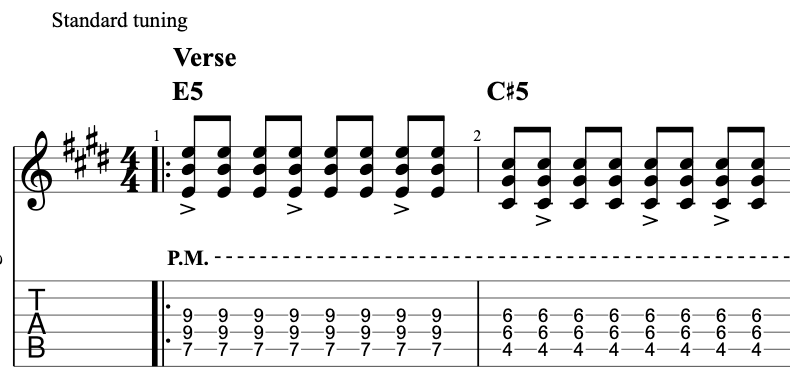
The main underlying feel for “Your Love” is a driving 8th-note rock feel. In 4/4 time, 8th notes divide each beat into two equal parts, creating a steady rhythm like this:
1 & 2 & 3 & 4 &
The numbers (1, 2, 3, 4) represent the main beats in the measure, while the "&" represents the offbeats, or the notes in between the strong beats.
When counted out loud, it sounds like:
"One-and, Two-and, Three-and, Four-and."
Here’s an example of a simple strumming pattern in the style of “Your Love”:
Conclusion
To wrap it up, “Your Love” is a legendary pop-rock anthem from the ‘80s that’s chock-full of essential rock guitar techniques.
So, keep practicing, and if you want to learn songs way faster, better understand the fretboard for lead and rhythm, and not waste years spinning your wheels with guitar, grab my free fretboard guide here right now:
Jon MacLennan
Like this blog post? Get Jon’s best guitar lessons straight to your inbox.
Discover the 5 easiest and fastest ways to play the blues scale anywhere on the neck with this FREE PDF GUIDE
