Quick & Easy Zombie Chords & Guitar Lesson
Behold... the first music video from an Irish band to hit 1 billion views on YouTube.
The video was so polarizing it was banned in certain countries. The message behind the song and powerful imagery were meant to reflect the religious and political turmoil in Ireland during the early 90s.
Below I’m going to share with you some insider tips on how to play in the guitar style of it. It’s not too difficult and is a great choice for newer players.
So grab your axe and let’s dive into this “Zombie” chords and guitar lesson!
Who Wrote Zombie?
"Zombie" was written by Dolores O’Riordan, the lead singer of the alternative rock group The Cranberries. O’Riordan composed the song alone, both the lyrics and melody, during the band's 1993 tour in the UK.
It was a protest anthem written in response to the 1993 IRA bombing in Warrington, England. This tragic event killed two children: three-year-old Johnathan Ball and 12-year-old Tim Parry. The bombing was part of the long-running conflict known as The Troubles between Irish nationalists and the British government. O’Riordan was deeply moved by this event and this was the inspiration for "Zombie".
O’Riordan described the song as a cry against war and violence. It portrays the perspective of an observer tired of seeing innocent people suffer.
"Zombie" was recorded at The Manor Studios in Oxford, England, and was produced by Stephen Street (who also worked with many other famous bands like The Smiths and Blur). The Cranberries took a different approach with this song. They went with a grungier, heavier sound in contrast with their previous more dream-pop style.
The song was released as the lead single from their second album, No Need to Argue (1994).
It went #1 in multiple countries, including Australia, France, and Germany. It reached the Top 10 in the U.S. and UK Singles Chart. And in 1995, won the MTV Europe Music Award for Best Song.
The video was directed by Samuel Bayer (who also did Nirvana’s Smells Like Teen Spirit). It features Dolores covered in gold paint, standing in front of a cross with children dressed as soldiers. This video was banned in certain countries for its strong political themes.
One other interesting note:
O’Riordan originally planned on giving "Zombie" to another artist rather than keeping it for The Cranberries. However, after playing it for the band and producer, they convinced her it should be theirs.
Once it went to the record label, they initially didn’t want to release it as a single. They thought it was too heavy and different from their previous hits (Linger, Dreams). The band insisted, and it became their biggest song ever.
Now, you may be wondering…
What is the tuning for Zombie?
The tuning for "Zombie" as recorded by The Cranberries is standard tuning. Standard tuning for a guitar is spelled out as EADGBE.
Here are the strings:
- E (6th string, lowest pitch)
- A (5th string)
- D (4th string)
- G (3rd string)
- B (2nd string)
- E (1st string, highest pitch)
Now that you know the “Zombie” tuning, let’s next talk about the…
Zombie Chords
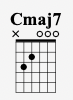
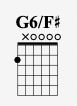
If you want to play “Zombie” on guitar you’ll need to know 4 main chords they are Em, Cmaj7, G6, and G6/F#. Let’s take a look at a few ways these chords can be played on the fretboard.
Em is played using all 6 strings like this:

Cmaj7 has a slight jazzier sound to it. Here we’ll play from the 5th string down like so:
G6 is played using all 6 strings like so:
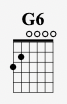
Note: so far all the previous chords use only 2 fingers on the fretting hand. (This is great for newer players)
Finally, G6/F# sounds complicated but you only need one finger to play it:
If you’ve struggled to understand the fretboard for RHYTHM and LEAD guitar and want to discover the easiest and fastest way. Then get your hands on my free fretboard guide PDF right here now:
Is Zombie hard to play on guitar?
“Zombie” is not too difficult to play on guitar as it only uses 4 chords and the progression repeats over and over for the whole song. The chord shapes can all be played as open position chords (no bar chords required) which also makes it easier to get down.
What key is Zombie in?
“Zombie” as recorded by The Cranberries is in the key of E minor. The primary scale is the E natural minor scale which uses the notes: E – F# – G – A – B – C – D – E
Let’s take a look at how these chords all relate in the key of Em:
Em (E minor) - The Tonic (i)
Notes: E - G - B
This is the home chord of the key, built on the 1st degree (E, G, B) of the E minor scale.
Since it's the tonic, it provides a strong sense of stability and resolution.
Cmaj7 (C major 7) - The VI7 Chord (VI7)
Notes: C - E - G - B
This is built on the 6th degree of the E minor scale (C, E, G, B).
In E minor, C major is a common chord because it's the relative major (E minor and C major share the same key signature).
Adding the B (maj7) gives it a more sophisticated, jazzier sound.
G6 (G major 6) - The III6 Chord (III6)
Notes: G - B - D - E
G major is the III chord in E minor (built on G, the 3rd degree of the E minor scale).
The 6th (E) makes it sound more open and dreamy.
It has a strong connection to both Em and Cmaj7 because they all share E, G, and B.
G6/F# (G major 6 over F#) - A Passing Chord Leading to Em
Notes: F# - G - B - D - E
This is basically a G6 chord with F# in the bass.
The F# in the bass creates a descending motion (G → F# → E), which is a smooth transition back to Em. This is heard throughout the song as the progression cycles over and over. Functionally, it can be seen as a passing chord leading back to Em.
Here’s a quick recap of these movements:
- Em (i - home base)
- Cmaj7 (VI7 - provides a lift and a major contrast)
- G6 (III6 - connects to both Em and C naturally)
- G6/F# (a smooth transition back down to Em)
So that’s the theory, but all of that doesn’t mean a thing without a good…
Zombie Strumming Pattern
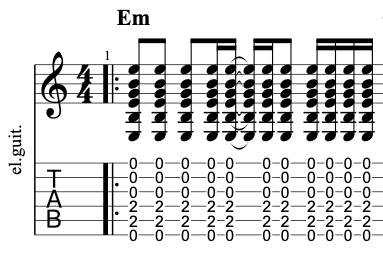
The main underlying groove for “Zombie” is a driving 8th-note rock feel. In 4/4 time, 8th notes divide each beat into two equal parts, creating a driving, steady rhythm like this:
1 & 2 & 3 & 4 &
The numbers (1, 2, 3, 4) represent the main beats in the measure, while the "&" represents the offbeats that add energy and momentum.
When counted out loud, it sounds like:
"One-and, Two-and, Three-and, Four-and."
This gives the tune a strong and consistent forward motion. This is a great option to strum all the way through. However, if you want to spice things up a bit, I might play a combination of 8th notes, 16th notes, and ties like this:
Conclusion
“Zombie” is a great example of how artists can use music to create ripples in society and culture. Shining light on wrong-doing, and being a powerful display of expression. Bottom line, it’s a hauntingly epic rock song of the 90s.
Keep practicing, and if you want to learn songs way faster, better understand the fretboard, and not waste years spinning your wheels with guitar, grab my free fretboard guide here right now:
Jon MacLennan
Like this blog post? Get Jon’s best guitar lessons straight to your inbox.
Discover the 5 easiest and fastest ways to play the blues scale anywhere on the neck with this FREE PDF GUIDE
